



Why are consumers buying fewer retail Wi-Fi devices? Report finds stronger ISP equipment reshaping demand, even as mesh systems and gaming routers continue growing.
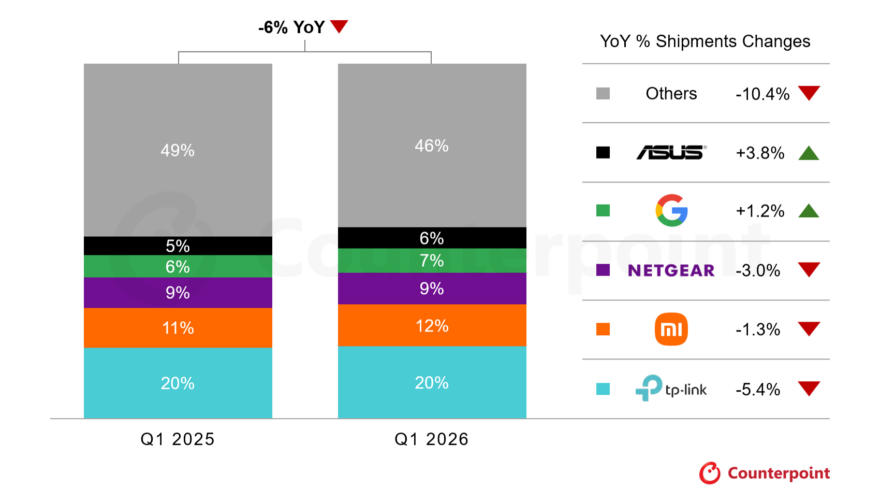
The global retail Wi-Fi customer premises equipment (CPE) market contracted 6% year-on-year during the first quarter of 2026, extending a prolonged downturn as internet service providers (ISPs) continue improving their bundled networking equipment, according to Counterpoint Research‘s latest report.
The decline follows a fourth consecutive year of shrinking shipments in 2025. Compared with the market’s 2021 peak, global retail Wi-Fi CPE volumes have now fallen by nearly 34%.
Demand surged in 2021 as COVID-19 lockdowns drove widespread home working, online education and streaming, increasing the need for reliable home networking and wider wireless coverage. Consumers responded by purchasing retail Wi-Fi products, particularly mesh networking systems, to improve connectivity across their homes.
However, Counterpoint said the market has since shifted as ISPs upgraded their broadband CPE offerings, including integrated mesh Wi-Fi solutions and support for newer wireless technologies. These improvements have narrowed the performance gap with retail products, reducing the need for consumers to buy standalone networking hardware.
According to the report, TP-Link and Xiaomi remained the largest vendors in the retail Wi-Fi CPE market, together accounting for almost one-third of global shipments during the quarter. They have a market share of 20% and 12% respectively.
Netgear, ASUS and Google, with 9%, 7%, and 6% share, completed the top five vendors by shipments. Among the leading suppliers, only ASUS, Google and Amazon’s Eero recorded year-on-year shipment growth.
Counterpoint Principal Analyst Tina Lu said ISP-supplied equipment now satisfies the requirements of most households, while retail networking products increasingly appeal to power users seeking higher performance and greater control over home networks.
Despite the broader market contraction, mesh Wi-Fi systems continued to grow as households sought whole-home wireless coverage for an increasing number of connected smart devices. Google and Amazon’s Eero benefited from this trend, supported by their established smart home ecosystems.
Gaming routers also recorded growth, driven by enthusiasts seeking lower latency, greater reliability and faster connectivity for competitive and cloud gaming. Senior
Analyst Taimur Zafar highlighted, “Enthusiastic customers, with an understanding of network requirements for gaming, continue to seek high-performance hardware that can offer ultra-low latency, strong reliability and higher speeds. As online and cloud gaming services continue to grow, retail vendors will continue targeting this premium segment of consumers.”

