




What happens when factory data moves beyond monitoring? Smart automation can turn everyday production information into better decisions, fewer losses, and stronger returns.
Manufacturing industries are increasingly relying on automation to improve operational efficiency, product quality and profitability. Rather than focusing solely on producing more, manufacturers are adopting intelligent control systems that monitor equipment, automate routine processes and provide real-time insights for better decision-making. These technologies not only help maximise production yields but also minimise waste, reduce downtime and improve asset utilisation.
Grainfuel Distilleries Pvt Ltd, an ethanol manufacturing facility commissioned in Ahmedabad in November 2024, demonstrates how integrating industrial automation across production, quality assurance and enterprise systems can significantly improve plant performance. The facility follows an integrated biorefinery approach in which process by-products are converted into valuable products, supporting both operational efficiency and sustainable manufacturing. The company promotes sustainable manufacturing practices by supporting a net-zero carbon footprint through efficient resource utilisation and environmentally responsible operations. We follow a zero liquid discharge (ZLD) approach, ensuring that all wastewater is treated and recycled for reuse, with no water being wasted, contributing to environmentally responsible production.
Building a sustainable manufacturing ecosystem
The ethanol production facility has been designed as an integrated biorefinery, where nearly every by-product generated during manufacturing is utilised. Raw materials such as rice and maize are processed to produce ethanol, while residues are converted into distiller’s dried grains with solubles (DDGS). Carbon dioxide generated during production is captured and liquefied for use in the beverage industry, boiler ash is repurposed for sustainable construction materials, and other by-products are processed into commercially useful materials.
This circular approach helps minimise waste while creating additional revenue streams, demonstrating that sustainability and profitability can complement one another rather than compete.
How distributed control systems improve plant operations
At the centre of the plant’s automation strategy is the distributed control system (DCS), which continuously monitors, protects and controls equipment throughout the production process.
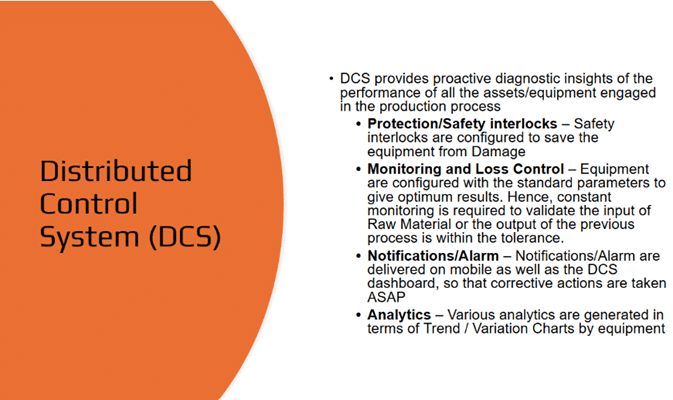
Beyond displaying process data, the DCS provides proactive diagnostics by monitoring the operating conditions of production assets in real-time. Safety interlocks are configured to protect expensive equipment from damage, while predefined operating parameters ensure that machinery functions within safe operating limits.
Each critical asset is assigned standard operating values, alarm thresholds, and trip limits. When equipment approaches an alarm condition, notifications are generated and delivered both to designated managers and engineers in the field, as well as to the DCS interface. If operating conditions exceed predefined safety limits, the equipment is automatically shut down to prevent damage and ensure plant safety.
Monitoring critical plant equipment
The DCS supervises several critical production systems, including boilers and steam turbines. Parameters such as furnace temperature, turbine speed, vibration levels, and operating temperatures are monitored continuously.
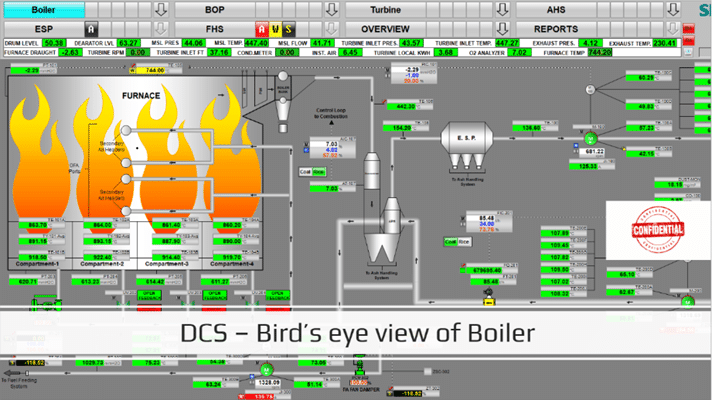
Emissions data collected from pollution control equipment is transmitted automatically to regulatory authorities, including state and national pollution control boards, ensuring continuous environmental compliance without manual intervention.
By replacing manual supervision with automated monitoring, the plant reduces human error while maintaining safe and reliable operations.
Integrating production data with ERP
Automation also extends to enterprise resource planning (ERP), enabling production systems to exchange data automatically with business applications.
Flow meters installed throughout the production process continuously collect operational data, which is transmitted to the DCS in near real-time. Production formulas are configured within the ERP system, allowing information on raw material consumption, utilities, and ethanol production to be transferred automatically into production orders.
This automated exchange eliminates repetitive manual data entry while improving the accuracy and consistency of production records.
Automating quality control
Quality assurance is also integrated into the digital workflow.
When raw materials such as rice, maize, or coal enter the facility, their details are directly transferred from the ERP system to the quality control application using application programming interfaces (APIs). Laboratory analysis is then performed using spectrometers and a bomb calorimeter that capture measurement results without requiring technicians to manually enter data.
After analysis, quality inspection results are transmitted back to the ERP system through APIs. Suppliers receive immediate notifications regarding the status of their raw material deliveries, indicating whether the material has passed quality tests, failed quality checks, or is subject to quality-related penalties. In cases of quality deviations, debit notes are generated automatically, minimising administrative effort while ensuring transparent, consistent, and efficient quality management across the procurement process.
Eliminating errors through automated weighbridge integration
Vehicle weighing is another area where automation improves operational accuracy.
Gross and net vehicle weights captured at the weighbridge are transferred directly into the ERP system using an API in the gate entry reference. Since these measurements cannot be modified manually, the process eliminates data manipulation and reduces the likelihood of human error while improving inventory accuracy.
Using analytics to improve yield and profitability
The large volume of operational data generated throughout production enables comprehensive analytics that support continuous improvement.
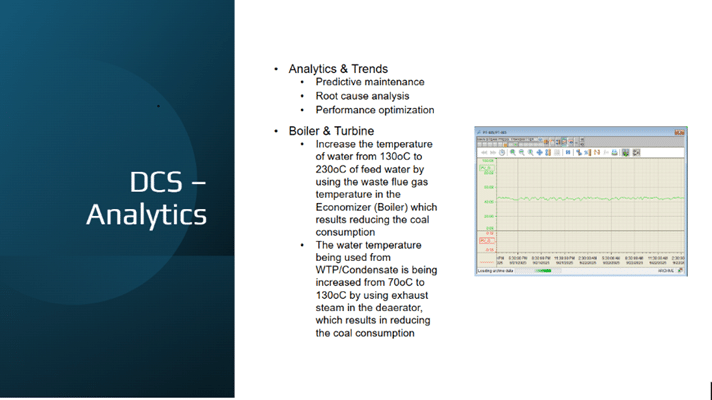
Plant operators analyse raw material consumption alongside production output, evaluate the cost of chemicals and consumables per unit of production, and compare monthly performance trends to identify opportunities for optimisation. These insights enable process adjustments that improve production efficiency, reduce waste, and ultimately increase profitability.
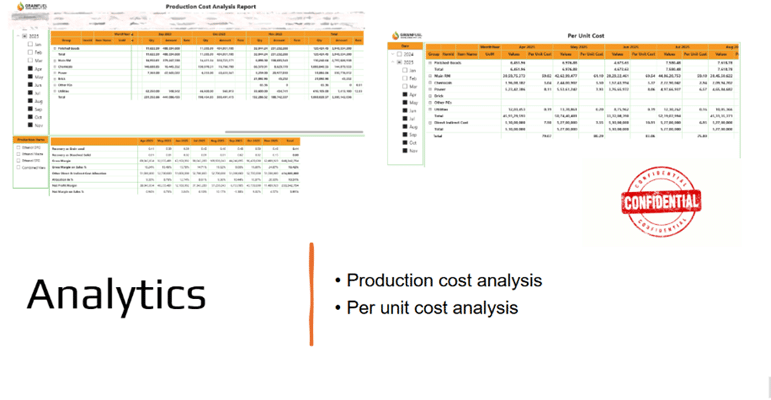
By relying on data-driven decision-making instead of intuition, manufacturers can continuously refine production processes while maintaining consistent product quality.
Opportunities for AI in industrial automation
Although the current automation platform primarily relies on predefined operating parameters, alarms, and process analytics, the large volume of operational data it generates provides a strong foundation for future artificial intelligence (AI) and machine learning (ML) applications.
Historical production data could be used to develop predictive models capable of identifying equipment failures before they occur, forecasting production trends, optimising raw material utilisation and recommending operational improvements.
As manufacturing plants continue adopting data-driven technologies, smart automation will become an increasingly important driver of sustainable production, higher yields, and long-term profitability.
This article is based on the talk ‘Boosting Yields and Profits: Smart Automation in Production’ by Haroon Chimthanawala, Grainfuel Distilleries Pvt Ltd, at EFY Expo, Gujarat 2025. It has been transcribed by Ananthu Ashok, Electronics For You.

