Soaring memory costs force phone makers to cut low-margin lines, squeezing budget brands while market giants Apple and Samsung consolidate their lead.
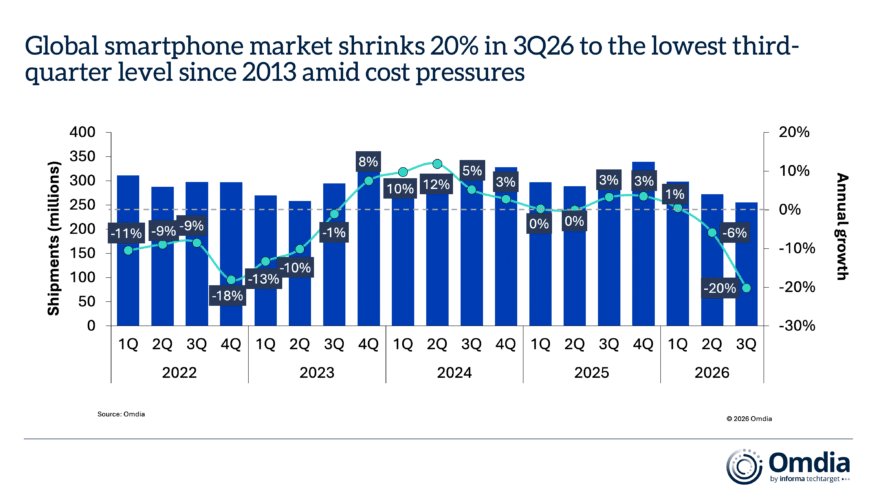
Global smartphone shipments fell by 20 per cent year-on-year in the third quarter of 2026, accelerating sharply from the 6 per cent drop in the previous quarter, according to preliminary estimates from research firm Omdia.
Shipments also contracted quarter-on-quarter despite new flagship launches and seasonal stock preparations. High memory and storage costs have restricted pricing flexibility, forcing manufacturers to cut back on lower-margin models.
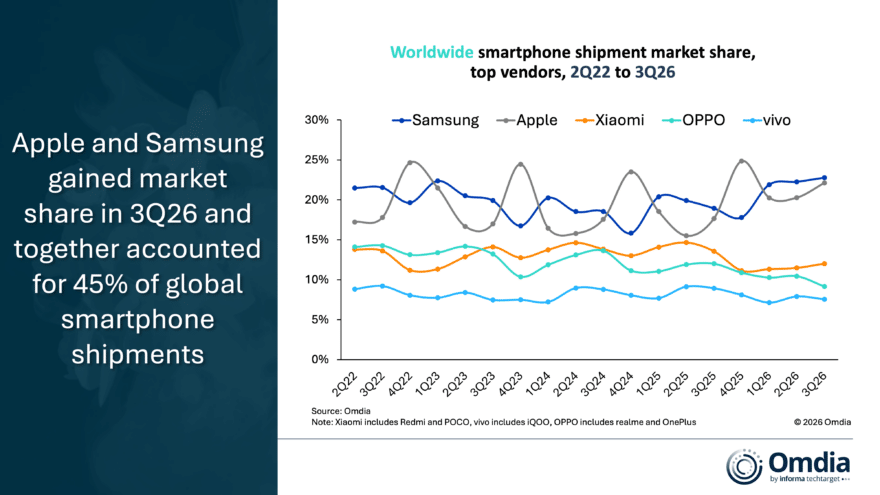
This downturn has deepened market polarization. Samsung and Apple together secured 45 per cent of global shipments, up roughly eight percentage points from last year, as mass-market rivals suffered steeper declines.
Samsung retained top spot with a 23 per cent market share. Its wide product range and global distribution helped cushion the slump, supported by the August launch of the Galaxy Z Fold8 and Flip8 series.
Apple ranked second with a 22 per cent market share. Demand for the iPhone 17 family and the September launch of the iPhone 18 Pro, Pro Max, and the foldable iPhone Duo helped sustain momentum.
While artificial intelligence is not yet a primary purchasing driver for consumers, Apple Intelligence could play an increasingly critical role in differentiating the user experience and maintaining the brand’s long-term ecosystem advantage.
Xiaomi held third place with 12 per cent, followed by OPPO at 9 per cent and vivo at 8 per cent. Escalating component costs are putting severe pressure on margins, particularly across budget-conscious segments.
“Rising component costs and differing vendor responses are reshaping the competitive landscape, but market share alone does not tell the full story,” said Hayden Hou, Principal Analyst at Omdia. Strategic investments during this slump will decide who emerges strongest once cost pressures ease.
Lucas Zhong, Senior Analyst at Omdia, noted that budget-focused vendors face a tough balancing act, especially in emerging markets. Scaling back shipments to protect margins risks damaging long-term brand visibility and channel presence.
Looking to the fourth quarter, festive promotions are unlikely to fully offset supply-side pressures. Manufacturers will need disciplined inventory management and better financing options to drive upgrades, rather than relying on broad discounting.