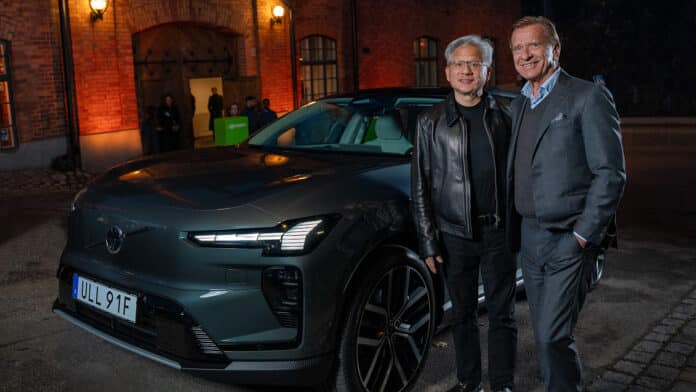

Volvo Cars will bring nearly a century of safety research and its human-centric approach to the partnership
Volvo Cars has announced an expanded partnership with NVIDIA to advance AI-powered vehicle safety and automated driving technology in its future cars. The collaboration aims to enable vehicles to navigate complex real-world environments, from highways and busy urban streets to parking scenarios, with the goal of supporting door-to-door automated driving.
The technology will debut in a next-generation Volvo car as part of the company’s recently announced largest-ever product push. The expanded collaboration will combine Volvo Cars’ vehicle safety systems and engineering expertise with NVIDIA’s AI and accelerated computing technologies.
The technology stack will include NVIDIA Hyperion, a sensor and computing architecture, Halos OS, and the Alpamayo Stack driving software. Together, these technologies are intended to support advanced automated driving capabilities and enable a gradual introduction of eyes-off and mind-off driving features.
Volvo Cars will bring nearly a century of safety research and its human-centric approach to the partnership, aiming to establish new benchmarks for safe, convenient and reliable automated driving.
“By working with NVIDIA, we bring together two distinct strengths: industry-leading safety knowledge and world-class AI technology. That combination gives us a unique opportunity to create safer and more attractive cars for our customers,” said Håkan Samuelsson, president and CEO of Volvo Cars.
NVIDIA founder and CEO Jensen Huang said the collaboration would combine Volvo’s vehicle safety systems with NVIDIA Hyperion and Halos to develop a new generation of cars designed to make driving safer and more effortless.
The partnership builds on a collaboration that began in 2017. Volvo Cars is integrating advanced computing capabilities into its next generation of electric cars as part of its broader push towards software-defined vehicles.