


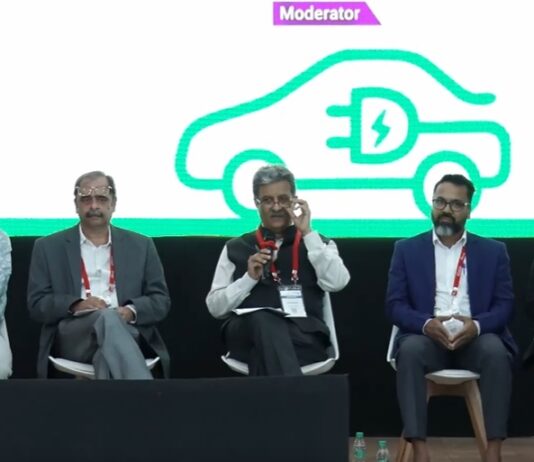

More than just innovation, the future of India’s automotive industry hinges on the need for urgent collaboration among government, industry, and academia. This theme took centre stage at a thought-provoking panel during the EFY Pune Expo.
We often talk about India’s steady 7% gross domestic product (GDP) growth as though it is a given. And yet, when we step back and consider the global context: geopolitical turbulence, economic slowdowns elsewhere, broken supply chains, the fact that India continues to hold this trajectory is nothing short of remarkable. It speaks to the deep, intrinsic strength of our economy, particularly the role of internal consumption in maintaining this stability. While much of the world grapples with uncertainty, India moves forward with purpose, and that momentum is unmistakably visible in our automotive sector.
The automotive industry accounts for nearly 40% of India’s manufacturing GDP. Any sector linked to automotive growth naturally finds itself buoyed by its momentum. The market opportunity is vast and expanding, but it raises pressing questions for all of us: How can we contribute meaningfully to this growth? What should our next steps be? How do we align with the government’s Production Linked Incentive (PLI) schemes? And most importantly, are we prepared to meet the moment?
The infrastructure-mobility loop
Automotive is a mirror or reflection of how the economy is doing. In India’s case, that reflection looks optimistic, ambitious, and sharply forward-looking. One of the strongest tailwinds lifting the sector is infrastructure. We have seen a lot of connecting roads happening. A few years ago, we were still anchored to entry-level hatchbacks like the Alto or the 800. Today, consumer preference is decisively moving towards vehicles that prioritise comfort, safety, and performance. What we drive has become a statement of what we expect from our lives and our machines.
Indian OEMs are matching this evolution in aspiration with unprecedented boldness. As Krishna Bhojkar of Bhojkar Consulting rightly points out, “It is literally unbelievable what Tata and Mahindra are in a position to do.” The electric vehicle (EV) surge, in particular, has seen these domestic players outpace expectations, pushing volumes and product innovation to levels once thought exclusive to global brands. “They are giving a run for it to the global giants,” he added.

It seems like we are no longer talking about catching up. We are setting benchmarks. Indian companies are demonstrating that frugal innovation, when combined with scale, can be a globally disruptive force.
Economic indicators and the big picture
The numbers support the narrative. India is now the third-largest passenger vehicle manufacturer globally, and the largest two-wheeler producer in the world.
And there is still room to grow. For two-wheeler manufacturing, our per capita income currently stands at $ 2730 but is projected to reach $12,400 by 2047, unlocking vast consumer demand. Car penetration remains low, just 24 per 1000 people, making the runway for future growth significant.
Yet as Bhojkar warned, “If we increase the number of cars, I do not know where we are going to drive it.” This light but pointed caution speaks to a larger truth. Automotive growth cannot be viewed in isolation. It must move in step with urban planning, public transport systems, and environmental considerations. Smart cities cannot exist without smart mobility, and mobility itself is now inseparable from the electronics and intelligence systems that power it.
India’s automotive decade: what drives growth, what threatens it?
Government directives have helped shape the broader framework for transforming the Indian automotive industry. But Dr Ajay Palkar, former SGM, Head – Electrical & Electronics at Skoda India, has a wider perspective. “Everything starts from innovation and goes till the realisation of any product,” he explained. That journey begins when an OEM begins to define the vehicle or mobility solution of the future and continues well beyond the product’s launch.

This includes ensuring serviceability, maintaining inventory, and providing long-term support, something often underestimated. It is a massive job for any vehicle manufacturer when they start defining a product for the market.
At the core of this evolution lies software. “Everything is driven by software: software on wheels,” he said, referring to the shift from conventional powertrains to electric mobility. “The number of electronic instruments going into the car is more than 150.” The challenge, then, is not just about including these systems, but integrating them coherently and reliably.
He lays out three primary challenges:
1. Vehicle architecture
The architecture of a vehicle today is no longer a monolith. It also depends on where the vehicle will be sold. Regional requirements, regulatory environments, and cost sensitivity demand different architectures. In India, cost-effective architectures dominate; in premium global markets, the expectations change drastically. The key question becomes: “Can we have only one architecture or multiple architectures?”
2. Business strategy and market readiness
“Which areas do we need to focus on from a business perspective? For global markets, what are the challenges while selling that product?” Customer demands, market timelines, and regulatory readiness; these factors define the real-world viability of a product. A lot of things fall into business and strategy, especially as companies transition from domestic to global footprints.
3. Skills, technology, and integration
Perhaps the most pressing and long-term challenge, according to Dr Palkar, is the skills gap. “Today, conventional powertrain technology has been working for decades, so skilled manpower is already available. For EVs, skilled manpower is not available, or very limited.” The learning curve is steep. “Technological changes are happening rapidly,” he said, citing advanced driver assistance systems (ADAS), cybersecurity, sensor integration, and system-level connectivity as growing demands. Integration is going to be a huge task for everybody.
He also flagged the need to close the gap between academia and industry. “The ecosystem has to be developed for skilled manpower, and the industry must focus on retaining those skills.”
How are tier 1s balancing OEM pressures with cost, quality, and innovation?
According to Nitesh Shah of Dcontour Litetech, the answer lies not in resisting this pressure but in embracing it as an opportunity to lead.

“It is not anymore just Make in India,” Shah said. “We need to start thinking about Innovate in India, Design in India, and then making it in India. That is the thought process we need to focus on this coming decade.”
For tier 1 players, responding to OEM, the challenge lies in delivering advanced, feature-rich solutions that are both affordable and globally competitive. Shah explained how Indian suppliers are uniquely positioned to deliver on this value-driven mandate.
“We are sandwiched between two types of ecosystems. On one side, the US and Europe demand high-quality, robust products. On the other hand, the Chinese ecosystem delivers cost-effective solutions packed with features. In India, it all boils down to value for money: every extra rupee must bring extra features,” he noted.
This duality, high expectation, tight cost, is what Shah views as India’s competitive advantage, rather than a constraint. “Being Indian, I am proud to say we are the right fit for this model. Since childhood, we are trained to want high quality, but at a lower cost.”
Citing examples like the Alto 800 and Mahindra B60, Shah emphasised the need to cater across segments while maintaining uncompromising quality standards. “Even if we design for Alto, the OEM expects the highest quality. So, when we provide solutions, they must be systematic, outcome-focused, and aligned with end-customer expectations.” It is a chance to be competitive globally.
But technical execution is just one piece of the puzzle. The second key area is skill development: specifically, the urgent need to decentralise talent creation across India.
Skill development must now go beyond centres like Pune, NCR, and Chennai and be distributed to tier 2 cities as well. This would not only ease population congestion in industrial hubs but also help build locally sustained talent pools capable of supporting regional automotive growth.
“Why do we only have 24 vehicles per 1000 people? Because we are confined to limited zones. If we decentralise, we will create space for mobility and for skilled labour,” he pointed out.
The final and most crucial pillar is ecosystem alignment. No stakeholder, OEM, tier 1, or tier 2 can thrive in silos. For tier 1 suppliers, the next decade will be defined not just by what is built, but how collaboratively and how smartly.
Can Indian automotive electronics break free from import dependence and inertia?
“Today’s regular entry-level cars typically have a maximum of 25 ECUs and include only a limited number of electronic features,” Hrishikesh Kamat of Shalaka Connected Devices pointed out. “But every alternate year, when new cars are launched, the number of features increases. And they are now more electronic and software-based.”

The move toward software-defined vehicles is no longer theoretical. It is actively reshaping even traditional ICE vehicles, while EVs, where ‘the core becomes electronic,’ demand even more from India’s electronics ecosystem. Yet much of the supply chain remains import-dependent.
The question, then, is not only where the challenges lie, but how we activate the local ecosystem to address them. According to Kamat, the first barrier is systemic inertia.
From certifications to security requirements, from scaling manufacturing to deep software validation, the threshold for entry is extremely high. Few startups have successfully navigated that path from scratch.
That is why the onus must also be on OEMs. “Innovation needs to be driven from the OEM side as well,” he said. “If OEMs start approaching startups or design houses with electronic and software capabilities… Now we need to indigenise it. We need to build it within the country.”
The capabilities are already present across the Indian startup and design community. What is needed is a shift in how product development is commissioned away from incremental upgrades and towards indigenous replacements for critical imports.
This shift is already underway.
“Lot of OEMs today, they are approaching mid-size startups,” Kamat noted. “Even a lot of incubators are being funded today to develop technologies.”
The current wave of interest is centred on battery management systems, powertrain electronics, software stacks for dashboards, and EV motor control, each a domain historically reliant on foreign tech.
This momentum is promising. Government policies are enabling startups to access funding when they come forward with strong ideas. OEMs are beginning to see startups not only as fringe innovators but as core contributors to product localisation.
Can India Build a Stronger Homegrown Ecosystem for Automotive Electronics?
When it comes to electronic content in vehicles, the shift from internal combustion engines to EVs has been nothing short of transformative and demanding. As Vishwanath Gaonkar of iVP Semiconductors observes, “Between ICE and EV engines, the number of electronics and software components is significantly higher. You are looking at something like 25 electronic components in ICE vehicles versus about 150 in EVs.”

That is a six-fold jump; not just in component count but also in engineering complexity. This rapid escalation brings into sharp focus a fundamental gap: India’s over-reliance on imports for core electronic components. Gaonkar points out, “One of the biggest challenges in electronics is that all the components today are coming from elsewhere. There is nothing in India that is part of the semiconductor.”
But it is not just about hardware. Software, Gaonkar notes, is one of India’s strengths. “India is predominantly a software-driven market. If I talk about Bengaluru, we have so many software engineers; unlimited, I would say. Most of the global companies are using Bengaluru as a hub for software development.”
Still, a bottleneck persists on the electronics side. While local software capability has scaled globally, electronics manufacturing continues to lag, especially when it comes to replacing Chinese imports. To that end, iVP is focusing on two-wheeler electronics, a fast-moving sector where localisation could yield a significant impact. But electronics design and manufacturing challenges do not end at sourcing. Another critical frontier is cybersecurity.
Cybersecurity is one facet of a broader vulnerability. Power and RF electronics remain significant blind spots in India’s capabilities. “We have a lot of digital electronics happening in India right now,” Gaonkar points out, “ but academia also has to give more importance to power and RF. That is still lacking.”
The issues are complex and layered. But there is a clear direction forward, one that hinges on ecosystem collaboration. Academia and industry have to work more closely together.
From Theory to Practice: Will Industry-Academia Collaboration Catch Up?
If the demand side is running faster than we can train people to catch up, then no matter how promising our future looks on paper, we will never quite get there. That is the hard truth staring us in the face, and the reason we need to take industry-academia collaboration from intention to execution. Not next year, not soon. Now.
Today, the biggest talent mismatch in automotive electronics isn’t just about the number of engineers; it is about their readiness. The core of the issue is structural. Infrastructure in universities is often not aligned with industry needs. Do students have access to CAN simulators, dash-based kits, lidar, vision systems, or infotainment modules that let them tinker, test, and explore the future of automotive technologies hands-on? More often than not, they do not.
There are exceptions, OEMs who have invested CSR funds to build labs in selected institutions but we need systemic effort, not isolated generosity.
Another part of the problem lies in the orientation of academia itself. When most professors come from purely academic backgrounds, teaching can remain rigidly theoretical. We have seen this firsthand: students spend semesters preparing presentations and memorising formulas, but never get their hands greasy, figuratively or literally. And in automotive, we need more grease monkeys who know the system inside out because they have worked on it.
That disconnect comes at a cost. Across the industry, it takes between 12 to 18 months to get a freshly graduated engineer trained up to be job-ready. That is a year or more of lost time, lost momentum, and often, lost interest.
What if we could shrink that gap dramatically? One proven approach lies in incentivising internships: something that is now standard in computer science programs but still rare in hardware and electronics-focused streams. If automotive engineering students had structured internship opportunities built into their curriculum, we would start seeing sharper, more relevant talent in the pipeline.
That brings us to the next opportunity: decentralising access. Today, most companies only collaborate with the top few engineering institutes in their vicinity: think COEP, MIT, or VIT in Pune, for instance. But what about the promising students from second-tier colleges? The problem is not a lack of potential; it is that the dots are not being connected.
To truly level up, we need to reimagine how we invest our time. What if we created a shared ecosystem in which professionals across the industry committed to teaching as part of their professional growth? Not as an afterthought, but as a metric that counts, perhaps even towards performance appraisals. Could we build a system where two Saturdays a month are set aside for hands-on student mentoring? What if industry mentorship became an expected part of being a professional engineer?
On the academic side, we must break out of the IIT-NIT bubble. Yes, those institutions are valuable, but they do not hold a monopoly on talent. In every local college, there are at least a few students with real drive and capability. The question is: are we giving them the opportunities they deserve?
There are no silver bullets here. But what we need is collective action. If we can align industry commitment, academic openness, and policy support into a cohesive ecosystem, the gains will be real, measurable, and lasting. Until then, we must keep building, connecting the dots, one student, one professor, one lab, and one internship at a time.
Closing the loop between classrooms and companies
It is no secret that everything students need is already available to them: online resources, tutorials, simulators, and open source projects. Yet, we cannot help but question: how often do they truly engage with it? Are they diving deep or simply skimming through and regurgitating what is needed to pass exams?
Only 7–8% of graduating engineers manage to secure jobs. Of them, around 3% move abroad. Which leaves us staring at the uncomfortable question: what happens to the remaining 90%? These students are not unintelligent. They have cleared exams, possess aptitude, and have a baseline IQ. What they lack is an ecosystem that nurtures their abilities.
The spark of curiosity seems missing. There are no spontaneous questions; no ‘what,’ ‘why,’ ‘how,’ or ‘where.’ The first challenge is therefore to instil curiosity. That one shift can make all the difference.
The second challenge lies in the disconnect between code and context. Many software engineers, for instance, are able to write code, but have no idea where or how that code is being used. This leads to a critical gap: without application awareness, we cannot build engineers capable of solving real-world problems.
We often break the challenge into three layers: academia, government, and industry. Let us start with the academic institutions. The first issue is that syllabi are outdated. They tend to change once in five years, while technology transforms every 18 months. Moore’s Law may be under pressure, but its essence still holds; progress is fast, and curricula are slow.
Within electronics engineering, interest continues to skew toward software. Even so, what is being taught in colleges barely scratches the surface of product engineering. If a student wires up a basic circuit and it works, both student and teacher consider the job done. But that is just 10% of the journey. True product engineering begins after that moment.
Government support is another variable. Funding is often concentrated in IITs, IIMs, and IISc, while thousands of other institutions are overlooked. Yet talent exists everywhere. Bright minds are not limited to elite institutions. Unfortunately, much of the IIT talent exits the country, patents technologies, and contributes to industries outside India.
At a recent power sector seminar, nearly all academic participants were PhDs from IITs. Not one represented a regular college. Their research was cutting-edge, but largely geared toward foreign companies. This imbalance must be corrected.
Which brings us to the third challenge: industry itself. The onus is on us to go back and share what we know. We must engage with academia, share domain realities, and help shape curricula that align with market needs.
Where startups can lead and what is holding OEMs back
If there is one truth we have seen up close, it is that innovation does not always need to come from the top. It can just as easily begin in a garage, a lab, or the mind of a 22-year-old with nothing but conviction and code. Yet, OEMs and tier 1s, by and large, have remained cautious, rarely engaging with startups unless they see a fully productised, investment-ready solution. The idea of co-developing innovation or giving early-stage companies the room to grow is still not widely embraced.
So where exactly should startups focus their energy?
Trying to enter the core vehicle systems, such as braking, powertrains, or transmissions, is near impossible for a young company. These domains are fortified by decades of engineering, high safety standards, and regulatory complexity.
But outside that core lies an expanding frontier: vehicle intelligence, user experience, and diagnostics. These areas are less capital-intensive and more software-driven, making them ripe for disruption.
Finding the right niches: where startups can win
| Some of the promising niches where startups can invest their energy for significant returns include: * Infotainment platforms * Predictive diagnostics (examples include forecasting part failures based on driving behaviour) * Driver behaviour analytics * Camera vision systems, both for ADAS and manufacturing QC Vehicle-to-Everything (V2X) communication, such as alerts for unseen emergency vehicles, can we build systems where a car senses an ambulance approaching well before a human driver does? Or on the factory floor; can we create low-cost, high-accuracy vision systems that detect defects in real time? * These are not science fiction; they are tangible, buildable, and aligned with the future of software-defined vehicles. Startups that can anchor their products in these domains will not just find customers, they will shape where the industry goes next. |
We also need to stop glorifying unicorns. The goal should not be a billion-dollar valuation but a billion rupees in impact. A robust ecosystem of 200 mid-sized companies that know how to survive, solve real-world problems, and scale sustainably is far more valuable than a single unicorn whose product never leaves PowerPoint.
The bottom line: there is no shortage of whitespace. There is a shortage of support, of collaboration, and of shared risk-taking. That is what we need to fix.
Genuine industry-academia partnerships are still few and far between, and in automotive, dedicated forums for this kind of exchange are virtually non-existent beyond bodies like CII or ACMA.
Real solutions from academia: a university’s perspective
| A director from Vignana University, Andhra Pradesh describes what is already working, if we choose to notice. Three programmes stood out: Centres of excellence (CoEs): Focused on drones, robotics, and EVs, these are not window dressing. They are hands-on environments where students and industry co-create. Faculty immersion programmes: Professors are embedded within companies for up to a year, returning with practical insights. The program now spans over 30 industry partnerships. Professors of practice: Adjunct roles for industry experts delivering content based on live projects. |
A Sector at the Crossroads
India’s automotive sector is not without its constraints: skills gaps, infrastructure pressure, and import dependencies persist. But there is momentum, driven by a complex blend of policy, market demand, and industry ambition.
We are at an inflection point. And whether India becomes a global automotive leader will depend not on any single breakthrough, but on how well its ecosystem works together; across scales, regions, and disciplines.
This article is based on insights from the panel discussion “Automotive Trends: Challenges and Growth Opportunities (ICE & EV),” held on 15 May 2025 at the EFY Expo, Auto Cluster Exhibition Center, Pune. The session brought together industry leaders, including Krishna Bhojkar, Partner at Bhojkar Consulting (Moderator); Automotive and manufacturing strategist with 32+ years of leadership in manufacturing engineering, digital transformation, and global growth. Nitesh Shah, Founder and CEO of DContour LiteTech; Entrepreneur and innovator in lighting design, optics, and automotive technologies, with nearly two decades of sustainable technology development. Hrishikesh Kamat, Managing Partner and CEO of Shalaka Connected Devices; Founder of Shalaka Connected Devices LLP and IoT/IIoT innovator with over a decade of experience in smart manufacturing, automation, and connectivity. Dr. Ajay Palkar, Senior General Manager (HoD – Electrical & Electronics), Skoda Auto India; Skoda Auto India Engineering leader with 35+ years across automotive, defence, and industrial domains, specialising in powertrain systems, sensors, embedded electronics, and EV technologies. and Vishwanath Gaonkar, Associate Director-Hardware of iVP Semiconductor Electronics industry expert with 20+ years in system design, driving innovation in robust, scalable hardware across the full product lifecycle. The discussion was transcribed and curated by Apurba Sen, Senior Journalist, EFY.

