


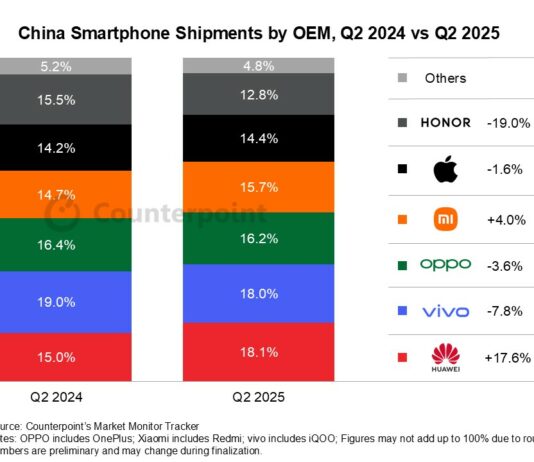

Subsidy-fuelled demand fades as China’s smartphone shipments dip 2.4% in Q2 2025; Huawei surges while Apple, Xiaomi, and vivo race to stay competitive.
China’s smartphone shipments declined by 2.4% year-on-year (YoY) in the second quarter of 2025, according to a recent data published by Counterpoint Research. The report highlighted that is decline reflects subdued demand, aided in part by seasonal weakness and the tapering of earlier subsidies
Among the market players, Huawei reclaimed market leadership, reporting a 17.6% increase in shipments, giving it a market share of 18.1%, up from around 15% a year earlier. Its growth was powered by strong mid-to-high-end models, including the Nova 14 series, and substantial discounts on premium models.
At the same time, Apple’s shipments in China fell by 1.6% YoY, reflecting weaker demand despite aggressive discounts on its iPhone 16 Pro and Pro Max models during the 618 shopping festival.
China’s local brands Vivo, Oppo, and Xiaomi followed in market share rankings. vivo maintained second place, although its shipments fell 7.8% YoY. It buoyed by strong mid-to-low-tier sales and a surge in demand for its new S30 series, especially among younger consumers drawn to vibrant design and portrait photography.
Despite sales dropping 3.6%, OPPO benefited from its timely launch of the Reno 14 ahead of the shopping festival. The fashionable design appealed to young female buyers. Its sub-brand, OnePlus, achieved notable growth with performance-focused models featuring a chip-level game engine, initially introduced in the Ace 5 series.
Xiaomi claimed a 15.7% market share, with a 4% increase in shipments, ranking as the second-fastest-growing brand. Even without new mid-range launches during the promotion period, it maintained momentum via price cuts on popular models like the Redmi K80 and Mi 15. Its first self-developed chip, the Xring O1, featured in the Xiaomi 15S Pro.
Other factors, including front-loaded demand tied to past subsidy programmes and a shift by brands from inventory buildup to destocking, also weighed on shipment volumes. While some local subsidies were cut back or delayed, China’s national smartphone subsidy programme is still expected to run through 2025.
Counterpoint analysts noted that the company-specific strategies varied as brands responded to easing subsidy effects.
While Huawei and Apple led the growth, while vivo, OPPO, and Xiaomi remained competitive through pricing, promotions, and product positioning.

