


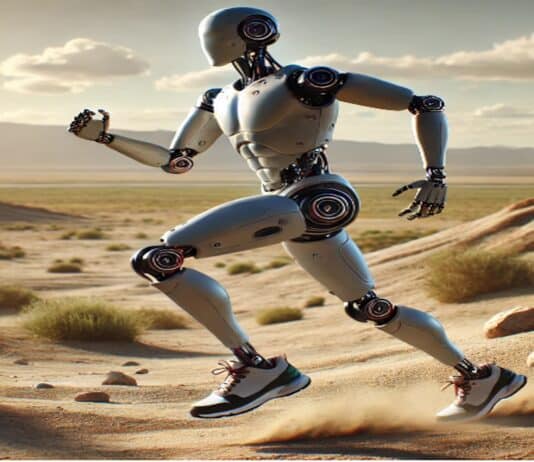

With a surge in humanoid robot deployments in 2025, led by Chinese startups and Tesla, the signals are of rapid commercialisation, falling costs and growing adoption across logistics, factories and automotive production.

The humanoid robot industry moved closer to large-scale commercialisation in 2025, as global installations rose sharply. According to Counterpoint Research, worldwide deployments increased by 16,000 units during the year, driven by growing use in data collection, research, warehousing, logistics, manufacturing and automotive operations.
Market concentration remained high. The top five original equipment manufacturers accounted for 73% of all humanoid robot installations in 2025, highlighting the early dominance of a small group of players as the sector scales up.
Shanghai-based startup AGIBOT emerged as the clear market leader. Founded in February 2023, the company expanded rapidly and began mass production of its X2 and G2 humanoids in 2025. By leveraging a broad product portfolio, an open-source strategy and a large humanoid manipulation dataset, AGIBOT achieved commercial deployments across hospitality, entertainment, manufacturing and logistics. More than 5000 robots have already rolled out from its Shanghai factory, giving the company a 30.4% market share.
Unitree ranked second with a 26.4% share. Known globally for its quadruped robots, Unitree has applied its expertise in dynamic motion and balance control to humanoids. Its G1 robot drew attention at CES 2026 with a live boxing demonstration. Vertical integration, including self-developed motors, reducers, LiDAR and customised MCUs, has allowed Unitree to deliver strong locomotion performance at lower costs.
UBTECH placed third with a slightly over 5.% share. The Shenzhen-based, Hong Kong-listed firm focuses on industrial applications. Its Walker series is already deployed on automotive factory floors and uses BrainNet 2.0 and Co-Agent technology to enable collaborative learning between robots.
Leju followed closely with a 4.9% share, supported by its partnership with Huawei Cloud, which enables cloud-based training and skill upgrades for its KUAVO series.
Tesla entered the top five in 2025, capturing nearly 4.7% share as production of Optimus Gen 2 and Gen 2.5 ramped up. With mass production of Gen 3 planned for 2026, Tesla is expected to play a central role in driving humanoid adoption across the automotive sector.
Looking ahead, Counterpoint identifies three key trends. Affordable humanoids are emerging, with products such as NOETIX’s Bumi priced below $1600 and aimed at household interaction.
Robot-as-a-service models are gaining traction, particularly in China, to reduce ownership costs. At the same time, leading players are scaling production, pointing to lower costs from 2026 onwards.
It is expected that cumulative humanoid installations to exceed 100,000 units by 2027, with logistics, manufacturing and automotive accounting for 72% of annual deployments.

