



Despite GST and raw-material volatility pressures, rising efficiency mandates, falling LED prices and smart adoption drive India’s indoor lighting market towards an estimated US$11.54 billion by 2031.
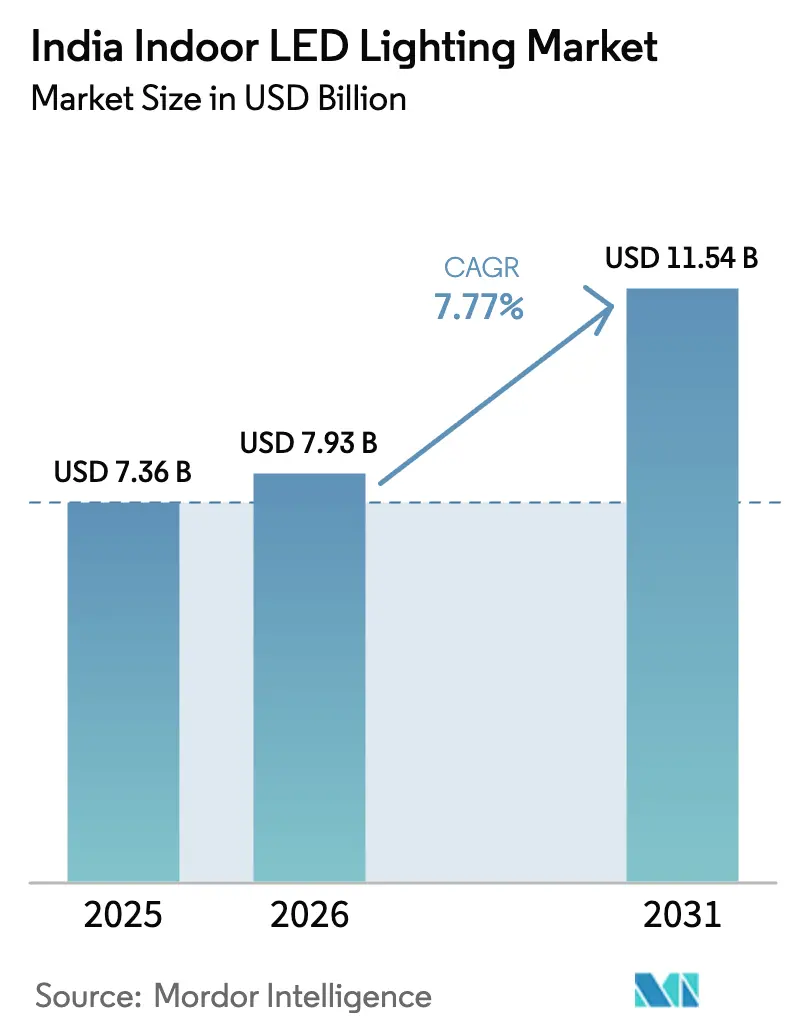
India’s indoor LED lighting market is projected to expand steadily, driven by policy support, falling component costs and growing adoption of smart building technologies, according to a report by Mordor Intelligence.
The market is estimated to rise from US$7.36 billion in 2025 to US$7.93 billion in 2026, reaching US$11.54 billion by 2031, at a compound annual growth rate (CAGR) of 7.77% between 2026 and 2031.
The report acknowledged that government-led energy efficiency programmes and large-scale procurement initiatives have played a central role in accelerating adoption. Under schemes such as UJALA, average LED lamp prices have declined by about 90% compared with 2014 levels, supporting wider penetration, particularly in tier-2 and tier-3 cities.
At the same time, domestic manufacturing supported by the production-linked incentive (PLI) scheme is strengthening supply chains and reducing import dependence.
As of 2025, luminaires accounted for 61.25% of market revenue, reflecting demand for integrated lighting systems, while lamps are expected to grow at a faster CAGR of 8.52% through 2031.

At the same time, the residential segment held a 41.15% share and is forecast to expand at a CAGR of 9.62%, supported by rising incomes and increasing smart-home adoption. Retrofit installations accounted for 76.10% of installations, although new installations are projected to grow at an 8.15% CAGR.
Wholesale and retail channels contributed 56.05% of revenue in 2025, while e-commerce is emerging as the fastest-growing segment, with a CAGR of 7.82%, thereby improving access in non-metro markets.
However, the report also cautioned that the growth is moderated by cost pressures and policy constraints. An 18% GST on LED products continues to affect upfront pricing, while fluctuations in raw materials such as indium, tungsten and aluminium are creating margin pressures.
Supply chain risks have also increased following export restrictions on key materials.
Mordor concluded that the market remains moderately concentrated, with Havells, Crompton and Bajaj Electricals collectively accounting for just under one-quarter of revenue in 2025, amid increasing competition from global and domestic players.

