
LG has also incorporated a scalable software platform based on its proprietary Automotive Telematics Platform (ATP)
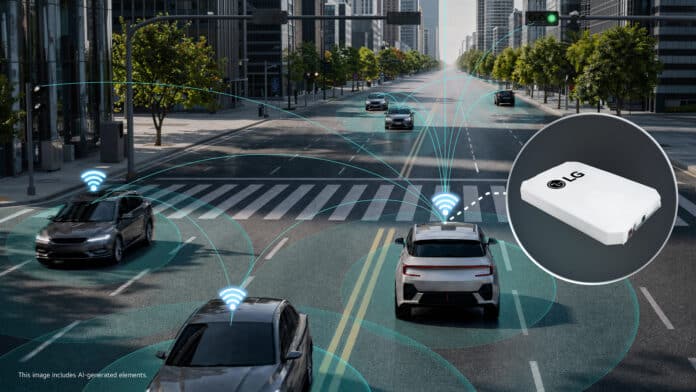
LG Electronics has started mass production of its next-generation 5G Release 16 (R16)-based smart telematics solution, which integrates a communications module and up to 12 antennas into a single unit. The company has already begun deliveries to a premium European automaker, with the solution marking its first deployment in a production vehicle in Europe.
The integrated system is designed to address the growing complexity of vehicle communication architectures as automakers add technologies such as 5G, Wi-Fi, Vehicle-to-Everything (V2X) and multi-frequency Global Navigation Satellite Systems (GNSS).
Traditional vehicle communication systems generally use separate telematics control units and externally mounted shark-fin antennas. As the number of communication technologies increases, additional antennas are often required, resulting in more RF cabling, wiring complexity, vehicle weight and manufacturing costs. These challenges are particularly significant for electric vehicles, where additional weight can affect driving range.
LG’s new solution combines the communications module and multiple antennas into a single unit, with an internal architecture capable of accommodating up to 12 antennas. This design is intended to reduce dependence on external antennas and minimise RF cabling while maintaining connectivity performance.
The solution features a modular architecture that allows the telematics and antenna boards to be combined or separated depending on automaker requirements. This enables the system to be adapted for both new vehicle models and existing vehicle platforms.
LG has also incorporated a scalable software platform based on its proprietary Automotive Telematics Platform (ATP), which has been developed over more than a decade. The common software architecture allows the same core platform to be reused across different applications, with adjustments primarily required for chipset-specific interfaces. The solution supports multiple communications chipsets, which can also help automakers reduce supply chain dependency on individual components.
The telematics system has undergone real-vehicle testing under high-temperature conditions to verify stable data transmission and reception. LG said its experience in communications, antenna and mechanical design has helped optimise the system’s thermal performance and reliability.
According to LG, the integrated architecture is designed to serve as a core communications platform for software-defined vehicles (SDVs), supporting applications such as over-the-air updates, V2X and autonomous-driving data transmission.
Eun Seok-hyun, president of LG Vehicle Solution Company, said the smart telematics solution goes beyond hardware integration by redefining the architecture of vehicle communications. LG plans to continue developing integrated telematics technologies aimed at supporting the evolving requirements of the SDV era.