




Factories already have more data than they know what to do with. The real challenge is making sense of what is happening across machines, production lines and maintenance operations. Somewhere between all that data and the next decision, AI is beginning to change the game.
Manufacturing plants generate vast amounts of data from machines, sensors and control systems, but much of this information remains isolated within individual systems. This makes it difficult to obtain a complete view of what is happening across the plant and respond to emerging issues in time.
Artificial intelligence (AI) can provide the decision layer needed to connect these fragmented sources of information. By analysing operational data holistically, AI can help manufacturers move beyond monitoring individual events towards more informed decision-making across production and maintenance.
When Factory Data Tells Only Half the Story
Modern manufacturing environments often have multiple production lines operating simultaneously, each generating alerts and operational data. Operators may respond appropriately to local events, such as abnormal motor temperature, bearing vibration, energy consumption anomalies or lubricant condition warnings, yet equipment failures can still occur when these events are considered in isolation.
A typical example is a factory where one production line generates an abnormal motor temperature warning while another reports excessive bearing vibration. Since neither alert appears critical on its own, operators may choose to delay action. However, when these seemingly independent events are viewed together, they may indicate an emerging equipment failure. The absence of a central decision-making layer means that although every operator performs their assigned task, no system correlates the information to recommend timely corrective action.
Agentic AI introduces a new level of industrial intelligence by enabling autonomous, goal-oriented decision-making across interconnected production systems. Unlike conventional AI, which primarily analyses data and generates predictions, Agentic AI continuously monitors areas such as manufacturing processes, batch operations, maintenance schedules and quality while understanding their relationships across the production environment.
It can correlate seemingly unrelated events, identify emerging failure patterns, recommend maintenance actions and coordinate responses among production lines in real time. By acting as an intelligent decision-making layer that collaborates with human operators rather than replacing them, agentic AI supports the Industry 5.0 vision of human-centric, resilient and sustainable manufacturing.
What Is Holding AI Back?
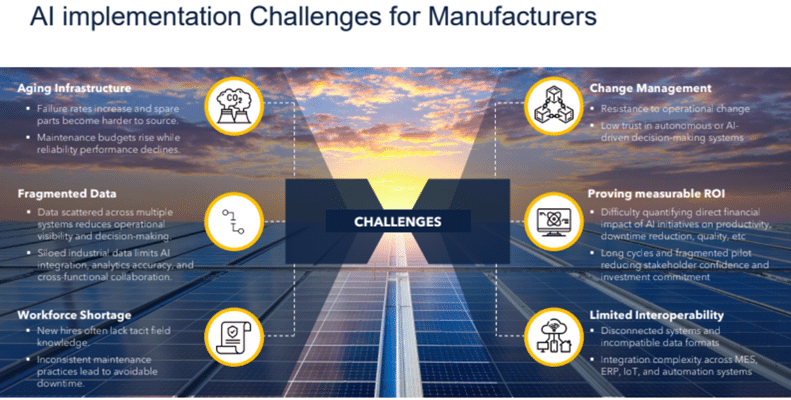
Despite the growing potential of AI, several challenges continue to hinder its adoption across manufacturing environments. These challenges extend beyond technology and include operational, organisational and business-related factors.
Ageing infrastructure: Many manufacturing plants continue to operate equipment that has reached or exceeded its intended service life. Although supervisory control and data acquisition (SCADA) systems and programmable logic controllers (PLCs) collect operational data, monitoring is often limited and inconsistent. As equipment ages, maintenance costs increase while overall reliability declines.
Fragmented data: Operational data is often distributed across multiple systems supplied by different vendors, each using its own software platform and data format. This fragmentation reduces operational visibility and makes it difficult to generate holistic insights or establish a single source of truth for decision-making.
Workforce shortage: Manufacturers are facing a shortage of experienced personnel capable of analysing conditions across multiple production lines and identifying emerging issues. Inconsistent maintenance practices and varying methods of documenting work orders further complicate operational decision-making.
Change management: Organisational resistance remains another barrier to AI adoption. Shop-floor personnel may be reluctant to embrace new monitoring methods or AI-assisted decision-making systems, making change management an important part of successful digital transformation.
Proving measurable return on investment (ROI): Manufacturers also face difficulties in demonstrating the business value of AI investments. Organisations often struggle to establish a clear economic model that shows how AI implementation translates into measurable improvements in productivity, equipment performance and overall operational efficiency.
Limited interoperability: Modern manufacturing environments consist of multiple production lines, industrial systems and automation platforms that often operate independently. Integrating data across PLCs, SCADA systems, enterprise resource planning (ERP) platforms and other industrial technologies remains a significant challenge, limiting the ability to obtain a unified view of manufacturing operations.
The Decision Gap in Industrial Operations
Manufacturing organisations do not suffer from a lack of data. Large volumes of operational information are already stored across operational technology (OT) systems, cloud platforms and industrial repositories. The real challenge is converting this information into meaningful operational decisions.
This creates what can be described as a decision gap. Although similar operational parameters exist across different systems, they are often stored in different formats and interpreted independently. As a result, there is no single source of truth capable of providing a complete operational picture.
Human processes further contribute to this challenge. Engineers may document work orders using different formats and levels of detail, leading maintenance teams to interpret priorities differently. Consequently, similar issues may receive inconsistent responses depending on how the information is recorded.
Rather than lacking data, manufacturers are overwhelmed by it. AI introduces the missing decision layer by analysing variables across multiple systems simultaneously, identifying relationships between operational conditions and generating insights that support more informed and timely decision-making.
From Data to Action
AI-driven operations extend beyond simple data collection by transforming industrial information into actionable insights. Through predictive analytics and pattern recognition, AI agents can continuously analyse equipment behaviour, assess asset health and identify conditions that may lead to future failures.
One important capability is predicting the remaining useful life of industrial equipment, allowing maintenance activities to be planned before failures occur. AI also shifts the focus from monitoring individual assets to evaluating the overall health of production lines, helping manufacturers maximise production output.
Practical benefits have already been observed through AI adoption. Implementing anomaly detection on industrial data streams has resulted in machine downtime reductions of around 40 per cent, improving equipment uptime. Predictive alerts also help supply chain teams monitor spare-parts consumption patterns, enabling inventories to be replenished before shortages occur and reducing maintenance costs.
AI further contributes to extending the lifecycle of capital assets. According to the presentation, the use of predictive analytics, AI inputs and agentic AI has led to asset health improvements of approximately 40 per cent over time. In addition, operations and maintenance (O&M) activities become more efficient by replacing routine preventive maintenance with predictive interventions that are carried out only when equipment is approaching a failure point.
The Evolution of Maintenance Strategies
Manufacturing maintenance has evolved through several stages, each offering a different approach to managing industrial assets.
The earliest approach is reactive maintenance, commonly referred to as a run-to-failure strategy, where equipment is repaired only after it breaks down. This is followed by preventive maintenance, where assets undergo scheduled servicing every three or six months regardless of their actual condition. Although widely practised, this approach is not always cost-effective because maintenance is performed even when equipment is operating normally.
The next stage is condition-based maintenance, where corrective actions are triggered by predefined thresholds captured through sensors, SCADA systems and PLCs. Rather than following fixed schedules, maintenance decisions are based on the operating condition of the equipment.
More recently, manufacturers have begun adopting predictive and prescriptive maintenance. Predictive maintenance identifies potential failures before they occur, allowing corrective action to be taken in advance. Prescriptive maintenance goes a step further by using AI algorithms to recommend multiple corrective actions for a detected issue. For example, if an oil leak is identified, the system may suggest possible causes such as a bearing fault or a faulty gasket, enabling O&M teams to determine the most appropriate repair strategy.
Looking ahead, agentic AI is expected to drive the next stage of industrial automation. These systems are expected to support increasingly autonomous manufacturing environments, often referred to as lights-out factories, where AI agents and robotic systems can perform monitoring, recommend corrective actions and automate selected maintenance activities with minimal human intervention.
Where Should Manufacturers Start?
Successful AI adoption begins with understanding the current maturity of a manufacturing plant. Before implementing AI, organisations must assess their existing industrial processes, IT systems and operational challenges through a structured gap analysis. This assessment helps identify major pain points and available digital infrastructure, providing the foundation for developing an AI ecosystem that supports manufacturing operations across the organisation.
Although manufacturers possess large volumes of operational data collected from SCADA systems, PLCs and other industrial platforms, much of this information is not actionable. Parameters such as vibration, temperature and humidity are continuously monitored, and trend graphs are readily available, but they rarely provide the insights needed to support plant-wide decision-making. Similarly, many organisations operate separate dashboards for production, quality and maintenance. While each department effectively monitors its own operations, these siloed systems fail to generate a unified view of the manufacturing environment.
Developing an AI transformation roadmap therefore requires organisations to focus on three key areas. The first is the domain, which involves understanding the type of manufacturing operation, industry-specific requirements, domain knowledge and the art of the possible within that sector. The second is the digital aspect, where organisations evaluate the availability of data across industrial systems, including Internet of Things (IoT) platforms, SCADA systems, PLCs and ERP systems. The third is the business perspective, which focuses on strategic objectives and business key performance indicators (KPIs), such as revenue per production line and other performance metrics that provide a competitive advantage.
Rather than attempting to automate every process at once, manufacturers should adopt a phased implementation strategy that addresses simpler, high-value use cases first before progressing to medium and more complex deployments. This approach enables organisations to build reusable digital capabilities over time instead of developing isolated applications for individual problems, ultimately supporting increasingly autonomous manufacturing operations.
AI Across the Manufacturing Value Chain
AI has applications throughout the manufacturing value chain, supporting functions ranging from sourcing and procurement to customer service. Manufacturing operations typically include procurement, inbound logistics, production, quality, outbound logistics, sales and customer support, each of which can benefit from AI-driven insights.
AI can improve inventory tracking, forecast demand, support sourcing decisions and benchmark annual budgets against expenditure on materials and workforce costs. Within production, camera vision systems can identify manufacturing defects, while quality inspection systems use camera-based image analysis to detect issues automatically.
AI also supports outbound logistics by tracking fleet movements and monitoring consignments throughout the supply chain. By connecting information from different stages of manufacturing, organisations can establish a digital thread that provides a comprehensive view of operations across the entire value chain.
| The Technologies Behind Industrial AI |
| A wide range of AI technologies are contributing to manufacturing transformation. Computer vision has become one of the most widely adopted technologies for quality inspection and defect detection. Vision systems can identify scratches, dents and other manufacturing defects in automotive production, while electronics manufacturers use camera-based inspection to verify processes such as wave soldering. These applications support object detection, defect recognition and product classification. Alongside computer vision, traditional AI and machine learning (AI/ML) continue to support predictive and prescriptive analytics by applying statistical models to OT data and generating predictive insights. The emergence of generative AI has introduced natural language processing (NLP) capabilities that allow engineers to interact with machine data using natural language. Instead of manually analysing industrial data, users can query operational information, perform what-if analyses and receive AI-generated responses based on machine data collected from PLCs. The next stage of this evolution is agentic AI, where AI systems automate operational workflows across production, maintenance, quality and packaging. Once failures are detected, workflows that traditionally relied on calls, emails or short message service (SMS) notifications can be initiated automatically, enabling faster coordination across manufacturing operations. |
| AI in the Factory |
| Several practical applications demonstrate how AI is already being deployed in manufacturing environments. One such use case involves computer vision-based pallet loading and unloading at packaging facilities. The system uses computer vision to detect pallets entering into the container, and then automatically counts the number of pallets being loaded and presents the information through dashboards. Another use case focuses on AI-based prescriptive maintenance of industrial components. In one implementation involving turbine equipment, AI was used to analyse gear stress and strain under varying load conditions. |
As AI moves from monitoring individual machines to connecting information across production, maintenance and quality, its role in manufacturing is becoming increasingly strategic. The shift is not simply about collecting more data, but about turning existing information into timely decisions that can improve how industrial operations perform.

