
India’s EMS Market Set To Cross ₹12.68 Trillion By FY30

India’s electronics manufacturing services (EMS) sector is entering a new phase as rising exports, government incentives and the China+1 strategy drive manufacturing investments.

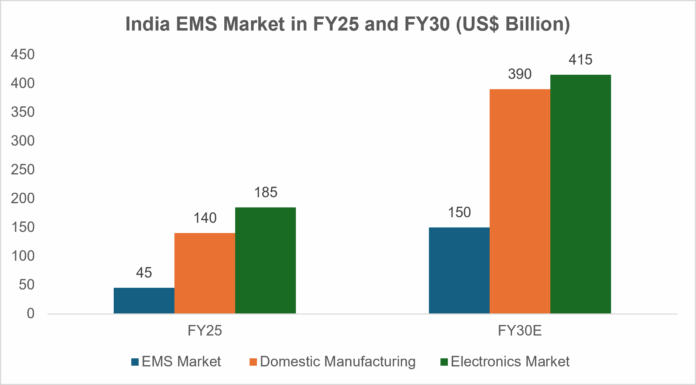
India’s electronics manufacturing services (EMS) market is expected to grow sharply as global electronics companies diversify their supply chains and manufacturers expand capacity in the country. According to KPMG, the Indian EMS market reached approximately ₹3.38–3.81 trillion in FY25 and is projected to cross ₹12.68 trillion by FY30.

India has emerged as the world’s second-largest mobile phone manufacturer by volume and an increasingly important production base for global technology companies. Smartphone exports are also rising, with Apple and other global electronics companies and their suppliers increasingly using Indian plants as export hubs.

The EMS sector recorded a revenue compound annual growth rate (CAGR) of around 24 per cent between FY19 and FY24 and is estimated to grow at around 27 per cent between FY24 and FY29, supported by supply-chain diversification and the China+1 strategy.

Government programmes including the Production-Linked Incentive (PLI) scheme, SPECS, EMC 2.0, India Semiconductor Mission (ISM) and Electronics Components Manufacturing Scheme (ECMS) have helped attract investments and expand India’s electronics ecosystem.

- Advertisement -

The broader electronics manufacturing sector has also expanded significantly, with production rising from around ₹1.9 trillion in FY15 to ₹11.3 trillion in FY25. Electronics have consequently moved from the seventh-largest export segment in FY22 to one of India’s leading export categories.

Components remain a challenge

Despite this growth, India accounts for only around 5–6 per cent of global EMS manufacturing output. The country has developed strong capabilities in smartphone assembly and PCBA manufacturing, but remains dependent on imported components, particularly from China and Hong Kong.

The next phase of growth is therefore expected to focus on increasing domestic value addition through component manufacturing, semiconductor fabrication, packaging and design.

India is targeting a ₹42.28 trillion electronics ecosystem by 2030, including ₹33.82 trillion in manufactured electronics and ₹8.46 trillion in components.

Achieving this target will require India to move beyond assembly-led manufacturing and diversify into semiconductor design and packaging, IT hardware, telecommunications, automotive and medical electronics. As global supply chains continue to diversify, strengthening domestic components and higher-value manufacturing will be key to India capturing a larger share of the global electronics value chain.


- Advertisement -
Loading form…
Nikita Kumari
Nikita Kumari
Nikita Kumari is a Journalist at EFY. She decodes deals, investments, and policy shifts, redefining the semiconductor and tech landscape.

Industry's Buzz

Volvo Cars Expands NVIDIA Partnership for Advanced Automated Driving Safety

0
Volvo Cars will bring nearly a century of safety research and its human-centric approach to the partnership Volvo Cars has announced an expanded partnership with...
Smartphones

Global Smartphone Shipments Plunge in the Third Quarter of 2026

0
Soaring memory costs force phone makers to cut low-margin lines, squeezing budget brands while market giants Apple and Samsung consolidate their lead. Global smartphone shipments...

US Firms Team Up on Silicon-Sulfur Battery Platform

0
XBM and SiCAM Technologies join forces to develop a sustainable, ultra-high-density battery technology using locally sourced materials for drones and electric aircraft. Lithium-sulfur cathode developer...

China’s Luxury EVs Target the EU Market

0
Facing tough competition at home, Chinese electric vehicle manufacturers are mounting a high-tech challenge to Europe’s legacy marques by swapping traditional heritage for digital...
NVIDIA CEO Jensen Huang

Nvidia Pledges $250M UK AI Safety Boost

0
Tech giant commits $50 million annually in computing power to back Oxford, UCL, and Imperial College London research into secure autonomous AI Nvidia has announced...

Learn From Leaders

Pravin Patel, Founder and Chairman, Brio Agri, India

“Our goal is not to replace farmers, but to empower them with better tools,...

0
In an exclusive interaction with EFY's Saba Aafreen, Pravin Patel, Founder and Chairman of Brio Agri, discusses building hydroponics and controlled-environment agriculture in India,...

Does India’s Chip Packaging Growth Need Local Materials At Scale?

0
What will it take for specialised semiconductor materials manufacturing to grow in India? Packaging volumes will be a key factor as OSAT facilities move...
Ronak Kumar Samantray, Founder, TM2Space Technologies Pvt Ltd.

“Our goal is to build data centres in space.” – Ronak Kumar Samantray, TM2Space

0
A space startup aims to build orbital data centres, letting users run AI models and store data on satellites while also supplying satellite hardware...

India’s Photonics Puzzle Is Finally Coming Together 

0
Can India turn its scattered photonics capabilities into a stronger industry? A new association aims to connect the ecosystem and strengthen the domestic value...
Jin Bains, CEO, Mini-Circuits

Mini-Circuits CEO Jin Bains on Navigating High-Frequency Component SWaP-C Constraints, Emerging Markets, and Career...

0
In this exclusive, Jin Bains, Chief Executive Officer (CEO) of Mini-Circuits, explains in a conversation with Dilin Anand of EFY about areas of emerging...

Startups

UST Selects 19 Startups for D3 Startup Challenge 2026 in Bengaluru

0
The programme is designed to identify technologies that address business challenges, assess their practical applications and determine their potential to scale UST, an AI and...

Compcarta Reduces The Cost And Complexity Of End-To-End Chip Design

0
Building a chip should not require assembling an entire design ecosystem. A Noida-based startup is developing a browser-based EDA platform that aims to reduce...

Aquaexchange Brings Monitoring And Automation To Shrimp Farming

0
The startup has developed an AI- and IoT-enabled platform that helps shrimp farmers manage farms, access financing, monitor operations, and connect with markets. The startup...

Drone-Like Aircraft For Logistics From BluJ Aerospace

0
Hyderabad-based BluJ Aerospace is developing indigenous electric and hydrogen-powered vertical take-off and landing (VTOL) aircraft for remote cargo transport. BluJ Aerospace, a Hyderabad-based aerospace startup...
Jash Jetly, Co-founder and CEO of EVE

“The cloud isn’t the only way to run AI. We’re proving it can happen...

0
A startup is building a decentralised AI and communication network that runs across everyday devices instead of centralised cloud servers. In an interview, Jash...