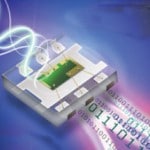
Meet World’s smallest ARM powered microcontroller

The KL02 promises great potential for ultra-small-form-factor products in applications such as portable consumer devices, wearable devices and ingestible healthcare sensing.

Freescale Semiconductor has introduced its new Kinetis KL02 MCU–the world’s smallest ARM Powered MCU. The KL02 holds great potential for ultra-small-form-factor products in applications such as portable consumer devices, remote sensing nodes, wearable devices and ingestible healthcare sensing.

Measuring just 1.9 x 2.0 mm, the Kinetis KL02 MCU is 25 percent smaller than the industry’s next-smallest ARM MCU. Within this miniscule device, Freescale has included the latest 32-bit ARM Cortex-M0+ processor, cutting-edge low-power functionality and a range of analog and communication peripherals. This enables system designers to dramatically reduce the size of their boards and products while retaining the all-important performance, feature integration and power consumption characteristics of their end devices. In addition, space-constrained applications that previously couldn’t incorporate an MCU now can be upgraded to become smart applications, adding a new tier of devices to the IoT ecosystem.

“Freescale has been a pioneer in many aspects of the ARM Powered MCU market with our Kinetis portfolio,” said Geoff Lees, senior vice president and general manager of Freescale’s Microcontroller business. “We were the first to market with MCUs based on the ARM Cortex-M4 and Cortex-M0+ processors, we set new standards for entry-level MCU energy efficiency, and we’ve now created the world’s smallest ARM Powered MCU, helping advance the Internet of Things era.”

“The Internet of Things will soon be a vast and diverse ecosystem of smart connected devices and screens that embed intelligence into many new areas of our lives. This could range from tiny sensors helping to monitor crops and deliver irrigation, to microcontrollers that enable entire buildings to be more energy efficient. Our mobile devices could be soon controlling and managing this data and making our lives easier to manage,” said Richard York, director, Embedded Processor Products, ARM. “The Kinetis KL02 CSP MCU brings the best ARM and Freescale technologies to applications at the very edge of the IoT and opens up exciting possibilities for a new tier of ultra-small, smart, power-efficient devices.”

- Advertisement -

The Kinetis KL02 is a wafer-level chip-scale package (CSP) MCU. Freescale’s CSP MCUs use the latest in package manufacturing technology to connect the die directly to the solder ball interconnects and, in turn, to the printed circuit board (PCB). This removes the need for bond wires or interposer connections, which minimizes die-to-PCB inductance and improves thermal conduction and package durability for physically harsh environments. The KL02 device is the third CSP MCU in the Kinetis portfolio, joining the larger 120/143-pin Kinetis K series K60/K61 variants. Additional Kinetis CSP MCUs with increased performance, memory and feature options are planned throughout 2013.

Building upon the energy efficiency of the Cortex-M0+ core, the Kinetis KL02 MCU reduces the power consumption threshold of the Kinetis L series to an even lower entry point and is ideal for the demanding power profiles of miniaturized, IoT-linked systems. The ultra efficient KL02 delivers 15.9 CM/mA* and, like the other Kinetis MCUs, it includes autonomous, power-smart peripherals (in this case, an ADC, UART and timer), 10 flexible power modes and wide clock and power gating to minimize power loss. A low-power boot mode reduces power spikes during the boot sequence or deep sleep wake-up. This is useful for systems in which battery chemistry limits the allowable peak current, such as those employing lithium-ion batteries frequently used in portable devices.

The Kinetis KL02 CSP MCU is expected to begin sampling to lead customers in March 2013. Broad market availability of production-qualified samples is planned for July 2013 from Freescale and its distribution partners. Suggested resale pricing is 75 cents (USD) in 100,000-unit quantities.


- Advertisement -
Loading form…

Industry's Buzz

thyssenkrupp

thyssenkrupp Expands Automotive Electronics R&D In Pune

0
thyssenkrupp Automotive Technology is expanding automotive electronics and software R&D in Pune, planning to grow its engineering team beyond 300 to support global programmes...

Nuuk and EPACK Durable Partner to Manufacture Small Appliances in India

0
Direct-to-consumer brands team up with contract manufacturers to boost domestic production of air fryers and circulator fans.  Direct-to-consumer (D2C) home appliance brand Nuuk has joined...

Potential US Curbs Bears Down on Chinese Optical Chip Stocks

0
Shares of upstream laser chip suppliers suffered steeper declines compared to downstream optical transceiver manufacturers. A report by Morgan Stanley, earlier this month, warned...
Prime Minister Modi

Modi Flags 6G And Domestic Electronics Production At IMC 2026

0
Prime Minister Narendra Modi has outlined India's next telecom priorities at India Mobile Congress 2026, linking the 5G-to-6G roadmap with semiconductor production, domestic electronics...
Fujitsu

Fujitsu-Owned 1Finity Deploys 200+ Engineers To Expand India’s Optical Networking Business

0
Japan’s Fujitsu-owned 1Finity is expanding its India networking business with more than 200 engineers as AI and data-centre growth drives demand for optical networking...

Learn From Leaders

Does India’s Chip Packaging Growth Need Local Materials At Scale?

0
What will it take for specialised semiconductor materials manufacturing to grow in India? Packaging volumes will be a key factor as OSAT facilities move...
Ronak Kumar Samantray, Founder, TM2Space Technologies Pvt Ltd.

“Our goal is to build data centres in space.” – Ronak Kumar Samantray, TM2Space

0
A space startup aims to build orbital data centres, letting users run AI models and store data on satellites while also supplying satellite hardware...

India’s Photonics Puzzle Is Finally Coming Together 

0
Can India turn its scattered photonics capabilities into a stronger industry? A new association aims to connect the ecosystem and strengthen the domestic value...
Jin Bains, CEO, Mini-Circuits

Mini-Circuits CEO Jin Bains on Navigating High-Frequency Component SWaP-C Constraints, Emerging Markets, and Career...

0
In this exclusive, Jin Bains, Chief Executive Officer (CEO) of Mini-Circuits, explains in a conversation with Dilin Anand of EFY about areas of emerging...

India Needs Not a Hundred, But Thousands of Chip Diversified Companies 

0
Can India build a semiconductor ecosystem beyond fabs? Indiesemic believes thousands of diversified chip companies are needed to make that possible. India’s semiconductor push is...

Startups

PowerMon

Aquaexchange Brings Monitoring And Automation To Shrimp Farming

0
The startup has developed an AI- and IoT-enabled platform that helps shrimp farmers manage farms, access financing, monitor operations, and connect with markets. The startup...

Drone-Like Aircraft For Logistics From BluJ Aerospace

0
Hyderabad-based BluJ Aerospace is developing indigenous electric and hydrogen-powered vertical take-off and landing (VTOL) aircraft for remote cargo transport. BluJ Aerospace, a Hyderabad-based aerospace startup...
Jash Jetly, Co-founder and CEO of EVE

“The cloud isn’t the only way to run AI. We’re proving it can happen...

0
A startup is building a decentralised AI and communication network that runs across everyday devices instead of centralised cloud servers. In an interview, Jash...
Mohit Gupta, founder and CEO, TYLsemi

Building AI Chips, One Block at a Time 

0
What if building an AI chip became as simple as assembling reusable blocks? The startup is working to make custom silicon accessible beyond the...
Seema Johar, Co-Founder and Product Director, Compcarta Solutions Pvt Ltd

“We Let Designers Focus on Innovation, Not Infrastructure.”- Seema Johar, Compcarta Solutions

0
In an exclusive interview, Seema Johar of Compcarta speaks with EFY’s Akanksha Sondhi Gaur about why setting up an EDA environment can be harder...