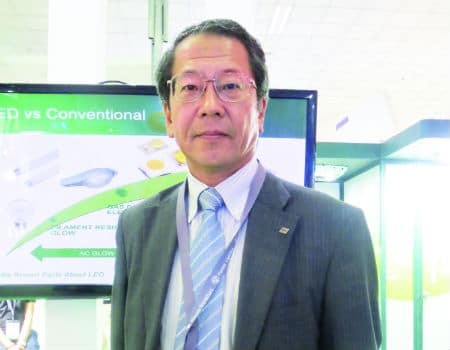

Thursday, December 18, 2014: Founded in 2009, Greenstar is an innovative company based in the United States, specialising in the design and manufacture of advanced and cost-efficient LED lights for outdoor applications. After its acquisition by Toshiba, Greenstar Products is expanding rapidly in many countries including India. In an interview with Richa Chakravarty of LED Bazaar, Yoichi Ibi, president and CEO, Toshiba Lighting and Technology Corporation, spoke about Toshiba’s strategy behind acquiring Greenstar, its expansion plans, product portfolio and R&D base in India.
 LB: How do Greenstar’s capabilities complement Toshiba’s with respect to your products?
The purpose of acquiring Greenstar was to increase our sales in Texas in the US. The LED market in India has grown dramatically since last year. Initially, we set up an R&D arm in India in 2009, which included design, development and the complete supply chain management for the US market. It was totally an export-oriented design centre. The headquarters in Texas had an assembly line, which did the final assembly, and then the lights were sold in the US and Mexico. After the acquisition, we saw the Indian market growing. So Toshiba and Greenstar, both thought of also starting the domestic sales operations. The company name still remains Greenstar Research and Development but it also has a sales and marketing arm in India, which commenced operations last year. So it is just our second year of sales and marketing activities in the country.
LB: Toshiba already has a lighting division, so what made it acquire Greenstar? How different are Toshiba’s and Greenstar’s product portfolios?
Toshiba has a 125-year legacy and began its India operations as a lighting company. It has enough experience and market share in the Japanese market. We already have three lighting facilities in China, four in Japan and currently we are focusing on the US and India markets. One way of entering a market is to manufacture the product yourself, and the other inorganic way is to buy out a company that is well established in this segment.
Greenstar has good expertise in the lighting industry as well as the fixtures and fittings used in different markets. Another major reason for acquiring Greenstar is that its expertise lies in outdoor lighting, while Toshiba already has a wide range of indoor and outdoor products. So this adds to the Toshiba range, and the two firms’ product portfolios complement each other. Greenstar is now taking care of many of Toshiba’s lighting projects in Japan. As of now, partial development of the product is done in India and the same light can be sold in Europe. In the coming years, the complete process of manufacturing a product, right up till the packaging stage, will be done by Greenstar in India.
LB: So Toshiba’s strategy was to enter the Indian LED market by acquiring an R&D facility here…
As I mentioned earlier, it basically started with the US as a market, for which the background design and development was being done in India. In early 2012, Toshiba had a marketing arrangement with Greenstar Products US, which gave it exclusive marketing rights for the US and Mexico. By the end of 2012, it turned out to be a 100 per cent acquisition. During that time, the entire company became an integral part of Toshiba. It started with the marketing rights for street lights in the US and, gradually, Toshiba realised the value and took over Greenstar wholly, including its R&D arm based in India. The research and development arm is a subsidiary of Greenstar Products US and Greenstar Products, in turn, is a group company of Toshiba.
LB: In India, does Greenstar meet all the international manufacturing standards for the global markets?
Yes, completely. The lights which have been sold in the US over the last five years were originally from Greenstar. They are now co-branded with Toshiba, post acquisition, and all are UL and FCC certified, as well as being approved by the US Department of Transport. Therefore, all the product specifications are met. This places our products way ahead of what India currently needs. Similarly, for our products in Europe, we have one installation base in Poland and one in Germany. European standards need the CE mark and we are certified for that as well. India needs the IS and ESL standards and we adhere to these specifications as well. Therefore, the widespread knowledge base is already available and it helps Toshiba greatly. As per the requirements and specifications of a particular company, we change some features to meet those essentials. Greenstar R&D is going to be a global hub for outdoor products.
LB: How has the company performed in the FY 2013-14?
Toshiba generated a revenue of US$ 2.2 billion, globally, in the FY 2013-14. Greenstar, on the other hand, recorded a revenue of around US$ 20 million.
LB: What growth figures do you forecast for the next financial year?
The Japanese lighting market is very stable. Seventy per cent of our revenue comes from that market. It is difficult to mention a precise figure, but we expect a revenue increase of around 5-10 per cent. Greenstar, on the other hand, is growing fast. We are targeting around 35-45 per cent growth on a year-on-year basis for the Indian market. We are targeting the same figure for Greenstar’s US arm as well. So put together, both the companies are looking at achieving a 35-45 per cent growth.
LB: Why are the LED players sourcing from outside when we have all the components and resources available here?
The first reason is the common notion that China is a huge market and only Chinese companies offer economies of scale. The other reason is that there seems to be more interest in selling or trading in these products, rather than in manufacturing. The essential part of manufacturing is developing vendors for several different components, and manufacturers do not want to invest in that since it requires a lot of attention and time. So, getting a ready-made product from outside and selling it under a new brand name is easier. The reliability, life and robustness of a product comes only when a company manufactures the product.
We do not think that China is more economical than India. We have run our operations here since five years, and if we can get all the things done locally and still export to other countries like the US, Japan and Australia, it proves that we can do things as economically as China does. We have a vendor base, 95 per cent of which is pre-dominantly in the NCR area, and we do not see any reason to produce in China.
LB: How do you view the Indian LED market?
Energy-saving devices are important for India. We see the markets opening up with the ‘Make in India’ call made by the new government. If the push towards renewable or green energy actually starts working, the LED market will boom at a fast rate. There will be ample opportunities for quality players in this segment.
LB: Are Indian players ready for this?
I cannot speak for other players but yes, Greenstar is ready for it. We have the right set of products and we are completely ready to take up the challenge. Toshiba is backing Greenstar with the right investments. Our policy is that 80 per cent of our vendor’s production capacity should be booked by Greenstar. This puts us in the driving seat and we can get the work done our way. We are geared up for the challenge, and are already working with EESL and various other agencies to make sure that the right product is chosen. So it is like a fight among equals.
LB: Since Greenstar specialises in outdoor lighting applications, what are the products being developed in Manesar?
All our products are developed or manufactured in Manesar. Just to name a few, we have a wide variety of street lights. There is no conventional lighting business in Greenstar. A complete range of street lights, flood lights and industrial highbay lights is available. In terms of applications, the areas we specialise in are road lighting, street lighting, lane lighting, flood lighting, construction lighting, façade lighting, advertisement billboard lighting, industrial lighting and warehouse lighting. It is interesting to note that we were a start-up five years back and we took a different path by specialising in outdoor lighting. Manufacturers usually graduate from indoor to outdoor lighting but we started with outdoor lighting.
LB: How has market acceptance for Greenstar products been?
Greenstar has an established business in Texas in the US. As far as branding goes, I will not say Greenstar is in the top slot. We are relatively new, just one-and-a-half years old in the sales and marketing field, but we are growing in leaps and bounds. We are also working on a couple of big projects, the names of which cannot be disclosed as of now. With the pace at which Greenstar is moving ahead, in a couple of years it is bound to become a brand name to reckon with.
LB: Is there any manufacturing facility coming up in India?
That depends on the volumes and growth that Greenstar will accomplish. If the volume and demand for the products go up, Toshiba is willing to invest in a manufacturing facility in India. Products for Europe and the US will be manufactured here in India.
LB: How does Toshiba-Greenstar plan to gain an edge over its many competitors in the lighting segment?
Our edge lies in technology and quality standards, which is what we aim to leverage via the Toshiba-Greenstar relationship. We do not want to play the price games. We are working on methods to reduce the cost of technology by intensifying our R&D and design efforts rather than compromising on quality. We are spending more on R&D, reliability testing and technological advancements which will ensure Toshiba-Greenstar stands out among others.
LB: Which segments do you see as driving forward the LED market in India?
We are currently focusing on four segments that we believe the growth drivers are coming from. Defence is a primary segment. Infrastructure is the second area we are focusing on in response to the government’s ‘Make in India’ call. Third, we are paying more attention to municipal corporations for street lights and outdoor lights. And fourth, our emphasis will be on the industrial segment including industrial campuses, warehouses and manufacturing units. We are working actively with the Indian defence forces for lighting up the borders with Pakistan. Out of six vendors invited for the bids, we are among the two finalists. As for the industrial segment, Reliance is one of our clients for refinery lighting and factory lighting. We’ve installed lighting for Wrigleys, Polyplex and some other local factories too.