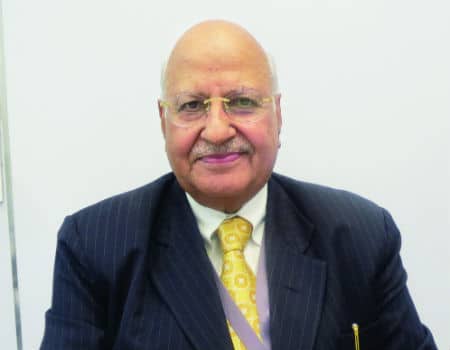

Thursday, December 18, 2014: Since its establishment, Eon Electric (formerly known as Indo Asian Fusegear Ltd) has grown into a multi-product, multi-location company specialising in manufacturing and marketing a wide range of high-tech electrical products. With its state of the art manufacturing facilities and R&D centres located in Haridwar and Noida, the company has grown exponentially under the dynamic leadership of Ved Prakash Mahendru. Eon is engaged in the manufacture and marketing of a large variety of electrical products including modular switches, wires and cables, lighting fixtures and luminaires, lithium ion batteries and other energy saving solutions. In an interview with Richa Chakravarty of LED Bazaar, Ved Prakash Mahendru, founder and chairman, shares his vision for Eon Electric—its growth and marketing strategies, and his plans to take the company to an even higher level.
 LB: What was the thought behind setting up Eon Electric?
My family migrated to India from Pakistan in 1947, and my first priority was to find a job for myself and take care of my parents. In those days, most of the products were imported from England—even the wood that was used for tennis rackets came from there. We were in Jalandhar then, and I wanted to begin manufacturing of sports equipment. Hence, I met the director of the Forest Research Institute at Dehradun, and together we discussed ways to treat ordinary wood so that it became strong enough to replace the imported English wood used to manufacture tennis rackets. While setting up the manufacturing plant, I had to wait six months for the electrical switches, required to operate the machines, to be installed. That’s when I realised the acute need for electrical switches in India and decided to start manufacturing them in Jalandhar, while reaching out to a market much beyond Punjab. So I ventured into manufacturing a full range of switches in 1961!
LB: What were the challenges faced when you started manufacturing switches?
We made high quality switches but some customers, like the government departments, would only accept those that were made in Britain or made as per British specifications. Finding buyers was our biggest challenge. The products available in the country were all imported from UK and were based on British specifications, unlike ours. We approached the railways, which was then the biggest buyer of switches. But they too refused since our products were not manufactured in Britain. I then modified the switches to suit not only the British specifications but also Indian environmental requirements. I got them tested to meet all these specifications, which were more stringent than the British specifications because of the harsh Indian environmental and usage conditions. That’s when our products started gaining acceptance in the market. Our switches not only met British specifications (manufactured according to the European weather conditions and hence working in up to 27ºC ambient temperature), but also took into account the Indian weather conditions and could withstand ambient temperatures up to 40-45ºC, which is the true requirement for usage of switches in Indian conditions.
This venture of ours brought about another big change in the Indian industrial environment. For the first time, Indian Standard Specifications (ISS/BIS) for electrical switches were prepared as per the requirements of Indian environmental and usage conditions, which were recommended by me, as mentioned earlier. For all government departments all over the country, the British specifications were replaced by ISS, which were far more suited to the Indian usage conditions. A large number of other manufacturers of electrical products followed suit and, in a short while, India became self-sufficient.
LB: How did you make the transition from the switches to the lighting industry?
For almost 25 years, we have been making switches in the country. Starting from 20A to 1000A, we have all kinds of switches. We were one of the largest producers of switches and circuit breakers in India, and exported extensively to the Middle East and to African countries.
Initially known as Indo Asian Fusegear, we entered into a joint venture with a German company called Kopp for advanced types of circuit breakers and switches, which were then known as Indo Kopp switches/MCBs. These became very popular across India. Even while we were making switches, we were constantly striving to innovate and explore products for the growing future needs of India. That was when we entered the CFL lighting market with a technology tie-up with a leading Korean company. We forayed into the lighting industry by manufacturing energy efficient CFL light bulbs. We had also put up a manufacturing plant in Haridwar. Meanwhile, LEDs were just penetrating the Indian market. It was in 2010 that we started our LED manufacturing business in India. Since then, we’ve closed down our CFL production line due to the hazardous substance (mercury) involved in its manufacturing process.
LB: How has the company performed since it made the transition from switches to LEDs?
Initially, it was a tough time for us, since the product was new and so were our distribution networks and customers. We had to earn the same trust from customers with our new product since not only were LEDs new in the Indian market but the price difference, too, was huge. The transition was tough but slowly the market started picking up. The future of LEDs is indeed very promising and so are the growth prospects of our business.
LB: What was the company’s revenue in FY 2013-14 and what do you forecast for the next FY?
Our company has registered good growth in FY 2013-14. In the lighting business alone, the company registered a turnover of around Rs 400 million. For 2014-15, the lighting market is expected to grow tremendously, and our revenue estimation is around Rs 1500-2000 million.
LB: What are your R&D plans in the country?
Eon has invested around Rs 1000 million in the past to develop new products in the country. We will continue to introduce new products in the future too. We plan to invest around Rs 500 million in R&D for new products and designs.
LB: What is Eon’s edge over its competitors?
Our main objective is to offer unique and the best products at the least possible cost, so that gives us an edge. Another advantage is that we always offer innovative and new products to the market. Recently, we introduced LED street lights that can sense the traffic density, and based on that, either light up or get dim. For the consumer market, we are also introducing lights that can switch on or off by sensing the object/person approaching or moving away.
LB: Does your product portfolio cater only to the Indian market or to the global markets too?
At the moment, we understand the problems of the local market better, and have introduced products keeping local requirements and preferences in mind. Over a period of time, when we are able to satisfy domestic needs, we aim to go all over the world.
LB: What are the trends in the LED sector today?
LEDs have revolutionised the lighting industry completely. The latest trend is that more of technology and electronics is being introduced to customise the product to suit consumer requirements. LED sensing technology and remote monitoring of lights, etc, are the trends that are evolving and will further expand the market in the coming years, resulting in greater comfort and satisfaction for the customers.
LB: What is Eon’s marketing strategy to increase LED market penetration?
Innovation has been our forte. Ever since we started manufacturing switches, we have always concentrated on offering something new to the market for greater comfort and safety. This definitely gives us the first mover advantage. Price is the other factor that we keep in mind. Consumers have a tendency to compare costs and the returns on their investment. So, we always offer products that not only carry the novelty factor but are also cost effective. And the most important factor is energy efficiency. The consumers today are not only aware about energy efficient products but are also emphatic about buying them to save on their electricity bills and conserve power for the nation. These are just a few aspects that Eon has focused on, with respect to customer comfort and cost cutting.
LB: What is the forecast for the LED lighting market?
LEDs have a great global market. The scale of growth is massive—today the industry is registering a 40 per cent growth and if reports are to believed, this double digit growth will continue for many more decades.