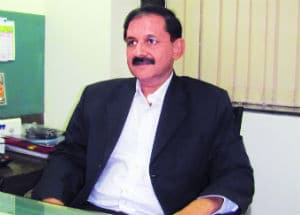

 January 24, 2015: Starting out as a small business to cater to the industry’s need for import substitutes, Elcom International has grown to be a leader in the field of professional electro-mechanical and electronic components over the last three decades. The company has its design and development centre and manufacturing facilities in Kolhapur, Maharashtra. Along with manufacturing components, the company also offers its services to international customers for designing, tooling and manufacturing products as per customer specifications. In a conversation with Richa Chakravarty of Electronics Bazaar, Dr Girish V Vaze, chairman and managing director of Elcom International, highlighted the evolving trends in the industry, the company’s business and marketing strategies and its expansion plans.
EB: Elcom has been manufacturing connectors for almost three decades now; so where do you see the industry moving?
We have been manufacturing various types of connectors in addition to a lot of other electro-mechanical and electronic products. With time, the applications have been changing and products are getting more complex, translating to a more complex design and development process. As we open up and cater to the global market, the unique and specific demands of international clients in terms of design, quality, standards, etc, are also to be met. Hence, it has become more challenging to make a profit given the costs of testing and approvals, as well as the constraint of ensuring quick time to the market. In the near future, we feel manufacturing activities in India will increase, and more complex products will be taken up for manufacture.
EB: Which are the application areas or segments generating the maximum demand? Which are the new segments that are opening up in the domestic market?
The segments that are witnessing increasing demand include communication, computing, automotive, consumer electronics, power electronics, solar applications, etc. All these sectors are growing in the domestic market as well, and will continue to do so in the coming years.
EB: How is the industry coping with the growing demand for miniaturisation in electronic devices?
The Indian manufacturing sector has been stagnating for more than 10 years, and most of the end user applications for large volume miniaturised connectors are not located in India. So, the majority of the miniaturised connectors are imported or come as part of PCBAs through imports. It will take some time for the Indian industry to get back into local manufacture fully. Only when the volumes are available will the local industry be able to begin the manufacture of miniaturised connectors on a large scale.
EB: Since a large section of the electronic components industry is dependent on imports, how do you see exports growing?
If the volumes are large enough, it will be economical to produce locally. We have been catering to the export market, where we get large volumes and so can produce and export. So, whether a product is manufactured locally or imported will depend on the applications and the volume of demand. If the demand increases for exports, then exports will increase. Imports are the option when local products are uneconomical or if the technology does not exist in India.
EB: What percentage of your business comes through exports?
Presently almost 45 per cent of our business comes from exports. We export to various countries including USA, the EU, Egypt, Turkey, Iran, UAE, Thailand, South Korea, Philippines, Hong Kong, China, Australia, etc.
EB: There are so many spurious, low quality components available in the Indian market today. Does Elcom also face the problem of its components being illegally duplicated? How do you resolve this problem and ensure that your customers get the high quality original product?
Large multinationals and quality conscious customers buy our components. Our products speak for their quality and reliability. There are some customers who do try and use some low quality components, which harms their reputation as the overall quality of their product deteriorates. So, once they have burned their fingers and realised the value of our products and services, they do come back to us.
Elcom offers solutions and not just components. We work with large customers right from the design stage and develop products that give them a great value proposition. We have in-house testing facilities which are internationally approved, and thus it is easier for us to get international safety approvals for the products we manufacture. We deliver quality and earn the trust of our customers.
EB: How is Elcom competing with global players from China, Taiwan, Malaysia and Thailand?
Elcom has a great team, which offers our multinational customers design and development support, in the course of which there are constant interactions with our engineers—through chat sessions, discussions and collaboration to develop products. Customers can trust Elcom with their requirements which they are sure we will not misuse, and we offer them long term cost effective solutions. We deliver consistent, good quality products with the specifications they require and the support they need. I believe our customers see value in our offerings, which opens up opportunities for us despite the existing competition from other global players.
EB: There are so many MNCs manufacturing electronic products in India. How do you see the future of the domestic components manufacturing business?
We expect that the volume of manufacturing by the many MNCs will increase in India. Once this happens, we see great opportunities for the good quality-conscious domestic component manufacturers.
EB: How do you maintain an edge over your competitors?
Reliability and the quality of our products is what differentiates Elcom from our competitors, who generally sell only components whereas we offer solutions. While most of our competitors generally compete on price points, Elcom operates on the basis of our customers’ trust in us.
EB: As channel partners are the backbone of a business, what initiatives have you taken to build your channel network?
We do believe in channel sales and a network, and have a large number of channel partners all over India. We have five channel partners in the USA, and a number of them in Europe, West Asia and other parts of the world. Along with this, to take our business forward, we participate in exhibitions and trade shows to find the right channel partners for us to work with. The Internet, too, has become a great channel partner for us, as we are getting a lot of our business online.
EB: You have your R&D centre in India. What are the current R&D activities you are involved in? Are you planning to launch any new products in the near future?
We are doing R&D in various fields and not only in connectors and components. We have launched smart power distribution units in India, and have developed a number of hardware and software products for the energy monitoring and controlling product lines. We have designed and launched solar connectors in India. We are also planning a number of other products, which we will talk about once they are ready to be launched.
EB: What are your future plans? Any expansion plans lined up?
We have embarked on an expansion plan and are building a new state of the art R&D and manufacturing set up of about 10,000sqm. We are also increasing the capacities of all our activities to cater to the growing demand.