



The government is expecting an investment of Rs 20,000 crore under the SPECS scheme and an investment of more than Rs 14,000 crore under the PLI for large scale electronics manufacturing
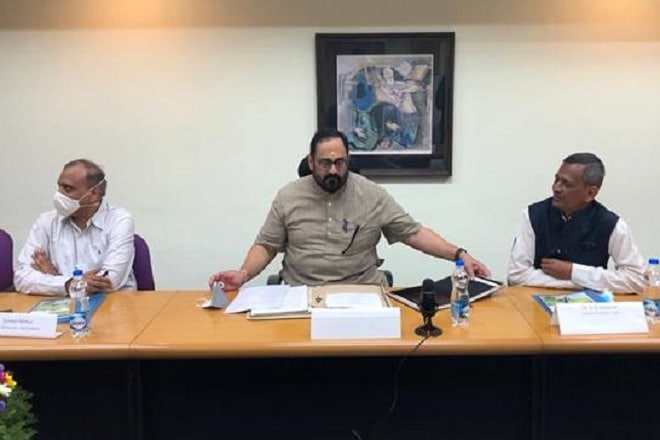
The government expects that an investment upwards of Rs 34,090 crore will be made under the PLI scheme for large-scale electronics manufacturing. Minister of state for electronics and IT Rajeev Chandrasekhar revealed this information in written reply in the Rajya Sabha.
The government of India, by 27 January 2021, had approved proposals of around 20 companies under the SPECS scheme. These approvals include Tata Electronics as well. Similarly, more than 20 proposals were approved under the PLI for large scale electronics. The government is expecting an investment of Rs 20,000 crore under the SPECS scheme and an investment of more than Rs 14,000 crore under the PLI for large scale electronics manufacturing.
Chanderasekhar said, “The total employment potential (both direct and indirect) of the scheme is approximately 6 lakh.”
He added, “In the aforementioned PLI schemes for large scale electronics manufacturing and IT hardware, the amount of investment expected to be brought in by the approved applicants is Rs 14,090 crore. The total employment (both direct and indirect) expected to be generated during the tenure of the schemes is about 8.57 lakh.”
Despite numerous steps taken by the Centre to boost electronics manufacturing in the country, import tariffs in India are still higher when compared to other countries. This is nulling the effect of the various PLIs by the government and is adversely affectively competitiveness and scale, as per a report by industry body India Cellular and Electronics Association (ICEA).
In the report, which was done in collaboration with IKDHVAJ Advisers LLP, the body concluded that import tariffs continue to be higher than those of China, Vietnam, Thailand and Mexico. The study highlighted that India has zero tariffs on 32 of the 120 tariff lines, while other countries have more zero tariffs – ranging from 53 (China) to 74 lines (Mexico).
The findings showed that for India to integrate into global supply chains, its tariffs on inputs should at least match or be less than that of its competitors.

