




With memory supplies tightening, device makers are raising prices, and Indian buyers are changing their habits. How is India bearing the brunt of the global memory crisis?
As the spotlight remains on the global AI race and who is winning with the highest number of data centres, another battle is quietly reshaping the global technology supply chain. Only a year ago, memory chips were just another component in our laptops or smartphones. Yet, by 2026, they have become one of the most talked-about resources in the industry.
Why?
Because they power AI infrastructure. But what does that have to do with consumer electronics? Let us consider an example.
On 6th July 2026, it was reported that Samsung was set to increase the prices of its upcoming foldable smartphones. The Galaxy Z Fold8 Ultra and Flip8 will cost more than their predecessors, with the Flip8 priced about 13% higher in South Korea. This is due to the AI boom. Rising DRAM and NAND prices, driven by AI demand, have nearly quadrupled memory costs, making memory account for about 40% of the bill of materials of an $800 smartphone.
DRAM provides a device’s working memory, while NAND flash is used for storage. Both are essential not only in consumer electronics but also in AI servers that process increasingly complex workloads. As AI demand continues to rise, manufacturers are prioritising high-margin DRAM and NAND chips for servers, leaving consumer electronics makers competing for limited supplies. This shortage is now beginning to shape product pricing worldwide, with price increases filtering through the supply chain to manufacturers and consumers alike.
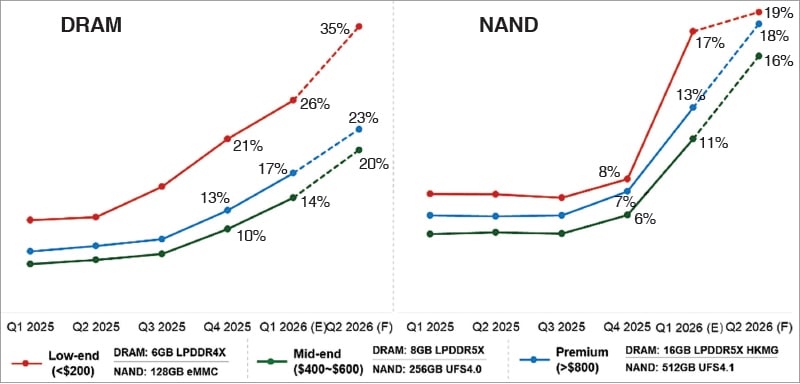
According to market research firm TrendForce, DRAM prices increased by as much as 98 per cent during the first quarter of 2026 and are expected to rise by another 58 to 63 per cent in the current quarter. As early as February 2026, Counterpoint Research estimated that memory prices had risen by approximately 80 to 90 per cent over the previous year, driven primarily by AI-related demand.
Now, India is not immune to this scenario. Industry experts say the country is already seeing the impact, particularly in the budget segment, with supply constraints expected to persist well into 2027.
Ajay Sharma, a veteran of India’s consumer electronics industry, believes the shortage is not caused by lower production but by a shift in allocation.
“Production has not reduced. It is being diverted towards AI infrastructure,” Sharma told EFY in an exclusive conversation.
“Manufacturers such as Samsung, SK Hynix, and Micron naturally prefer supplying higher-value AI servers because profitability is significantly higher than for smartphones or laptops. When production is limited, the category with higher margins and long-term contracts gets priority.”
Pressure reaches the Indian market
Although the supply imbalance is global, Sharma says Indian consumers are now experiencing its consequences.
“DRAM and NAND are part of the bill of materials of every smartphone, laptop, and consumer electronic product,” he says. “When their prices rise, manufacturers have little option but to pass on those costs.”
The impact appears to be most visible in smartphones, where memory accounts for a substantial share of manufacturing costs.
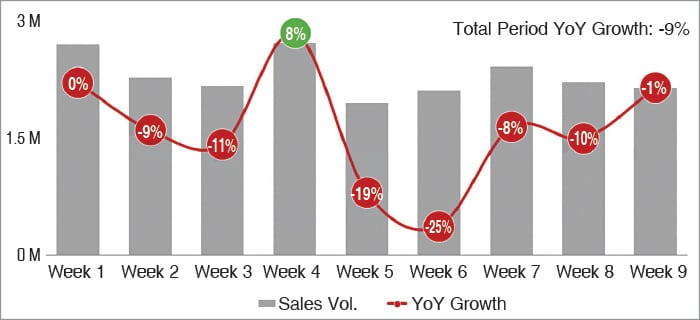
The data support this trend. According to Counterpoint, by March 2026, India’s smartphone market had begun slowing, with weekly retail sales declining by around nine per cent during the first few weeks of the year. Retailers have also reported softer consumer demand as device prices increase.
The slowdown is reflected in International Data Corporation (IDC) data as well. India’s smartphone shipments declined 4.1 per cent year-on-year during the first quarter of 2026, with entry-level devices recording the steepest fall. Smartphones priced below US$100 declined by nearly 59 per cent, while premium and upper mid-range segments continued to grow.
The reason for this discrepancy, according to Sharma, is that lower-priced devices have a higher proportion of memory costs.
“This means that although the cost of a DRAM or NAND chip does not vary much whether it is used in a ₹15,000 phone or a ₹30,000 phone, memory can represent a significantly higher share of the total cost of entry-level devices. The margins for brands are lower on one side, and on the other, customers are price-sensitive. Thus, manufacturers can hardly pass on the burden of higher memory component prices to consumers.”
Manufacturers have thus been gradually increasing prices instead of introducing one-off price hikes.
“If we require an overall increase of approximately 15 per cent, we try not to implement it all at once but gradually,” Sharma explains.
And it is not just smartphones. Several global manufacturers have already acknowledged increasing memory costs. In June 2026, Apple increased prices for selected MacBook, iPad, HomePod, and Apple TV models, citing higher DRAM and NAND prices. Retailers, including Currys in the UK, have also warned that laptops and smartphones are likely to become more expensive as AI infrastructure consumes a larger share of the memory supply.
Consumers are becoming more price-sensitive
In the Indian market, the entry-level smartphone segment has continued to demonstrate growth in terms of volumes, particularly among users who have upgraded to smartphones from feature phones or older 4G devices. However, the transition seems to be slowing because of rising device prices.
Sharma states that footfall at retail stores has declined, leading to longer inventory cycles at the retail level as customers looking for devices, especially in the low- and mid-range segments, are postponing their purchases.
IDC’s pricing-related data suggest that there is a visible shift in the market. In the first quarter of 2026, despite declining shipment volumes, the average smartphone selling price was US$302, indicating growing demand for higher-priced devices.
Customers are also changing the way they pay for their devices. According to Counterpoint, financing methods will account for 42 per cent of mobile phone sales in India in 2026, compared to just 35 per cent in 2025. Due to rising component costs, particularly memory, buyers are increasingly willing to purchase their devices through instalments rather than paying the full amount upfront. EMIs are becoming the new normal.
| India smartphone Market, top 10 brands | |||
| Brands | 1Q 2025 Market Share (%) | 1Q 2026 Market Share (%) | YoY Unit Change (%) |
| vivo | 19.7 | 19.6 | -4 |
| Samsung | 16.4 | 17.1 | 0 |
| OPPO | 12.0 | 15.3 | 22 |
| Apple | 9.5 | 9.4 | -5 |
| Motorola | 7.5 | 8.9 | 14 |
| realme | 10.6 | 8.8 | -20 |
| Xiaomi | 7.8 | 8.4 | 3 |
| Poco | 4.3 | 3.8 | -14 |
| iQOO | 2.3 | 1.9 | -23 |
| OnePlus | 2.4 | 1.7 | -32 |
| Others | 7.5 | 5.1 | -34.6 |
| Total | 100.0 | 100.0 | -4.1 |
Supply constraints are likely to continue
Although memory output is anticipated to grow, Sharma says the market needs to recalibrate. “The pressure will remain in the short term through 2026 and possibly continue into 2027,” he says.
This outlook is in line with estimates from Gartner and other research firms regarding memory demand, which is expected to continue affecting the consumer electronics market in the near future. According to Gartner, global PC shipments will be 10.4 per cent lower and smartphone shipments 8.4 per cent lower in 2026 due to increased component prices.
Undoubtedly, advances in AI are creating significant opportunities for the semiconductor industry. India is on the verge of establishing greater self-reliance in the sector. However, amid ongoing economic and geopolitical uncertainties, only time will tell what lies ahead for India’s consumer electronics industry.
With inputs from Ajay Sharma, industry expert and analyst.
Shubha Mitra, Assistant Editor at EFY, is keenly interested in policies and developments shaping the electronics business.

