The government of India has invested around ₹ 48,000 crores in order to introduce Smart City initiative that aims to create at least 100 smartcities, where public safety will be given paramount importance by city administrations. This would include protection against crime, natural disasters, accidents and terrorism. Smart City initiative imbibes four major rules of planning: social, physical, institutional and economic infrastructure.
One of the main pillars of institutional infrastructure is public security and safety. Technologically-driven surveillance systems are easy to scale up with a wide range of security systems that work on a single interface. These successfully consolidate physical safety needs ranging from video surveillance, intrusion alarms and access-control techniques, and conserve existing analogue systems. Thus, advanced surveillance techniques that are mostly driven by technology are considered highly cost-effective, as these can be further upgraded and come with low maintenance cost.
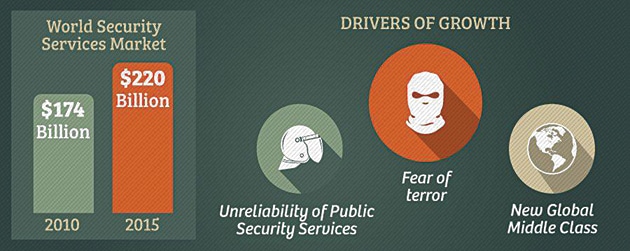
There has been a major shift in the demand for surveillance techniques from developed to developing nations in the past decade. Countries gaining from this change are parts of Asia, Eastern Europe, Africa and the Middle East where security markets are relatively untapped. Such an increase in the employment of security services is likely to be sustained by improved economic activities, growing construction activities, growing urbanisation and higher per capita income.
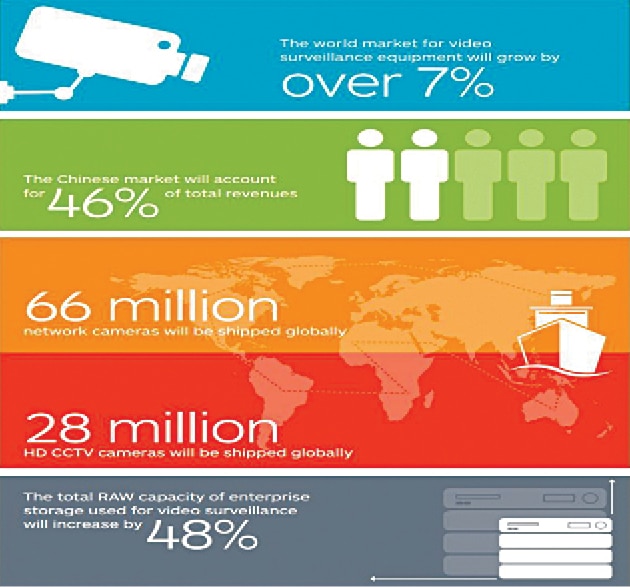
(Source: Image Sensors World, 2016)
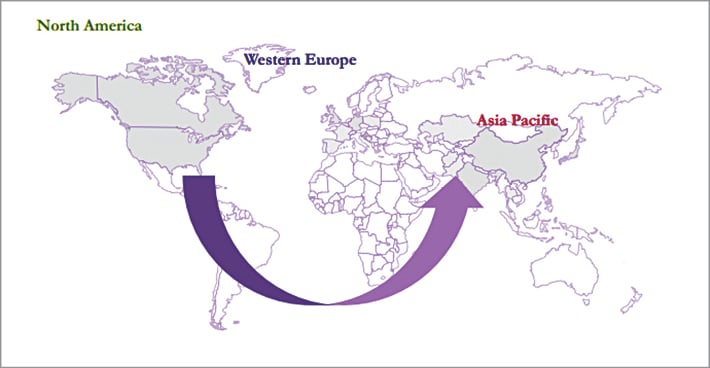
Improved economic productivity followed by rising per capita income promotes employment and installation of modern and advanced technology-driven surveillance systems. Also, manned security dominates demand in developing nations, whereas developed markets are focused more on electronic security services that are more widely used in the US, Canada, much of western Europe, Japan and South Korea. There is an overall shift in market share from western countries to the Asia-Pacific. Between 2002 and 2019, there is a steady increase in Asia-Pacific market and a gradual fall in North America and Europe markets, as can be seen from Fig. 4.
| Table II: Types of Surveillance Systems | |
| Type of surveillance | Brief description |
| Computers and network surveillance |
This technique involves observing and monitoring data that is transmitted over the Internet or over in-house networks, and retrieving computer activity or data stored on a hard drive. |
| Telephone surveillance | This technique involves surveillance of phone conversations; location tracking and monitoring data over the phone. Traditionally referred to as wiretapping, telephone surveillance has gained immense popularity in home and several business settings. |
| Video surveillance | This form of surveillance involves detecting and observing moving objects in a particular area. Demand for CCTV cameras and the likes is soaring globally due to rising threat to public and private security. |
| Social network surveillance | Surveillance of data from social networking sites such as Facebook and Twitter as well as traffic analysis information from mobile phone data is a form of social network surveillance. These social network maps are then data-mined to procure useful information such as personal interests, affiliations, beliefs and activities. |
| Biometric surveillance | This technique analyses physical or behavioural traits in human beings for authentication, identification and screening purposes. Physical characteristics such as facial patterns, fingerprints and DNA, and behavioral characteristics such as a person’s gait or voice are scrutinised for surveillance purposes. |
Growth drivers
Electronic security and surveillance have become alarmingly popular owing to the plethora of benefits that these offer. These not only protect against outside break-ins and burglaries but also play a critical role in sustaining businesses and creating a safer place to live and work. More often than not, investing in a few surveillance technologies can yield a high return on investment for an organisation. Increasing demands for VCA and VSaaS, incorporating artificial intelligence (AI) and video analytics, and amalgamation of electronic security with advanced technologies, such as drones and body cameras, are some of the key opportunities that propel the growth of the market.
According to ‘Digital Security and Surveillance’ report by Intel, retailers in North America lose up to US$ 45 billion a year due to employee theft, shoplifting and organised crimes. With the advent of surveillance technology, a huge number of retailers today rely on video and other forms of surveillance techniques to identify suspicious behaviour. Transformation from analogue-based surveillance to IP-based digital technologies has not only made surveillance technology more effective in its role of monitoring, detecting and intercepting undesirable behaviour, but has also played a significant role in delivering information that can be used to enhance business solutions and optimise overall business performance. According to reports by IMS Research, growing demand for digital security has created a US$ 40 billion industry.
Retail
Major demand for electronic security across the globe comes from retail, educational and public sectors. Retail is a major vertical market for the digital security and surveillance industry. Retail surveillance helps retail companies identify incidents of retail crimes like shoplifting, violence and vandalism. It is mostly carried out through CCTV cameras and has recently evolved to leverage biometrics to identify and prevent retail crimes. According to National Retail Foundation, organised retail crime costs the retail industry around US$ 30 billion each year, in addition to petty shoplifting. Retail stores also use video analytics to study the behaviour of customers in a store. Through CCTVs, they are able to recognise the likes and demands of their customers and use video footage to assist with store layout, merchandise positioning, staffing and promotions in order to improve customer experience.
Public sector
One of the biggest users of video surveillance is the pubic sector. Governments of different nations put the safety and security, and the need to protect their citizens, at a high priority. Such an intricate surveillance of the population is called mass surveillance. It is necessary to fight terrorism, prevent social unrest and protect national security.
Education
One of the faster-growing market segments for security technology is schools and universities. Combining proactive protection for students and teachers with digital security technology makes it possible to optimise safety while remaining within budget. Perimeter surveillance, video surveillance, tracking suspicious activities and reporting these to the authorities, and monitoring educational activities in and out of class, are some of the many solutions that are a result of surveillance techniques.