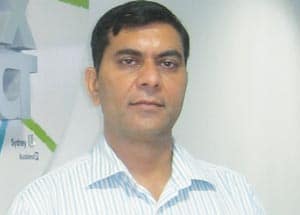


vice president, DC and sales operations,
Phoenix Contact India
Phoenix Contact is today ranked among the leading technology companies in India, thanks to the innovative and technologically advanced products it offers. In a span of less than a decade, Phoenix Contact India has achieved commendable feats in industrial connection devices. “We’ve grown by 20 per cent last year, and this year we target around 30 per cent growth,” says Rahul Yadav, vice president, DC and sales operations, Phoenix Contact India, in a conversation with Richa Chakravarty of Electronics Bazaar. He also discusses global trends, the company’s marketing strategies, and the challenges and opportunities that lie ahead.
EB: What are the latest global trends being witnessed by the component industry with respect to industrial connection technology vis-a-vis what’s prevailing in India?
The clear global trend in industrial connection devices is miniaturisation because of the space constraint. Compact devices delivering the same amount of power, efficiency and energy are, therefore, catching up. Connectors are the first point at which wiring is done. Hence, fast connection devices have become a developing trend because they save time. The improved reliability of these compact and fast devices is another trend.
In electrical and electronic products, more than half the problems occur at the first level, which is, connectors. Therefore, connectors must be reliable and be able to withstand all types of conditions—for instance, in Europe, the storage temperature is -40°C and in India this can go up to 50°C; and in an enclosed device, this can be 70-80°C. Hence, these components have to meet all these wide temperature variations as you cannot develop different components for different applications. So this reliability factor is a must in electronic devices.
Different termination technology is another trend catching up. If we talk about connectors specifically, the technology has been upgraded to become vibration proof and faster. We have new spring technology, insulation and displacement technology for the termination of wires. Keeping harsh industrial environments in mind, devices with higher protection levels to withstand severe climatic conditions are required and, hence, dust and waterproof devices are being used. Keeping the safety of equipment in mind, improvement in IP protection is another fast developing trend.
All these global trends are being currently witnessed in India, while in earlier times, there used to be a time gap. In fact, in some of the industrial segments, India is at par with the western world.
EB: How important is the Indian market for Phoenix?
Indian market is one of the most important across the globe. The economic growth that we have achieved in the last 10 years is encouraging, though there has been a slight decline in the last couple of years. Hence, the market is big, growing and the opportunities are great. This is one of the biggest markets, and the BRIC (Brazil, Russia, India and China) countries are set to outperform the rest of the world; so growth in India is a very important cog in this wheel of world economy.
In terms of GDP, analysts feel that by 2050, India will be among the top two or three economies. Our per capita income will increase and, simultaneously, we will require more products; hence, there is a huge market to cater to. Phoenix Germany has realised this and has already made huge investments. It plans to continue its investments in the future as well because it views India as a growing market.
EB: Which segments in India are you targeting?
We operate in all segments, but our strategy is to specifically target growth-oriented segments including solar power, wind power generation, energy distribution for the smart grid, etc.
EB: What are your marketing strategies in India?
We have 180 distribution channels across India. We have been actively participating in expositions and reaching out to our clients through various mediums. Also, with our strong distribution network, one can easily obtain products faster. We have made huge investments in logistics to provide products on time, and have backed this with an information system for customers to know the status of their order—whether their product has been dispatched or is about to arrive.
Manufacturing locally gives us an edge, with which we are able to bring down the cost and pass on the advantage to customers without cutting down on quality. With this, we are able to compete well in the market.
We have divided our market into three segments—device connection, industrial components and electronics (ICE), and control and industrial solutions (CIS). All these segments require greater attention and we operate in close proximity with our customers to understand their needs and deliver as per their requirements.
EB: Keeping Indian consumers in mind, are your products competitively priced?
A very important aspect to offering competitive prices is the localisation of products, the use of the latest equipment and components, and developing inhouse facilities for manufacturing products. This is one way of bringing down the cost and passing on the advantage to the market. Cost innovation has always been the philosophy of our company. A better performance with lower costs is possible only if one adopts better technology. This is what we have been able to achieve.
EB: What has Phoenix’s contribution been to the Indian electronics industry?
The first modular terminal block, which was developed by Phoenix, Germany. 90 years back, was later patented. We have always been a trendsetter and have introduced the most innovative products. We are the first to try novel technologies; however, before putting our products into the market, we make sure that they have undergone complete testing. Customers look forward to our products as they know we offer reliable and innovative products. This has been our contribution to all global markets, including India.
EB: Please elaborate on some of your innovative products?
There are a whole range of innovative products that cut across various segments. eMobility is catching on and there will be more electrical vehicles in the future. We have developed charging solution and connectors for electrical vehicles. We also have developed an innovative tool free connector of up to 1500 V for solar application to avoid cumbersome wiring in field. The connector is called Sunclix. Working in the field with tools makes work cumbersome, so to do away with it, we have developed the new tool-less connector.
For termination, we have brought in a new technology called ‘push in technology’, wherein you have to just push in the wire without any tool. We are using this technology in all our different terminal blocks, relays and PCB connectors. This technology provides for faster and reliable wiring. Our new range of M12, IP65 connectors is very compact with 4 pins and we have been able to achieve 14 amp/630V, high power in compact size per pin. With spring technology, push in technology, a higher ampere range, and the IP 67 range of connectors, we have introduced enhanced PCB connectors.
Contractron 4 in 1 is another unique innovation with four functions of forward, reverse, motor protection and emergency stoppage built up within design width of 22.5 mm. Radio line is a new wireless system for large systems and network. Its special features include extremely easy assignment of inputs and outputs by simply turning the thumbwheel without any programming. Also, Quint–UPS-IQ provides 100 per cent reliable power supply with intelligent battery management.
EB: What challenges and obstacles did you face while positioning your brand in India?
We began operations in India in 1993. It was a tough time for us as the market was then very insular. Customers were not exposed to new technologies and the new opportunities. Also, it was a whole new set of products, about which we had to educate our customers and build awareness. In the initial years we struggled to instill confidence in customers. Back then, people were more cost conscious; hence, creating brand awareness took some time. By 2005-06, we became the market leader in the power supply market, in PCB connectors and rail mounted terminal blocks.
EB: How many manufacturing facilities do you have in India?
We have three units in India. Two are located in Okhla, Delhi and one is in Prithala near Palwal (Haryana). The Prithala facility is spread across 44,515 sq m (11 acres), and that is where major manufacturing is focused now. We have an R&D and testing laboratory in Okhla, which focuses on developing products suited for both the Indian as well as the global markets.