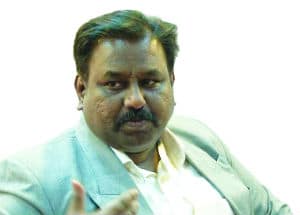

 May 19, 2015: Being a company that believes more in quality than in price, B.B. Battery Co. Ltd has been selling its products in India for over a decade. It has recently started its India operations as B&B Battery (India) Co. Pvt Ltd—and plans to start manufacturing in India in the years to come. In a conversation with Samonway Duttagupta, David Liu, global sales director, B.B. Battery Co. Ltd, and G. Ajit Kumar, director-India and SAARC, B&B Battery (India) Co. Pvt Ltd, share the firm’s journey so far and the roadmap ahead
EB: What are your views on the current battery market in India? Do you see it growing?
The Indian government is making cities smarter by introducing Wi-Fi connectivity and other modern facilities. In order to make these run uninterruptedly, one needs backup power, for which batteries play a vital role. Many new manufacturing units are coming up in India, and all of them run on power-dependent devices. In any case, the country is in need of clean energy. So as industry grows, the requirement for portable power will go up and we will have more opportunities.
Abiding by innovation
EB: In what way are your products more technologically advanced compared to others in the market?
If you look at the battery market in India, typically, there’s only one type of battery for all applications. But we have different types of batteries under each series, for different applications. Take our 20Ah battery category alone, for instance, in which we have different types of application-based batteries. The BP, BC, EVP and HR series may be different kinds of series, but the beauty is that each kind of battery behaves differently for a particular application. For example, we have a 7Ah battery for a particular series and the same battery for the SS series. The dimensions of the two batteries may be different, but one battery will have higher power. The construction and container would also change but the Ah capacity remains the same.
We have adequate experience now and know the specific requirements of this market. So having identified the market’s requirements, we can specially design the batteries for our customers. That’s our strength and that’s how we can differentiate ourselves from our competitors. Added to this, we also developed a lithium-polymer (LiFePO4) battery for mobility applications. An ordinary battery usually lasts for 400 cycles but lithium batteries usually have different age capacities. A lithium-polymer battery can last up to 2000 cycles.
EB: What are your unique and innovative customer care practices?
We believe that selling batteries actually amounts to selling a service and not a commodity. Our service comes free of charge along with the battery that we sell. So if customers come to us wanting to buy batteries, we don’t just tell them the cost, but instead, we ask questions like what application the battery is required for and what are the other specific requirements, so that we can suggest the best battery suited for the application and optimisation of the cost. After getting a customer’s requirements, we share this information with the field application engineering (FAE) team at our factory, who then identifies the model and series suitable to the clients’ requirements. Sometimes our engineers even work with the customers’ engineers to develop the best battery for them.
Manufacturing plans for India
EB: Are you planning to set up your manufacturing unit in India?
Yes, that’s a long term plan. We have now set up our sales office here to promote the brand in India. We have been in the country for more than 10 years but before setting up this India office, we used to sell our products through distributors. The India office has been set up about seven months back in Bengaluru with service and warehousing facilities at Chennai.
EB: Is it in response to the ‘Make in India’ campaign that you have serious plans to set up a manufacturing unit in India?
Yes, that is partially the reason. But it was also our own decision to grow the business in India. We are traditionally a company based in Taiwan and we have two manufacturing facilities in China, where we have been operating for the last 22 years. It won’t be difficult for us to transfer our knowhow to India, but it depends on the market because local production needs to have the support of a local market to achieve economies of scale.
EB: By the time you set up your manufacturing facility in India, other firms may come in, thanks to the atmosphere created by the ‘Make in India’ campaign. How do you plan to cope up with the competition at that time?
Yes, we are expecting price competition in the future but when we start manufacturing in India, our products will be cheaper than current levels as we can save on duties and taxes at both ends, which are currently embedded in our pricing of the products we sell in the Indian market. Besides, our strength lies in research and innovation. No matter how cheap someone else gets, what matters in the long run is a company’s innovation capabilities and the quality of its products. So our experienced R&D team not only allows us to design a battery, it also allows us to innovate something new. For example, we have jointly designed a product with a German company—we have come up with something like a Lego based battery. So we build a basic element, and our customers build their own battery based on that.
Brand positioning and strategies
EB: How do you plan to position your products in India?
For many years, we’ve had a reputation in this market for providing high quality products. We have had some original equipment manufacturer (OEM) customers who really care about the value associated with our brand name. So, our first target will be the OEMs in India. Second, we want to be identified for our high quality. Our products are not for the mass market. We want to target the mid-level and top-level companies. We also want to identify application-based market segments—uninterruptible power supply (UPS) systems, telecom, electric vehicles, solar and renewable energy, and others.
EB: Does your product’s pricing play a major role when competing with the other brands?
Yes, it does. But when you offer quality, you can’t compromise on the price. Besides, we believe in low ownership costs. So a customer can buy the product at a comparatively higher price but when the battery lasts for about seven to eight years, the cost of ownership obviously comes down.
EB: What are your business strategies for the Indian market?
We have been here for more than a decade now and have done more than one million installations in the country. We have gathered distributors who have helped us sell the batteries here. So these batteries have already been subjected to the vagaries of the Indian market.
Those who know about the company and our reasons for selling our batteries at their respective prices understand us, and that enables us to go back to them directly to further our business relationship. So we are using distribution channels and adopting business strategies that have worked for us all these years. But at the same time, we are trying to come up with new ideas with our R&D strengths. Anyway, the ‘Make in India’ drive is making a lot of our international clients consider moving to India, and that will keep us going here.