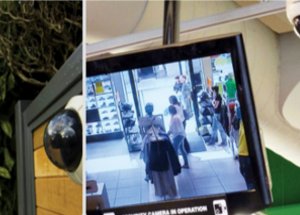

With CCTV cameras being installed in busy markets of even small cities, and demand increasing from the residential sector as well, this industry is set for tremendous growth
Swelling crime rates and terror attacks have made CCTV based surveillance imperative. The need for safety and security in almost every walk of life has fuelled the demand for CCTV cameras, which has ultimately translated into lucrative opportunities for vendors and suppliers.

By Uma Gupta
Thursday, October 10, 2012: The Indian CCTV camera market is growing at a very fast pace. Expanding at a CAGR of 30 per cent, it is expected to more than double to Rs 22 billion by 2015 from about Rs 10 billion at present, according to an ASSOCHAM study.
Where is the demand coming from?
As far as regions are concerned, the major demand is coming from northern India, which accounts for almost 35 per cent of the total sales. This is followed by southern India at 30 per cent and the west at 25 per cent. Eastern India accounts for the rest.
Most of the demand is coming from the government sector, which is likely to remain the biggest growth driver. Security is a major issue in the banking industry too.
“Since the government is determined to safeguard all public places such as markets, airports and railway stations, the demand from the government sector remains high compared to any other sector,” informs Soumin Ray, national sales manager, security products, Matrix Comsec. The major customers of CCTV cameras include government offices, banks, hotels, schools, jewellery shops, retail sector and corporate houses. However, in the coming years, demand from the residential sector is expected to surpass other segments.
While releasing a study on CCTV cameras, DS Rawat, secretary general, ASSOCHAM said, “Rising industrial activity amid security threats and the fear of potential terrorist attacks have fuelled the demand for CCTV cameras, and government authorities and the private sector are investing huge amounts in installing them.”
 Players in this sector are taking advantage of the increasing demand to expand their business. Many of the players have bagged meaty projects. A Reliance Industries Limited led consortium is set to bag an important project of installing CCTV cameras at all major traffic junctions in Mumbai. This project of the Maharashtra government, worth Rs 10 billion, will comprise the installation of around 6000 CCTV cameras across the city. It will also include setting up of data servers in places like the National Stock Exchange and the Bhabha Atomic Research Centre. This pioneering project gained acceptance after the terrorist attacks on 26/11 in the country’s financial capital.
Apart from the metros, CCTV cameras are being installed in busy markets of cities like Jaipur too. The master control room to monitor the footage is located at the police station.
Jaipur police has joined hands with various traders’ associations to install CCTV cameras in busy city markets to strengthen security. All shopping malls and busy markets are monitored by nearby police stations.
“Tier II and tier III cities, currently with only a small proportion of security system installations, are going to emerge as the real growth drivers of this technology based industry in the long run,” said DS Rawat.
Manufacturing scenario in India
Despite this huge demand, the Indian electronics security industry is largely based on imports, with a handful of indigenous manufacturers struggling to survive in a market that has giant global players on one side and the unorganised sector on the other. Imported CCTV cameras are usually cheaper than those made in India.
However, initiatives are being taken to encourage indigenous manufacturing, as there is increasing demand for customised electronic security solutions. Local manufacturers are playing a major role in catering to the requirements of Indian customers. Seeing the opportunities, many new companies are entering the fray. Matrix, an access control and time attendance solutions provider, is one such company that is soon going to launch digital video recorders (DVRs) and cameras.
Local manufacturing, however can get a boost only with government support. “Indian manufacturers should get preferential treatment in government purchases if they fulfill the requirements. The additional burden of excise duty mentioned in the Budget should be withdrawn, in order to make locally manufactured products more price competitive in the market,” says Soumin Ray.
The market is currently flooded with cheap, low end products from China. Therefore the government needs to work on the standardisation of electronic security equipment and come out with a policy to protect the Indian buyers’ interests and investments.
Recent technological developments
CCTV cameras and DVRs are evolving technologically in several aspects, ranging from storage capacities and image resolution to compression standards.
“IP or wireless cameras are the most recent development with high speed Internet connections available freely. The initial cost of the camera is high but as no cabling is involved, it saves a lot of installation time and costs,” informs Harshal Desai, partner, Navatek Systems.
Intelligent video analytics has altogether changed the perception for DVRs in the video surveillance industry. It is obvious that with an increase in the demand for these products, feature enhancement will happen. At the same time, competition in the market will make the product more cost competitive, ensuring value for money to customers.
Video analytics or intelligent video surveillance (IVS) technology turns CCTV cameras into predictive tools that allow users to spot suspicious activities and prevent incidents in a proactive way, rather than just filming the events for investigative use after an event.
This technology uses software to automatically identify specific objects, behaviour or attitudes in video footage. It is used for intrusion detection and the software is ‘intelligent’ enough to take on the role of human interventions normally required to detect intrusions.
This technology has the capability to analyse a video frame or a group of video frames to detect, classify, recognise or identify a predetermined event that has been programmed through the IVS software. It uses mathematical algorithms to detect moving objects in an image and filter non-relevant movements. It then creates a database that records the attributes of all the objects detected and their movement properties.
Video analytics technology works best for large infrastructures, such as a mass transit system, where over a thousand surveillance cameras may be deployed. These installations have to transmit, view and archive a huge amount of video, which is impossible for a human monitor to analyse in order to detect suspicious behaviour or events.
New features being included in these systems are smoke detection, behavioural analysis, as well as other features for military applications, forensic studies, 3D volumetric analysis, etc.
What’s selling the most
According to Hiren Bhandari, director (technical), Mantra Softech, the analogue camera market will not achieve a greater scale. Currently, IP cameras are relatively higher priced and hence sales are lower. “If the IP cameras’ costs can be reduced, they will overtake analogue camera sales,” he says.
According to Soumin Ray, “Each CCTV camera model has a unique feature that can be used for different purposes and provides different image quality. Widely selling models include box, dome, IR dome and bullet cameras. However, dome cameras are most popular as these are easy to install. Also, it is difficult for anyone to gauge in which direction the lens of the camera is pointing, which eliminates the possibility of any fraud. These cameras are available in several models as well.”
CCTV cameras for homes are usually small and compact in size compared to commercial CCTV cameras. Home systems are mainly standalone. On the other hand, commercial surveillance usually involves networked systems that can be viewed from several locations. Also, business applications require more accurate imaging. However, the major differences between home and commercial systems are in the associated features.
Generally, commercial or business houses use DVRs with a large storage capacity and central monitoring software to view several systems from one location, while cameras are normally used for long range coverage and night vision facilities. Also, commercial installations normally use high quality coaxial cable. In the home segment, pre-made CCTV cables (with BNC and RCA adaptors) that are cheaper and thinner are preferred.
Electronics Bazaar, South Asia’s No.1 Electronics B2B magazine