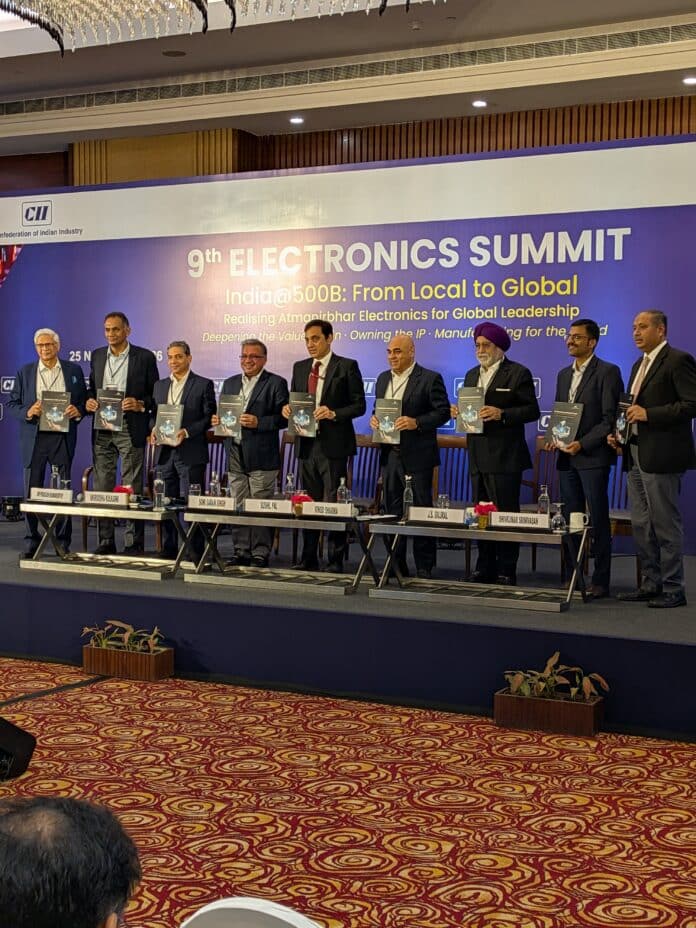

At its 9th Electronics Summit, Confederation of Indian Industry (CII) laid out ten product categories that must be prioritised in India for intellectual property (IP) generation, ranging from smartphones to smart metering systems.
To shift the focus from assembly to capacity building, CII listed 10 product categories in its report that must be prioritised in India to build domestic brands. These included smartphones, chargers and power supplies, laptops and notebooks, industrial control systems, air conditioners, micro and small motors, servers, audio and hearables, security cameras, and smart metering systems. Manufacturing capabilities, bBrand and market ownership remain split across the product categories.
The report further classifies the ten product categories into four strategic pathways, along which, specific constraints of each product must be addressed. Smartphones, chargers and power supplies must adopt a strategy of ‘Consolidate and Own’, according to which existing manufacturing scale must be leveraged to deepen domestic brands, design, IP, and power electronics components.
Laptops, servers, security cameras, and audio hearables must adopt a strategy of ‘Build the Product Engine’, under which product engineering, system design, and foundational component ecosystems shall be developed, according to the report. Smart metering and industrial control systems are advised to shape institutional demand through a ‘Standards and Procurement’ led strategy. Air conditioners, along with micro and small motors, should adopt a ‘Component-led’ strategy, where domestic sourcing of compressors, motors, magnets and other critical inputs must be prioritised.
The industrial association, Confederation of Indian Industry, organised the 9th edition of its Electronics Summit on Wednesday, where it released an internal report titled ‘Making India A Product Nation: From Making Electronics to Owning More of What is Made.’ The theme of the summit was centred on expanding India’s electronics and semiconductor industry to $500 billion by 2030.
Releasing the report, Vinod Sharma, Managing Director/CEO of Deki electronics and Chairman of CII Committee on Electronics, said in a presentation that domestic electronics production had expanded sevenfold between 2014-15 and 2025-26, while exports had surged eleven times. The sector generated about 2.5 million direct and indirect jobs. The presentation also questioned the level of intellectual property generation in the sector, as domestic value addition remained at just 18 to 20 per cent as of April 2026.
The report also says that five technology input clusters will be required for implementing these pathways,including firmware and security; compute and memory; display, optics and sensors; power electronics and magnetics; and motors, magnets and materials. Efforts must also be made to streamline the products through the consumer markets (household), institutional markets (departments, utilities and enterprises) and industrial markets (manufacturers and MSMEs).
Six core enablers are identified in the report for effective transition to a product nation. These include patient long-term capital; specialist and systems talent; design, testing and production boosted by AI adoption; dedicated R&D and product engineering; robust testing, qualification, and certification infrastructure; and predictable regulatory and duty regimes to ensure input-cost certainty.
For policymakers and industry leaders, the report advises to follow implementation in phases. In the near term (by the end of 2028), it advises establishing a clear baseline for Indian ownership, strengthening design capabilities, clarifying policies and providing demand visibility to domestic suppliers. Within the medium term (2029-2031), it advises advancing product-specific manufacturing and design. In the long term (beyond 2031), the report advises developing capabilities at a globally competitive scale and linking future policy incentives to domestic ownership and market competitiveness.