Rapid adoption driven by end-to-end AI models and falling hardware costs expected to dent new car sales in US and China.
The global robotaxi fleet is projected to expand from 10,000 units in 2025 to 181,000 by 2031, achieving an average annual growth rate of 78 per cent.
Sustaining strong momentum, the market is forecast to hit 2 million operational vehicles by 2035 at a compound annual growth rate of 57 per cent. By the middle of the next decade, autonomous fleets are expected to begin curbing new light-vehicle sales, displacing purchases by 4 per cent in China and 1 per cent in the United States.
Five core factors are boosting this market expansion:
- Bill-of-Materials Reduction: Lower manufacturing and hardware costs achieved through economies of scale and reduced system redundancy.
- Operational Efficiency: Higher operational excellence that increases total revenue while driving down daily running costs.
- Data-Driven Algorithms: The deployment of end-to-end architectures—including Vision-Language-Action models and World Models—providing a clear technical path forward.
- Hybrid Operations: Blending driverless robotaxis with traditional human-driven taxis to improve customer experience and reach profitability.
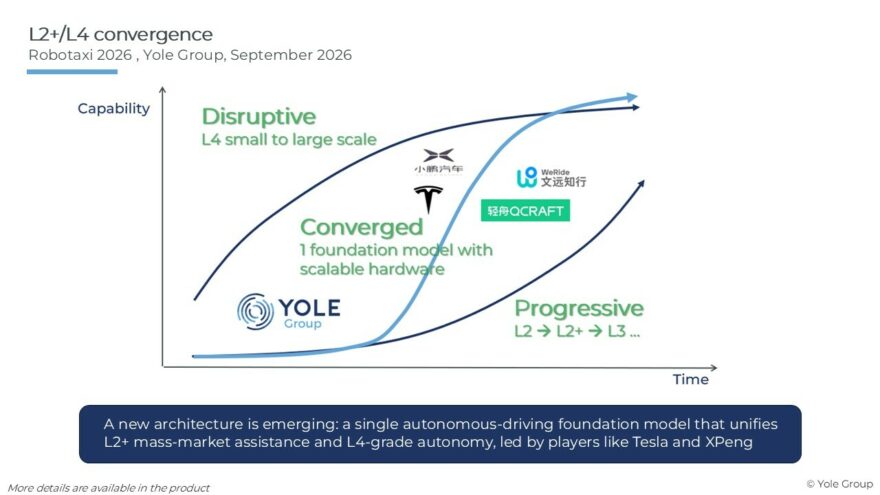
- L2+/L4 Convergence: Leveraging real-life driving data from widespread L2+ vehicle fleets to refine L4 robotaxi foundation models.
Multi-sensor fusion combining LiDAR, cameras, and radar remains the dominant perception approach across production-bound vehicles. This multi-modal suite delivers the high-density 3D spatial mapping and object-classification redundancy required for safe Level 4 driverless operations.
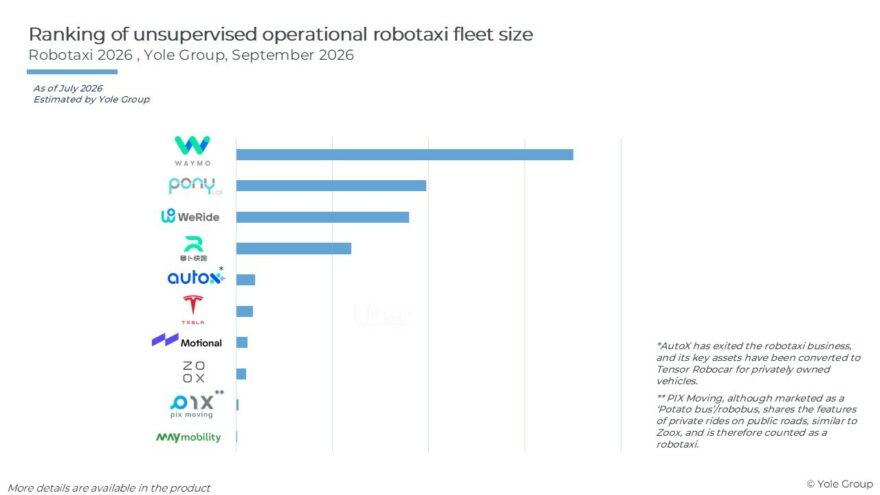
Established operators such as Waymo, Pony.AI, WeRide, and Apollo Go currently lead the sector, alongside emerging automotive entrants including Tesla, XPeng, and Geely.
Economic modelling indicates that US-based robotaxi operations reach profitability once vehicle utilisation exceeds roughly 40 per cent due to substantial savings on labor costs.
Key systems suppliers largely mirror the existing advanced driver-assistance systems (ADAS) ecosystem, with total addressable semiconductor markets for autonomous sensors and processors forecast to reach $4 billion (£3 billion) each by 2035.