
India’s EMS Market Set To Cross ₹12.68 Trillion By FY30

India’s electronics manufacturing services (EMS) sector is entering a new phase as rising exports, government incentives and the China+1 strategy drive manufacturing investments.

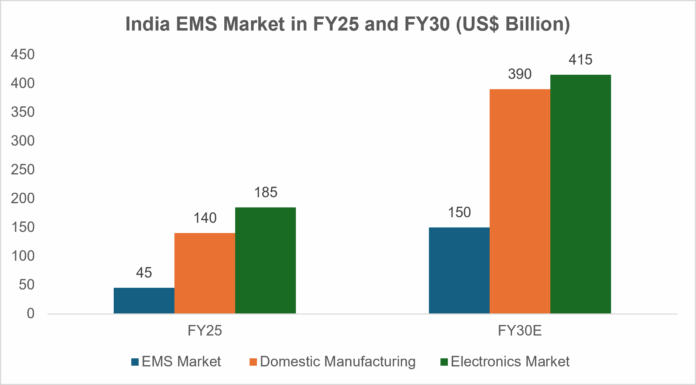
India’s electronics manufacturing services (EMS) market is expected to grow sharply as global electronics companies diversify their supply chains and manufacturers expand capacity in the country. According to KPMG, the Indian EMS market reached approximately ₹3,380–3,810 billion in FY25 and is projected to cross ₹12,680 billion by FY30.

India has emerged as the world’s second-largest mobile phone manufacturer by volume and an increasingly important production base for global technology companies. Smartphone exports are also rising, with Apple and other global electronics companies and their suppliers increasingly using Indian plants as export hubs.

The EMS sector recorded a revenue CAGR of around 24 per cent between FY19 and FY24 and is estimated to grow at around 27 per cent between FY24 and FY29, supported by supply-chain diversification and the China+1 strategy.

Government programmes including the Production-Linked Incentive (PLI) scheme, SPECS, EMC 2.0, India Semiconductor Mission (ISM) and Electronics Components Manufacturing Scheme (ECMS) have helped attract investments and expand India’s electronics ecosystem.

- Advertisement -

The broader electronics manufacturing sector has also expanded significantly, with production rising from around ₹1,900 billion in FY15 to ₹11,300 billion in FY25. Electronics have consequently moved from the seventh-largest export segment in FY22 to one of India’s leading export categories.

Components remain a challenge

Despite this growth, India accounts for only around 5–6 per cent of global EMS manufacturing output. The country has developed strong capabilities in smartphone assembly and PCBA manufacturing, but remains dependent on imported components, particularly from China and Hong Kong.

The next phase of growth is therefore expected to focus on increasing domestic value addition through component manufacturing, semiconductor fabrication, packaging and design.

India is targeting a ₹42,280 billion electronics ecosystem by 2030, including ₹33,820 billion in manufactured electronics and ₹8,460 billion in components.

Achieving this target will require India to move beyond assembly-led manufacturing and diversify into semiconductor design and packaging, IT hardware, telecommunications, automotive and medical electronics. As global supply chains continue to diversify, strengthening domestic components and higher-value manufacturing will be key to India capturing a larger share of the global electronics value chain.


- Advertisement -
Loading form…
Nikita Kumari
Nikita Kumari
Nikita Kumari is a Journalist at EFY. She decodes deals, investments, and policy shifts, redefining the semiconductor and tech landscape.

Industry's Buzz

LAPP Expands Its Bhopal Facility

0
The investment comes as India continues to increase spending on infrastructure, manufacturing and energy projects. LAPP has inaugurated the expanded manufacturing facility of LAPP Cable...
Littelfuse, C&K Switches, Arcimoto, Concentrix, Hepsiburada

Jubilant Ingrevia to Acquire 40% Stake in Zettaone Technologies for ₹189.2 Crore

0
The acquisition is part of Jubilant Ingrevia's broader strategy to establish a presence in the Electronics Development and Manufacturing Services (EDMS) segment Jubilant Ingrevia Ltd...

ELCINA Pushes for Up to 3-Year Gestation Period Under ECMS

0
Equipment delays prompt ELCINA to seek extended gestation periods under ECMS.  The Electronics Industries Association of India (ELCINA) has urged the government to extend the...

e-con Systems Achieves IATF 16949 Certification for Automotive Camera Portfolio

0
The certification also extends quality requirements across e-con Systems’ supplier base, strengthening supply-chain quality management. e-con Systems has recently received the IATF 16949:2016 certification to...

Singular Photonics Secures $2.15m to Scale SPAD Sensors

0
Former Arm CTO joins board as Scottish semiconductor pioneer doubles sales momentum  Fabless semiconductor developer Singular Photonics has closed an oversubscribed funding round of $2.15...

Learn From Leaders

L Venkata Subramaniam, CEO, Qbit Force, Andhra Pradesh

“We Aim To Make Quantum Computing More Visible, Understandable, And Open To Build On”...

0
From building India’s first open quantum hardware ecosystem to assembling a working quantum computer in just four months, Qbit Force is redefining how deep...
(L-R) Nikesh Gondchawar, Strategic & Technical Advisor – Robotics Manufacturing; Shrikrushna Kakade, Founder Partner; Nikhil Kakade, Senior Technical Advisor – Robotics & Control Systems, SlightGen Solutions LLP

“A Made-In-India Robotic PCB Soldering System That Automates The Through-Hole Soldering Process!” – Shrikrushna...

0
Electronics manufacturing is complex, and automation often comes at a high cost. To bridge this gap and offer a more affordable solution in India,...
Navdeep Narula, Executive Director, Client and Endpoint Solutions, Ingram Micro, India

“Enterprise Computing Is Shifting From CPU to GPU And Now Toward NPU-Based Systems ”...

0
The shift from CPU to GPU to NPU-based computing is redefining today’s enterprise endpoints. In an exclusive conversation, Navdeep Narula from Ingram Micro discusses...

India’s Robotics Push Opens New Hardware Opportunities

0
How do you build India’s physical AI future when critical robot components still come from overseas? Niqo Robotics reveals where the gaps remain.  India’s push...
Gadhadar Reddy, CEO and Founder, NoPo Nanotechnologies

How A Material Thinner Than Human Hair Could Transform EV Batteries And Electronics –...

0
What if a material 200,000 times thinner than a human hair could transform EV batteries, semiconductors, and advanced electronics? NoPo Nanotechnologies is making that...

Startups

L Venkata Subramaniam, CEO, Qbit Force, Andhra Pradesh

“We Aim To Make Quantum Computing More Visible, Understandable, And Open To Build On”...

0
From building India’s first open quantum hardware ecosystem to assembling a working quantum computer in just four months, Qbit Force is redefining how deep...

Pune-Based Slightgen Solutions Powering India’s PCB Automation With Indigenous Robotics

0
Can manufacturers access cost-effective, customisable robotic soldering systems for PCB assembly automation? This Pune-based startup aims to address that challenge. SlightGen Solutions LLP is a...
(L to R) C2i Semiconductors Founders—Vikram Gakhar, Founder & Director, Mixed Signal; Preetam Tadeparthy, Founder, CTO, VP, Engineering; Ram Anant, Founder & CEO; B.S. Dattatreya, Founder & Director, Power

Bengaluru Startup Targets AI Data Centre Power Delivery

0
C2i is building power systems that can help AI servers use electricity more efficiently and reliably. Two friends, Ram Anant and Preetam Tadeparthy, were working...
(L-R) Sri Kusulu Devalla, Co-Founder and Hetendra Singh Rathore, Founder, Segritech

“We don’t just sort fruit; we match every quality grade with the right buyer.”...

0
An agritech startup has developed an AI-powered machine that sorts and grades fruits directly on farms, helping reduce post-harvest losses by connecting produce with...
Akshar Vastarpara, Founder and CEO, Vicharak

“Our SBCs Are Designed As Complete Edge-Computing Platforms That Combine Everything On A Single...

0
An Indian startup builds affordable edge AI boards for robots, drones, and industry, positioning them as Raspberry Pi alternatives. In an EFY interview with...