
“National Electronics Mission, if implemented, will be one of the strongest steps taken to encourage development of electronics industry in India”

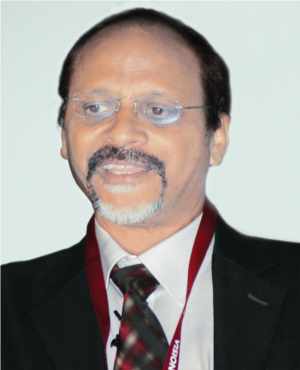
The Indian Electronics and Semiconductor Association (IESA), a premier trade body that has represented the Indian electronic system design and manufacturing (ESDM) industry since 2005, works closely with the government as a knowledge partner on the sector. Dr Satya Gupta, the outgoing chairman, IESA, spoke to Dilin Anand and Ashwin Gopinath of EFY about the challenges being faced by the ESDM industry and the measures being taken to improve the situation.

EB: A recent IESA report on the ESDM industry shows that 65 per cent of India’s electronics products are being imported. Please throw some light on the subject.

When we decided to do the report on the ESDM industry, the whole idea was to look beyond the semiconductors and focus on the overall electronics market, because that’s where the end products get created. We found that in spite of the global economic slowdown, the Indian ESDM industry is witnessing a healthy 9-10 per cent annual growth rate that is expected to help achieve a market value of US$95 billion by 2015. Domestic firms contribute a mere 35 per cent of the electronics products, and even in those products, the actual domestic value addition is very low. If you look at the overall value addition, products with high domestic value addition (of more than 50 per cent) constitute only about 7 per cent of the total market.

EB: How can we accelerate the process of improving the situation for domestic manufacturers?

I personally believe there are three ingredients that make a successful domestic product. First is the innovative product idea, the next is the infrastructure so that ideas can be taken from prototyping to high volume manufacturing, and finally, the presence of a fiscal environment that enables the domestic manufacturing of the product at a price that is competitive with its imported counterparts.

- Advertisement -

On the infrastructure side, the Indian government, with its National Policy on Electronics, is aiming to address issues like the lack of manufacturing facilities, testing and qualification facilities and has an option of giving incentives for setting up manufacturing units that are common to all products, etc. On the commercial side, we see a handicap of about 20-22 per cent, compared to the products imported from countries like China, which makes production in India difficult. On this front, IESA is conducting a study with 5-6 critical product segments and dissecting the overall costs that go into manufacturing these products in India vs the same in other countries.

Finally, we need to create an ecosystem of innovation where ideas at the grassroot level are encouraged, nurtured and promoted. IESA is working on creating ESDM innovation centres in the country, where raw ideas can be converted into prototypes and products, resulting in successful start-up companies.

EB: Any suggestions that you would like to give to help face the challenges of setting up a fab?

Many established fabs as well as the majority of customers are abroad, so unless you have a unique selling proposition, you won’t be able to break into the market. I appreciate the stance taken by the Indian government in this regard. If somebody is ready to bring in investments, technology, operational expertise, customer acquisition and ‘go-to-market’ strategies, the government will provide incentives, both fiscal and others, to build this capability in the country. It is also imperative that a local fabless ecosystem is developed so that the fab resources in the country are optimally utilised.

These challenges are not new and every fab in the world has faced similar challenges in its early days. I believe that an inspired entrepreneur with the support provided by the government can overcome these challenges to create a semiconductor manufacturing ecosystem in India.

Electronics Bazaar, South Asia’s No.1 Electronics B2B magazine

- Advertisement -
Loading form…

Industry's Buzz

BrahMos

Omnitech Gets BrahMos Order For Missile Airframe Assembly

0
Omnitech Engineering will assemble metallic airframe components and canister subsystems for BrahMos Aerospace under a development order, as the government looks to widen private-sector...
C-DAC

C-DAC to Develop Indigenous Silicon GPU by Mid-2028

0
The GPU by C-DAC is  currently at a functional stage running on a field-programmable gate array (FPGA) hardware. It is yet to undergo design...
Image for representation purpose

Green Aero Secures USD 14 Million To Build Jet Engine Capacity And Advance Defence...

0
Green Aero has raised $14 million in Series A funding to enlarge its jet engine facilities, pursue overseas buyers and continue developing military drones...

Ambarella Partners With Sigma Connectivity To Enhance its Edge AI Product Development

0
Under the partnership, Ambarella will offer its edge AI semiconductor technology and software development platforms Ambarella has recently partnered with Sigma Connectivity to enhance the...
Semiconductor Chip (Representation Image)

India-Italy Must Strengthen Collaboration on Semiconductors: Ambassador Bartoli

0
Italy has proposed to set up an Italian Innovation centre in India which will strengthen the collaboration between the two countries in strategic areas...

Learn From Leaders

Manav Marwah, Founder, AutoCuro, India

“The AI Assistant understands the topology of the board like a human engineer would.”-...

0
As AI enters PCB design workflows, component placement and routing are becoming key areas of automation. In this interview with EFY’s Nidhi Agarwal and...
Kalyana Putrevu, Chief Operating Officer, GOCL Corporation Limited

“Quality Has To Be Part Of The DNA”: GOCL On The Future Of Electronics...

0
What happens when quality becomes everyone’s responsibility on an electronics manufacturing floor? In an interaction with Electronics For You, the COO of GOCL discusses...
Rohin Y, CEO and Co-Founder, LightSpeed Photonics, India

“We reduce latency by shortening the distance signals travel through copper and extending that...

0
As AI data centres scale, how can optical connectivity overcome the limits of electronic interconnects? In an interview, Rohin Y of LightSpeed Photonics speaks...
SK Venkataraghavan, Director, Solutions and Services Group, Lenovo India

“Everybody wants to jump into AI, but many organisations are still not ready from...

0
In an exclusive interaction with EFY's Saba Aafreen, Lenovo's S. K. Venkataraghavan discusses the challenges of moving enterprise AI from pilots to production, with...
Santhosh Kumar, Managing Director at Texas Instruments India

“India Is Becoming A Place To Design Products For The World”- Santhosh Kumar, TI...

0
As Texas Instruments marks 40 years in India, Santhosh Kumar, managing director and president, TI India, speaks about the company’s evolution towards end-to-end product...

Startups

Manav Marwah, Founder, AutoCuro, India

“The AI Assistant understands the topology of the board like a human engineer would.”-...

0
As AI enters PCB design workflows, component placement and routing are becoming key areas of automation. In this interview with EFY’s Nidhi Agarwal and...
Jaisimha Rao, Founder and CEO, Niqo Robotics

“Our Robots Are Tractor-Mounted, With the Tractor Providing Propulsion, So the System Does Not...

0
A robot may work perfectly in a lab, but taking it to a real farm is a different test altogether. In an exclusive interaction...

RHIA’s PLC Slayer Eliminates Fragmented Architectures In Industrial Automation

0
The startup’s innovation integrates separate controllers, sensors, and motor drivers into a single, flexible industrial automation platform. Does building industrial-grade automation always have to be...

EVE NET Turns Spare Smartphone Capacity Into An AI Cloud

0
What if the phone in your pocket could help run AI? A Mumbai-based startup wants to cut AI computing costs by tapping into millions...

Vimag Labs’ Magnet-Free Motors Set To Redefine EV Efficiency

0
Can software replace rare-earth materials? This Bengaluru startup uses virtual magnets to eliminate traditional permanent magnets, boosting EV motor efficiency up to 95 per...