Solar installations in India increased 34 percent to 3.3 GW in Q1 2018

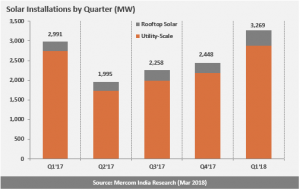
Indian solar market had its best quarter ever with 3,269 MW of solar installed in Q1 2018 according to Mercom India Research’s newly released Q1 2018 India Solar Market Update report.

Image for representational purpose only

The record quarter was partly a result of project commissioning’s that were originally slated for Q4 2017 but could not be completed due to grid connection issues. The report found that installations rose by 34 percent compared to 2,991 MW installed in Q1 of 2017.

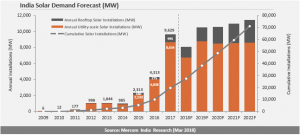
Mercom India Research is forecasting solar installations of approximately 8-9 GW in CY 2018 which is lower than 9.6 GW installed in 2017. The lower forecast is the result of a smaller pipeline of projects caused by uncertainty surrounding the safeguard duty and a slowdown in procurement by DISCOMs as higher module prices drove up auction bids.

According to Mercom India Research, Raj Prabhu, CEO and Co-Founder of Mercom Capital Group commented that even though Q1 was a record quarter, solar procurement activity has been muted over the last few quarters. But with an anticipated decline in module prices, we expect to see tariffs decline and distribution companies ramp up procurement activity.
- Advertisement -

According to the report, large-scale projects accounted for 88 percent of the installations with 2,879 MW compared to 2,188 MW in Q4 2017 and 2,746 MW installed in Q1 2017. Rooftop installations accounted for 12 percent of the installations with 390 MW, which was up compared to 260 MW installed the previous quarter and 245 MW installed in the first quarter of 2017.

The large-scale solar project pipeline for India stands at 9.7 GW with 10.2 GW tendered and pending auction as of the end of Q1 2018.

The uncertainty around the trade case has put a freeze on development activity and needs to be resolved immediately. The industry needs clarity on the safeguard duty to understand how it will be imposed and at what levels. Even with the announcement of the pass-through provision, concerns remain, and the industry wants a step-by-step implementation plan on paper with proper approvals.

The withdrawal of the anti-dumping petition was welcomed by many developers and EPCs, but the Indian Solar Manufacturers Association (ISMA) said that it intends to refile the case with new data. There is speculation that the case may be withdrawn if a satisfactory level of safeguard duty is imposed.

Issues relating to the Goods and Services Tax (GST) are cropping up again in some states, while custom duty issues at ports are now mostly resolved. As the adoption of solar continues to rise, multiple states have started to implement deviation charges on wind and solar projects for over and under generation of power.
The Q1 India Solar Market Update found that rooftop solar has been growing at a healthy pace but is very dependent on government tenders and projects. Open access projects were really sought after, but slowly states are making them less attractive by levying wheeling and banking charges. Residential solar is still untapped as financing and upfront costs continue to be big challenges. Government subsidies are not getting paid on time, affecting small installers.

On the bright side, solar module average selling prices (ASPs) began to decline in Q1 2018 after two consecutive quarters of increasing prices. The safeguard duty threat and rising module prices were the biggest challenges in the second half of 2017 and with module prices trending down we can expect procurement activity to pick up.

In other developments that are expected to positively affect the Indian solar industry, the Chinese government made a new policy announcement imposing installation caps and reducing feed-in-tariffs (FiTs) to essentially slowdown solar installations in China amid ballooning solar subsidy deficits. China was the biggest solar market in the world in 2017 with annual solar installations of 53 GW, a majority of them coming from distributed generation (DG) projects. The government now wants to impose a 10 GW cap on DG projects essentially putting the brakes on installations, which may result in a 20 GW decline year-over-year. This could mean a massive oversupply situation, which means an impending crash in solar module prices worldwide, including India.

This creates an optimistic scenario for Indian solar developers who could begin to bid lower, which in turn could open the auction floodgates as states jump in to lock in low tariffs.

Prabhu added that it now comes down to how the safeguard duty will be handled. Will the government apply a low tariff which could be easily absorbed by the industry as Chinese module prices decline or will trade cases drag on continuing to create uncertainty in the near future? There is a clear opening for the government right now to use this opportunity to lay the path for growth. Overall, things are looking much brighter for the Indian solar industry going into the second half of 2018.

(Source: Mercom India Research)

- Advertisement -
Loading form…

Industry's Buzz

NVIDIA

AM Intelligence to Deploy 9,000 Nvidia Rubin GPUs in Hyderabad 

0
AM Intelligence has ordered 9,000 Nvidia Rubin GPUs for a 30MW Hyderabad AI facility, forming the first phase of its planned 1GW compute-as-a-service network.  Data...

Aheesa Partners With Zigma to Take Indigenous VIHAAN-I Networking Chip to Market

0
VIHAAN-I is designed to support locally manufactured broadband devices and reduce dependence on imported networking silicon Chennai-based fabless semiconductor company Aheesa Digital Innovations (Aheesa) has...
Garuda

Bengaluru Based Airbound Raises $37 Million in Series A Funding to Expand Its Drone...

0
The company targets commercial scale across India, aiming to make aerial logistics cheaper than road transport while laying the foundation for modern aviation.  Indian aerospace...
Solar Panels (Representational Image)

Avaada Electro Files UDRHP for ₹7,600 Crore IPO 

0
The proposed IPO includes a ₹1,600 crore fresh issue, with around ₹1,200 crore earmarked for debt repayment and letter-of-credit obligations.  Avaada Electro has moved closer...

Homegrown IndieSemiC Launches Wi-Fi Module for IP Cameras and CCTV

0
Indian fabless startup offers local manufacturers a seamless, USB-based plug-and-play solution for wireless surveillance integration.  Fabless chip design startup IndieSemiC has launched the “ISC-8188-B”, a...

Learn From Leaders

(L-R) Nikesh Gondchawar, Strategic & Technical Advisor – Robotics Manufacturing; Shrikrushna Kakade, Founder Partner; Nikhil Kakade, Senior Technical Advisor – Robotics & Control Systems, SlightGen Solutions LLP

“A Made-In-India Robotic PCB Soldering System That Automates The Through-Hole Soldering Process!” – Shrikrushna...

0
Electronics manufacturing is complex, and automation often comes at a high cost. To bridge this gap and offer a more affordable solution in India,...
Navdeep Narula, Executive Director, Client and Endpoint Solutions, Ingram Micro, India

“Enterprise Computing Is Shifting From CPU to GPU And Now Toward NPU-Based Systems ”...

0
The shift from CPU to GPU to NPU-based computing is redefining today’s enterprise endpoints. In an exclusive conversation, Navdeep Narula from Ingram Micro discusses...

India’s Robotics Push Opens New Hardware Opportunities

0
How do you build India’s physical AI future when critical robot components still come from overseas? Niqo Robotics reveals where the gaps remain.  India’s push...
Gadhadar Reddy, CEO and Founder, NoPo Nanotechnologies

How A Material Thinner Than Human Hair Could Transform EV Batteries And Electronics –...

0
What if a material 200,000 times thinner than a human hair could transform EV batteries, semiconductors, and advanced electronics? NoPo Nanotechnologies is making that...
Raja Rajeev Kumar, Mentor at IIT Startups, Chairman of the Board of Trustees, LaxmiRamaVarma Holdings International, and Founder and CEO, ChromoSoul Ventures

“Build Strong Startups, and Funding Will Follow”- Raja Rajeev Kumar, IIT Startups, LaxmiRamaVarma Holdings...

0
While AI and software startups attract attention and capital, electronics ventures often struggle for both. Raja Rajeev Kumar from IIT Startups, LaxmiRamaVarma Holdings International...

Startups

(L to R) C2i Semiconductors Founders—Vikram Gakhar, Founder & Director, Mixed Signal; Preetam Tadeparthy, Founder, CTO, VP, Engineering; Ram Anant, Founder & CEO; B.S. Dattatreya, Founder & Director, Power

Bengaluru Startup Targets AI Data Centre Power Delivery

0
C2i is building power systems that can help AI servers use electricity more efficiently and reliably. Two friends, Ram Anant and Preetam Tadeparthy, were working...
Akshar Vastarpara, Founder and CEO, Vicharak

“Our SBCs Are Designed As Complete Edge-Computing Platforms That Combine Everything On A Single...

0
An Indian startup builds affordable edge AI boards for robots, drones, and industry, positioning them as Raspberry Pi alternatives. In an EFY interview with...
(L-R) Sri Kusulu Devalla, Co-Founder and Hetendra Singh Rathore, Founder, Segritech

“We don’t just sort fruit; we match every quality grade with the right buyer.”...

0
An agritech startup has developed an AI-powered machine that sorts and grades fruits directly on farms, helping reduce post-harvest losses by connecting produce with...
Dr Naveen Yanduru, CEO, Axiro Semiconductor Private Limited

“India Can Lead In IP—If It BacksIts Own Builders”

0
Axiro Semiconductor designs RF and satellite chips, ships millions worldwide, and retains its startup mindset while tackling complex technical challenges. In a conversation with...
Dr Sanjay Ahuja, Founder and CEO of Cionlabs, India

“We are solving India-specific challenges rather than offering generic ‘black box’ IoT solutions.”

0
From hybrid mesh networking to AI-enabled edge devices, an Indian IoT startup is developing home-grown solutions to improve connectivity, strengthen privacy and support the...