
Xiaomi Debuts First Electric Vehicle Boasting A Range Of 1,120 Kilometres

Electronics behemoth unveils a sophisticated rival to the Porsche Taycan, aiming for international markets; Xiaomi’s CEO Lei Jun declares the firm’s ambition to rank among the top five global car manufacturers in the next 15 to 20 years.

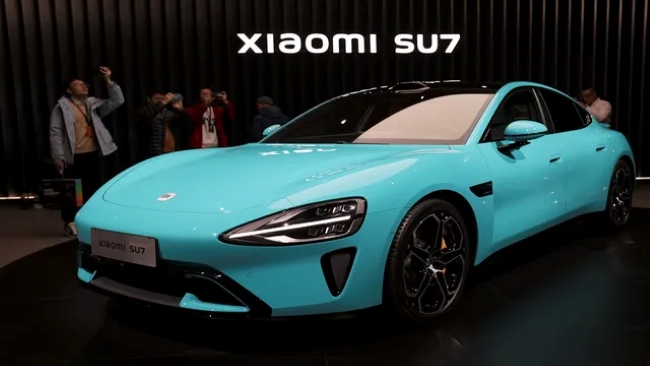
Xiaomi has introduced its first production vehicle, the SU7, positioned as a contender against the Porsche Taycan. This electric saloon is set to be globally available following its initial release in China next year.

The launch of the SU7 comes 1,003 days after Xiaomi, a prominent Chinese electronics company, first announced its venture into the electric vehicle market in 2021. The company pledged an initial investment of RMB10 billion (£1.1 billion), with an additional RMB70 billion (£7.8bn) earmarked for the next decade. The SU7 is just one of several models Xiaomi plans to release.

During the Shanghai unveiling, Xiaomi CEO Lei Jun expressed the company’s goal to rank among the top five car manufacturers globally within 15 to 20 years. Lei Jun expressed that Xiaomi aims to challenge both Porsche and Tesla, creating an innovative dream car for the new automotive era.

Xiaomi has disclosed plans for future models, including an SUV, as part of their expansion strategy. The foundational technology for Xiaomi’s first car is a new electric platform named Modena, designed to accommodate both 400-volt and 800-volt architectures and various motor configurations.

- Advertisement -

Sawyer Li, Xiaomi’s head of design, led the in-house styling of the SU7. Li, a renowned Chinese designer with experience at BMW, played a pivotal role in designing the BMW iX and Circular Vision Concept. The SU7 boasts an impressive aerodynamic profile with a drag coefficient of just 0.195, setting it apart as one of the most aerodynamically efficient production cars to date. Dimensionally, the SU7 is slightly larger than the Porsche Taycan, with a longer wheelbase offering more interior space.

The SU7 also excels in aerodynamics, rivalling the efficiency of other industry leaders like Geely’s new Galaxy E5 and GAC’s Hyper GT. Xiaomi has emphasized the structural integrity of the SU7, particularly its rear body structure, which is produced using advanced manufacturing techniques.

The SU7 is powered by Xiaomi’s proprietary electric motors, named after traditional combustion engine configurations. The base model features the V6 motor, designed for the 400-volt architecture, while the mid-range V6s, compatible with 800-volt systems, offer increased power. The dual-motor version combines these for a significant power output and rapid acceleration, supported by an ultra-fast charging system.

A more powerful V8s or ‘HyperEngine’ is slated for release in 2025, promising exceptional efficiency and power density, operating on the 800-volt system.

Lei revealed that Xiaomi’s prototype motors have reached speeds up to 35,000rpm in testing, hinting at even more potent versions of the SU7 in the future. Initial models will be equipped with a high-capacity CATL-supplied lithium-ion battery, ensuring a range of over 497 miles/800km. A more substantial 132kWh battery option is also in development.

The SU7’s charging capabilities are remarkable, with Lei noting significant range gains from brief charging periods.

Xiaomi, founded in 2010 by Lei Jun, has rapidly grown from a smartphone manufacturer to a major player in various technology sectors. After becoming China’s leading smartphone seller in 2014, Xiaomi expanded its portfolio to include electric home appliances. As of 2023, Xiaomi held a significant share of the global smartphone market.


- Advertisement -
Loading form…
Aryaman Raghuvanshi
Aryaman Raghuvanshi
Aryaman Raghuvanshi is a Journalist at EFY. His passion is to explore the future of mobility, which gets him to cover latest technologies shaping the future of automobiles and EVs. But, at times he writes on broader technologies too. LinkedIn: https://www.linkedin.com/in/aryaman-raghuvanshi-2431b7153

Industry's Buzz

thyssenkrupp

thyssenkrupp Expands Automotive Electronics R&D In Pune

0
thyssenkrupp Automotive Technology is expanding automotive electronics and software R&D in Pune, planning to grow its engineering team beyond 300 to support global programmes...

Nuuk and EPACK Durable Partner to Manufacture Small Appliances in India

0
Direct-to-consumer brands team up with contract manufacturers to boost domestic production of air fryers and circulator fans.  Direct-to-consumer (D2C) home appliance brand Nuuk has joined...

Potential US Curbs Bears Down on Chinese Optical Chip Stocks

0
Shares of upstream laser chip suppliers suffered steeper declines compared to downstream optical transceiver manufacturers. A report by Morgan Stanley, earlier this month, warned...
Prime Minister Modi

Modi Flags 6G And Domestic Electronics Production At IMC 2026

0
Prime Minister Narendra Modi has outlined India's next telecom priorities at India Mobile Congress 2026, linking the 5G-to-6G roadmap with semiconductor production, domestic electronics...
Fujitsu

Fujitsu-Owned 1Finity Deploys 200+ Engineers To Expand India’s Optical Networking Business

0
Japan’s Fujitsu-owned 1Finity is expanding its India networking business with more than 200 engineers as AI and data-centre growth drives demand for optical networking...

Learn From Leaders

Does India’s Chip Packaging Growth Need Local Materials At Scale?

0
What will it take for specialised semiconductor materials manufacturing to grow in India? Packaging volumes will be a key factor as OSAT facilities move...
Ronak Kumar Samantray, Founder, TM2Space Technologies Pvt Ltd.

“Our goal is to build data centres in space.” – Ronak Kumar Samantray, TM2Space

0
A space startup aims to build orbital data centres, letting users run AI models and store data on satellites while also supplying satellite hardware...

India’s Photonics Puzzle Is Finally Coming Together 

0
Can India turn its scattered photonics capabilities into a stronger industry? A new association aims to connect the ecosystem and strengthen the domestic value...
Jin Bains, CEO, Mini-Circuits

Mini-Circuits CEO Jin Bains on Navigating High-Frequency Component SWaP-C Constraints, Emerging Markets, and Career...

0
In this exclusive, Jin Bains, Chief Executive Officer (CEO) of Mini-Circuits, explains in a conversation with Dilin Anand of EFY about areas of emerging...

India Needs Not a Hundred, But Thousands of Chip Diversified Companies 

0
Can India build a semiconductor ecosystem beyond fabs? Indiesemic believes thousands of diversified chip companies are needed to make that possible. India’s semiconductor push is...

Startups

PowerMon

Aquaexchange Brings Monitoring And Automation To Shrimp Farming

0
The startup has developed an AI- and IoT-enabled platform that helps shrimp farmers manage farms, access financing, monitor operations, and connect with markets. The startup...

Drone-Like Aircraft For Logistics From BluJ Aerospace

0
Hyderabad-based BluJ Aerospace is developing indigenous electric and hydrogen-powered vertical take-off and landing (VTOL) aircraft for remote cargo transport. BluJ Aerospace, a Hyderabad-based aerospace startup...
Jash Jetly, Co-founder and CEO of EVE

“The cloud isn’t the only way to run AI. We’re proving it can happen...

0
A startup is building a decentralised AI and communication network that runs across everyday devices instead of centralised cloud servers. In an interview, Jash...
Mohit Gupta, founder and CEO, TYLsemi

Building AI Chips, One Block at a Time 

0
What if building an AI chip became as simple as assembling reusable blocks? The startup is working to make custom silicon accessible beyond the...
Seema Johar, Co-Founder and Product Director, Compcarta Solutions Pvt Ltd

“We Let Designers Focus on Innovation, Not Infrastructure.”- Seema Johar, Compcarta Solutions

0
In an exclusive interview, Seema Johar of Compcarta speaks with EFY’s Akanksha Sondhi Gaur about why setting up an EDA environment can be harder...