


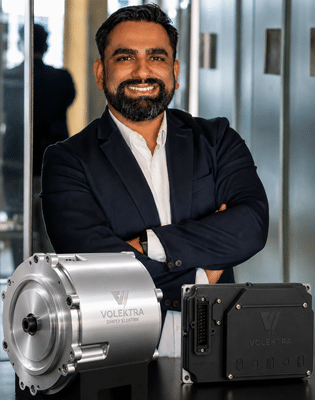

Can software replace rare earth magnets in electric motors? Manish Seth of Vimag Labs speaks to EFY’s Nitisha Dubey about Virtual Magnet Technology, which uses wireless power transfer to generate software-controlled magnetic fields inside motors without rare earth magnets.
Q. Could you briefly introduce Vimag Labs?
A. At Vimag Labs, we develop motors and control systems that do not use rare-earth magnets. Our technology is intended for electric vehicles, including two-wheelers, three-wheelers, passenger cars, buses and trucks, as well as drones, actuators, robotics and industrial equipment. We develop the core technology and commercialise it under different brands for different sectors, including Volektra for automotive applications.
Q. What differentiates your technology from conventional permanent-magnet synchronous motors (PMSMs)?
A. Our core technology, called Virtual Magnet Technology, is patented. It uses wireless power transfer to generate magnetic flux inside an electric motor. This allows us to develop motors that, according to our testing, can match or exceed the performance of conventional permanent-magnet motors without relying on rare-earth magnets.
Q. Could you explain the working principle of your Virtual Magnet synchronous motor in simple terms?
A. We use software and electronics to control the generation of a magnetic field inside the motor, replacing the need for permanent rare earth magnets. We develop both the software and electronics in-house and consider them part of our intellectual property. Once the field is established, the motor operates on principles similar to those of a permanent-magnet motor.
Q. How extensive is your patent portfolio around Virtual Magnet Technology?
A. We currently have five granted patents. One covers the core technology, while the others address specific applications. We also have at least eight patent applications in the pipeline, covering other aspects and newer generations of the technology. Our patent portfolio covers India, Europe, North America, and other markets.
Q. What kind of efficiency can your motor and control system achieve?
A. Our overall system cycle efficiency can reach around 92–93%, including both the motor and the control system. Motor efficiency varies with size and application, ranging from 93–94% for a 6kW–7kW motor to 95–96% for a 150kW motor. Actual performance depends on voltage, operating cycle, and application requirements.
Q. When do you expect the technology to become commercially available?
A. Our technology is progressing through automotive development cycles. We have sold initial samples and small quantities of parts, but commercial-scale production has not yet begun. We expect to deploy certain control systems in the coming months and plan to begin production of our first complete Virtual Magnet systems before the end of this year.

Q. Which customer segments are you initially targeting?
A. We are initially targeting electric vehicle manufacturers, particularly those producing two-wheelers and three-wheelers. We are also developing applications for passenger cars, electric buses, and trucks.
Q. Since the technology is still at an early commercialisation stage, what are your current revenue sources?
A. We generate revenue from initial sample sales and small quantities of parts, as well as customer-funded development programmes. Under these non-recurring engineering (NRE) engagements, customers pay us to develop systems for their specific requirements.
Q. How are you approaching manufacturing and what operations are being handled in-house?
A. We do not handle every manufacturing operation in-house. We focus on activities that depend on our core intellectual property (IP), including electronics assembly, system integration, software development, testing, and deployment. We outsource machining and other standard manufacturing operations to specialist suppliers. Depending on the product, we carry out around 30–50% of the work in-house, with the remainder handled by suppliers.
Q. What is your current team size and how is the organisation structured?
A. We have around 22 employees across India, Europe, and North America. Our Bengaluru headquarters focuses on research and development (R&D) and testing. We are also establishing a production facility in North India.
Q. Which vehicle segments will see your technology deployed first?
A. We expect the first deployments to be in two- and three-wheelers. We are also developing solutions for electric buses, trucks and passenger cars, although passenger-car programmes typically take longer. Development work is under way across all these segments.
Q. What is the current stage of your engagement with OEM customers?
A. Some of our two- and three-wheeler programmes are nearing commercialisation, and we expect to begin delivering parts in the coming months. We are in early discussions with original equipment manufacturers (OEMs) in the electric bus and truck segments. For passenger cars, we have been working with some customers on paid proof-of-concept programmes for the past two years.
Q. How does eliminating rare-earth magnets affect the cost and supply chain for OEMs?
A. We cannot comment directly on the effect on end-user prices, as these are ultimately determined by the OEM. However, eliminating rare-earth magnets can reduce OEMs’ exposure to magnet price volatility and supply-chain risks. We expect the technology to be broadly cost-neutral while allowing it to be manufactured in India. It may also provide scope for further technical development.
Q. What are the biggest challenges in convincing OEMs to move away from the established PMSM ecosystem?
A. The first challenge is demonstrating that the technology performs as claimed. We need to explain how it works, share test results, and validate its performance for customers. Once they are satisfied with the results, discussions move to implementation timelines, costs, and supply-chain readiness. These are common challenges when introducing a new technology into an established automotive programme.
Q. How do you plan to scale manufacturing once commercial orders increase?
A. We have already begun developing our supplier network and manufacturing capabilities rather than waiting for commercial contracts to be signed. As orders come in, we will build inventory and expand supply-chain capacity in line with demand. I have followed a similar approach while scaling global automotive programmes over the years.
Q. How does your technology compare with PMSMs in terms of torque density and motor size?
A. Depending on the application, our technology can offer around 5–7% higher torque density than a conventional PMSM in a similar power range. This could allow us to develop a smaller, lighter motor for a given torque requirement.
Q. What role does software play in creating and controlling the virtual magnetic field?
A. Our software controls the magnetic field inside the motor and coordinates it with the field produced by the stator. It responds to operating requirements, such as demands for greater torque or efficiency, by adjusting the field in real time, potentially thousands of times per second. This control relies on our software, electronics and firmware.
Q. Does the Virtual Magnet motor require a specialised inverter?
A. Our inverter architecture is designed to work with both conventional permanent-magnet motors and our Virtual Magnet motors. The additional component is the Virtual Magnet Controller, which operates with our inverter. The system combines standard components with our software and firmware to provide the required functionality.
Q. What are the thermal-management advantages of eliminating permanent magnets?
A. Because our motor does not use permanent magnets, it avoids the risk of magnet demagnetisation associated with excessive temperatures. This can reduce one of the thermal constraints found in permanent-magnet motors. However, thermal management becomes more challenging as the motor is made more compact.
Q. What are the key electromagnetic design considerations when removing permanent magnets?
A. Some of the details are part of our intellectual property, so I cannot disclose them. At a broader level, it is about balancing the motor’s performance across different operating conditions. A motor may perform particularly well at certain speeds but not as strongly at others, so the design needs to balance those characteristics. We have developed our own internal tools to design and optimise the motors. One difference with a permanent-magnet motor is that a magnetic field is always present, whether it is needed or not. With our approach, the magnetic field can be generated according to the operating requirement. There are certain challenges at very low speeds and high torque, but we have addressed these through motor-design principles, including approaches that are covered by our patents.
Q. What were some of the major design challenges while developing this technology?
A. There were many. When we started, there were no established tools for designing and simulating this type of motor. We had to begin with calculations and develop our own software and systems to accelerate the design process. The technology requires the motor, electronics, software and firmware to work together reliably and deliver the required performance. We therefore had to develop and validate several elements simultaneously.
Q. How do you conduct R&D, simulation and testing before deploying the technology in vehicles?
A. We begin with virtual simulations using our internally developed tools. We conduct millions of simulations to validate the designs in the virtual environment, including digital-twin models. Once the design is validated, we build prototypes and conduct bench testing, including dynamometer testing and hardware-in-the-loop testing. After that, the systems are installed in pilot vehicles, followed by testing in customer vehicles and eventually on the road. The entire process works as a feedback loop: we learn from the results, update the design and improve the system. Our objective is to ensure that the performance predicted in the virtual environment closely matches what we observe in the real world.
Q. Where are your prototypes and production motors manufactured?
A. Our Bengaluru facility is primarily an R&D and testing centre rather than a motor manufacturing facility. Prototypes for the Indian market are assembled and tested in Bengaluru using components sourced from our suppliers. For European programmes, prototypes are developed through our facilities in Europe, including Germany and Poland. Our upcoming North India plant will handle pilot batches and eventually full-scale production. As production scales up, we will manufacture from this facility and ship to different markets depending on logistics, regulations and local requirements.
Q. What are Vimag Labs’ priorities for the next two years?
A. We have several new products and applications in the pipeline, including products for new sectors and higher power segments. However, our immediate priority is to execute and deliver the orders already in hand and mature the technology further before expanding too aggressively. We are focused on successfully bringing the current products to market while preparing the next generation of products and expanding into higher segments.

