


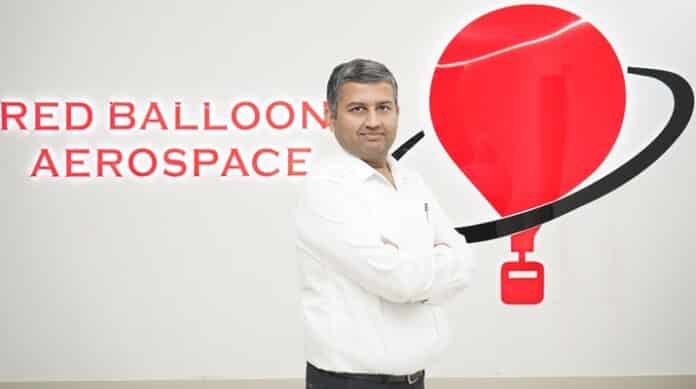

As nations explore high-altitude platforms for communication, surveillance, and scientific research, Red Balloon Aerospace is developing super-pressure balloons, tethered aerostats, and airships for near-space operations. In this conversation with EFY’s Nitisha, Dr Venkata Sai Kiran discusses the company’s technology, manufacturing capabilities, development plans, and potential applications.
Q. Please talk about Red Balloon Aerospace.
A. We are a deep-tech space startup focused on developing near-space platforms. We work on technologies that operate between 20 and 50 kilometres above the Earth, a region known as near space. Our aim is to provide some of the services offered by satellites and drones at a lower cost. We are developing a range of lighter-than-air systems, including super-pressure balloons, airships and tethered aerostats.
Q. For readers without a technical background, how would you explain your products in simple terms?
A. Think of our platforms as high-altitude stations in the sky. They can remain over a specific area for extended periods and provide communication, surveillance, environmental monitoring and scientific research services. Unlike satellites that operate hundreds of kilometres away, our platforms operate much closer to the Earth. Depending on the application and equipment used, this proximity could support higher-resolution imaging, lower communication latency and reduced operating costs.
Q. Please elaborate on the platforms developed by Red Balloon Aerospace.
A. We have three major platforms. The first is Vista, a high-altitude super-pressure balloon platform. The second is Altis, a tethered aerostat system designed for communication and surveillance applications. The third is Helix, a high-altitude airship designed for sustained operations in near space. Together, these platforms are intended to address different near-space applications.
Q. Which of your platforms have already been commercialised, and what is the development roadmap for the others?
A. Our Vista super-pressure balloon platform has been commercialised and flown during Mission SANA, carrying payloads for several aerospace firms and partners. We also provide launch services at customer locations, with customisation options. Meanwhile, Altis is under development, and Helix, our long-endurance stratospheric airship for telecommunications and cargo applications, is progressing towards its first prototype. We are targeting completion of the initial Helix airship prototype by December 2026, with flight trials expected to begin in early 2027.
Q. Why has this near-space region remained largely unexplored?
A. The main reason is the harsh environment. Atmospheric conditions between conventional aviation altitudes and outer space are challenging. Developing systems that can withstand these conditions requires advanced materials, specialised engineering and precise design. This complexity has discouraged many organisations from entering the field.
Q. India’s first stratospheric super-pressure balloon has recently been launched by Red Balloon Aerospace. Why is this achievement significant?
A. It is a major milestone because super-pressure balloons differ fundamentally from conventional weather balloons. Conventional zero-pressure balloons allow their internal gas pressure to remain close to the surrounding atmospheric pressure, whereas super-pressure balloons are designed to maintain a higher internal pressure. This helps them maintain a more stable altitude for extended periods, supporting sustained operations in near space. Potential applications include communication, surveillance, scientific research, and other activities that require a platform to remain airborne for long durations. The flight places India among the countries developing super-pressure balloon technology for sustained near-space operations.
Q. How do you differentiate a super-pressure balloon from a conventional high-altitude balloon?
A. In a conventional zero-pressure balloon, the pressure inside is nearly equal to the external atmospheric pressure. In a super-pressure balloon, the internal pressure exceeds the external pressure, and the envelope is designed to withstand this pressure difference. This design can help maintain a more stable altitude for longer periods, depending on the balloon’s design, gas volume, temperature, and atmospheric conditions.
Q. What were the biggest challenges in developing India’s first super-pressure balloon?
A. The challenges included developing the right materials, creating specialised infrastructure from scratch, building manufacturing capabilities and identifying skilled talent. Since there were very few reference points available in the country, we had to establish many capabilities ourselves.
Q. Tell us about the materials used in your balloons.
A. We have developed proprietary multi-layered nanocomposite materials specifically designed for near-space operations. These materials are lightweight, durable and capable of retaining hydrogen gas for extended periods while withstanding extreme temperatures and pressure variations. The material consists of multiple engineered layers, each serving a specific purpose.
Q. How indigenous is your technology?
A. Approximately 80 to 90 per cent of our technology is developed and manufactured in-house. We design and build our own materials, balloon systems, structures, and avionics, as we control the infrastructure needed for our near-space operations. Some specialised components are currently imported, but we intend to integrate more Indian-made electronics as the domestic semiconductor ecosystem grows.
Q. How does your manufacturing model differ from traditional aerospace companies?
A. We design and manufacture our products and also build many of the machines used in production. Where suitable equipment was not readily available, we developed our own manufacturing infrastructure. This approach gives us greater control over manufacturing processes and product development.
Q. Who are your target customers today?
A. Our customers include space startups, communications providers, research organisations, defence agencies, and companies working in environmental monitoring. Several organisations use our platforms to test technologies, validate systems and conduct experiments before deploying them in space.
Q. How is the company currently generating revenue?
A. At present, we generate revenue by offering near-space flight services to customers who want to test and validate experiments, sensors, communication equipment, and technology demonstrators. Depending on their requirements, customers can choose between rideshare missions, which accommodate multiple payloads on the same flight, and dedicated flights. These services support research, technology validation, and product development.
Q. How can your technology improve communication services?
A. Connectivity remains a challenge in many remote and underserved regions. Our near-space platforms can provide communication coverage across large areas, especially where installing fibre networks or cellular towers is economically unviable. A single platform can potentially replace hundreds of cell towers while delivering high-speed internet with very low latency.
Q. What role can your platforms play in future 6G networks?
A. Non-terrestrial networks are expected to become a key component of 6G infrastructure. Our platforms can serve as communication nodes in near space, supporting seamless connectivity for vehicles, IoT devices and communication networks. They offer lower latency and higher bandwidth compared to many existing satellite solutions.
Q. Beyond communications, what are the key application areas for your technology?
A. The applications are extensive. In agriculture, farmers can monitor crop health, irrigation requirements and pest activity in real time. In disaster management, our platforms can restore communications rapidly after natural disasters. We also support environmental monitoring, border surveillance, atmospheric research, industrial emission tracking and scientific experiments.
Q. How can the technology contribute to environmental monitoring?
A. Our platforms could be used to detect industrial emissions, monitor pollution sources, and track the movement of harmful gases. Operating in near space could allow us to collect data across large areas, with the resolution and coverage depending on the sensors and payloads used. Such data could support environmental monitoring and public-health planning.
Q. What payload capacities can your platforms support?
A. Our systems are designed to support payloads ranging from 1 kilogram to 20 tonnes, depending on the mission profile. We offer both rideshare missions for smaller payloads and dedicated launches for larger customer requirements.
Q. How cost-effective are your solutions compared to satellites?
A. Our platforms can be 70 to 80 per cent more affordable than satellite-based alternatives while delivering superior operational flexibility. In many use cases, they can provide significantly higher efficiency and faster deployment.
Q. What makes your platforms more sustainable than satellites?
A. Other satellites generally create debris or burn up after their operational life, but our platforms are reusable. Payloads can be safely recovered, upgraded and redeployed. This reduces costs and minimises environmental impact.
Q. What are Red Balloon Aerospace’s future plans?
A. We plan to introduce our Altis tethered aerostat system and develop a sub-scale version of our Helix airship. We also plan to expand our workforce, manufacturing capabilities and technology portfolio. Over the next few years, we aim to expand our existing facilities and develop near-space infrastructure for communication, surveillance, scientific research and commercial applications.

