
Pulse Energy currently works with more than 100 charge point operator partners and has a connected network of over 10,000 EV chargers
Pulse Energy has joined Unified Bharat eCharge (UBC) as one of its first certified technology enablers, supporting the nationwide interoperable electric vehicle (EV) charging network launched by the Ministry of Heavy Industries (MHI), Bharat Heavy Electricals Limited (BHEL) and the National Payments Corporation of India (NPCI).
The UBC network aims to address fragmentation in India’s EV charging ecosystem by allowing users to discover participating charging stations and pay for charging through UPI, without requiring separate applications, accounts or operator-specific prepaid wallets.
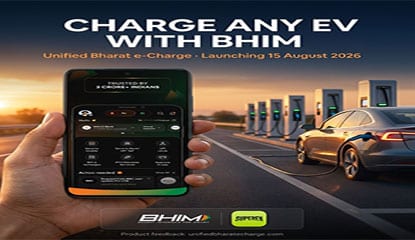
Initially available through the BHIM app, the network allows EV users to locate a UBC-enabled charging point, scan its QR code and make payment directly from their bank account through UPI. The network is being rolled out across cities and national highways, with plans to make UBC-enabled charging points accessible through additional payment, mobility and automotive applications.
As a technology enabler, Pulse Energy will help charge point operators integrate their existing charging infrastructure with the UBC network. This will allow operators to retain their existing hardware and brands while making their charging stations discoverable and accessible through a common interoperable network.
Pulse Energy currently works with more than 100 charge point operator partners and has a connected network of over 10,000 EV chargers. Through its UBC integration, the company will help these operators connect to the network and potentially reach EV users beyond their proprietary applications.
“Multiple apps and wallet loading for EV charging is exactly what we wanted to solve for. Discover EV charges on the BHIM payments app, charge, pay and go. Simple solution for everyone,” said Lalitha Nataraj, CEO, NPCI BHIM.
Akhil Jayaprakash, co-founder and CEO, Pulse Energy, said, “EV charging should not require drivers to think about which network they are using before they can plug in. The idea behind UBC is to make charging more accessible by bringing different networks onto a common infrastructure. For users, that means a simpler payment experience, while operators get the opportunity to serve users beyond their own applications.”
Unified Bharat eCharge has been developed as digital public infrastructure using the open Beckn protocol, with the underlying digital public infrastructure developed by the Network for Humanity (NFH) team. Its open architecture is designed to enable charging operators, technology providers and consumer applications to connect to a common ecosystem.
MHI is supporting the development of the National Unified Hub for EV charging, or Unified Bharat eCharge, to create a seamless and interoperable EV charging ecosystem across India. The ministry has appointed BHEL as the Project Implementation Agency, while NPCI BHIM Services Ltd (NBSL) has been engaged for the design and development of the platform.
The initiative is expected to simplify the EV charging experience for consumers while enabling charging operators to expand their reach through a common national network.