iVP semiconductor’s CEO and founder, Raja Manickam said that India must not just concentrate on building components and modules but a whole ecosystem of semiconductor manufacturing integrating MSMEs and academic institutions.
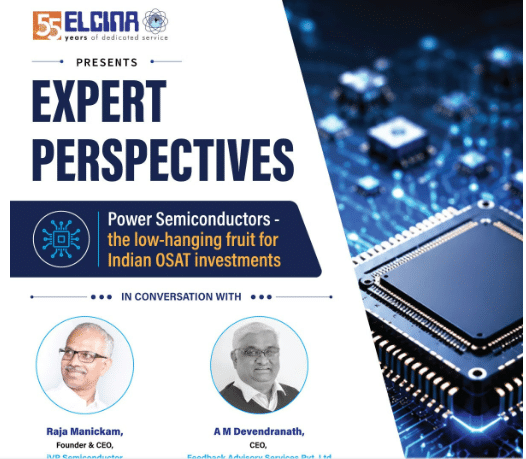
“We are focusing solely on power semiconductor devices as it a foundational component used in all sectors”, said Raja Manickam, the founder and CEO of iVP semiconductors in a webinar titled-”Power Semiconductors- the low hanging fruit for India’s OSAT investments”, organised by Electronic Industries association of India (ELCINA), on Friday.
Power semiconductor devices are key switching components like diodes, thyristors and IGBTs used across various sectors from electric vehicles, to consumer electronics and renewable energy. There is a lot of innovation happening in the sector as well, according to Manickam.
India’s current market lag and capacity shortfall
However, India’s position is a bit of a laggard in this space. “The global market for power semiconductor devices is about $80 billion to $90 billion approximately, India’s demand amounts to $3 billion to $4 billion of it and India’s building capacity including designing and manufacturing is just about 0.4 billion”, said A.M. Devendranath, CEO of Feedback Advisory Services Pvt. Ltd, in response to a question from EFY.
It is very important to serve the demand of the Indian market before we talk about the global share according to both the panelists. iVP semiconductor on its website claims that they are not just focused on building components and modules but an entire ecosystem around the development of power semiconductor devices.
The imperative for domestic manufacturing
Manickam stated that India ‘has to’ do manufacturing without any option. He said that any country that has some product companies like the US or Japan had some manufacturing capability at some point of time.
By product companies they meant big-revenue generating companies like Nvidia, and Qualcomm, which generally don’t engage in manufacturing. It was highly discussed how both the MSMEs and the academic institutions can play their part in building the product company ecosystem.
Leveraging academic research and global models
It’s important to integrate academic institutions with the industry to shift some share of research on to them. Manickam gave the example of Indian Institute of Science (IISc) doing some pioneering research in Gallium Nitride (GaN ) semiconductor technology. He also gave an example from China where industries pool funding for R&D in lead frames, basic metal material inside a semiconductor which holds the silicon pie.
Supporting MSMEs to drive supply chain innovation
Assimilating smaller industries is also critical to build a manufacturing ecosystem. In response to a question from EFY, Manickam said that the smaller industries need a lead time of two to three years before they start generating revenue. They might need some support from the lenders, including the government there.
As an example if we look at Taiwan Semiconductor Manufacturing Co. (TSMC), it buys materials from thousands of small suppliers, creating a demand for them. Along with it, these small enterprises can bring a lot of innovation in the manufacturing process, lowering the unit costs.
iVP’s vision and career advice for engineers
Manickam, who has formerly worked with Texas Instruments (TI) has said that he wishes to build an Indian TI for power semiconductors. He said in future iVP can emerge as a single stop solution for power semiconductor devices with almost 10,000 products in its catalogue.
For young graduates, he advised to focus more on Analog circuit designs as other sectors are going to face major competition from artificial intelligence. In response to a question, he said development of Gallium Oxide semiconductors in India can take eight to ten years.