



What if building an AI chip became as simple as assembling reusable blocks? The startup is working to make custom silicon accessible beyond the silicon hyperscalers.
Imagine building a custom artificial intelligence (AI) chip the way you assemble a computer. Instead of designing every component from scratch, you choose ready-made parts for functions like connectivity, power and memory, then add only the processor that makes your application unique. That is the idea behind TYLsemi. The startup develops reusable semiconductor building blocks, called chiplets, that allow companies to build custom AI processors faster, at lower cost and with significantly less engineering effort.
Founded in 2026 by semiconductor veterans Mohit Gupta and Sunil Bhardwaj, the Silicon Valley startup is developing reusable semiconductor building blocks, known as chiplets, that companies can combine with their own processor designs. Instead of building an entire chip from the ground up, customers focus only on the compute/accelerator/fabric engine that makes their product unique, while TYLsemi provides the remaining components needed to transform the design into a complete AI/XPU processor. “We want to democratise chip development. It should not be limited to hyperscalers. Everyone should be able to build custom silicon,” says Mohit Gupta, CEO and co-founder.
The idea emerged from a problem the founders had encountered throughout their semiconductor careers. As AI models become more specialised, organisations increasingly require application-specific silicon rather than general-purpose processors. However, shrinking process nodes, rising development costs, complex packaging and longer design cycles have made custom chip development practical only for companies with deep engineering resources. TYLsemi aims to lower those barriers, making custom silicon accessible to a much broader range of businesses.

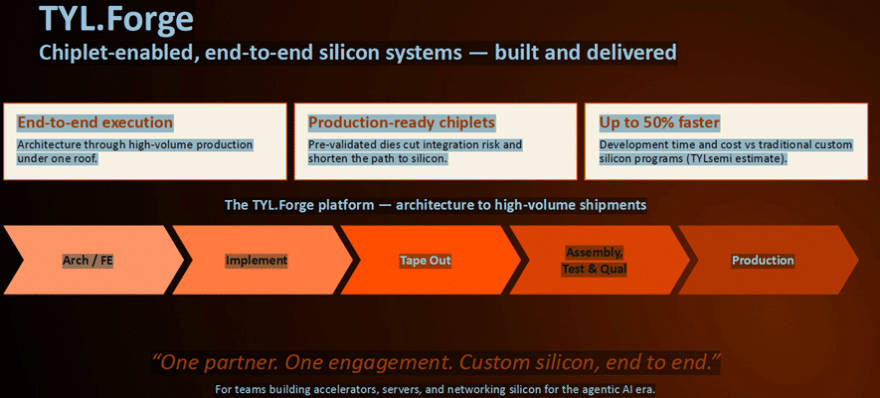
Rather than developing complete AI accelerators, TYLsemi is building the parts that almost every AI processor needs. Its first product family consists of three complementary chiplets, TYL.IO for high-speed connectivity based on PCIe/CXL/Ethernet, TYL.Power for efficient power delivery within AI accelerator packages, and TYL.Mem for addressing the growing memory bandwidth demands of AI workloads. These are brought together by TYL.Forge, the company’s silicon integration platform, which integrates TYLsemi’s chiplets with a customer’s custom die to create a manufacturable processor.
Instead of redesigning common functions for every new chip, customers can focus on the compute architecture that differentiates their product while TYLsemi handles the supporting silicon. “You come up with the architecture you’re trying to solve. Leave the rest to us,” says Gupta. The company also plans to expand its portfolio with optical connectivity chiplets as AI infrastructure continues to evolve.
Developing these reusable building blocks, however, is no easy task. Gupta believes power delivery is emerging as one of AI’s biggest engineering bottlenecks as accelerators move towards multi-kilowatt power envelopes. Delivering stable power to billions of transistors while managing heat inside increasingly dense packages has become just as important as designing the compute itself.
The company is also addressing challenges around chiplet interoperability, advanced packaging and system reliability. To ensure its products work seamlessly across heterogeneous systems, TYLsemi has built them around open industry standards including universal chiplet interconnect express (UCIe), peripheral component interconnect express (PCIe), Ethernet/ESUN, low-power double data rate (LPDDR)/double data rate (DDR) and high bandwidth memory (HBM), enabling customers to integrate reusable chiplets while reducing both development effort and time to market.
The company also believes semiconductor innovation has become too complex for any organisation to tackle alone. While its core chiplet technologies are developed in-house, fabrication is handled through Taiwan Semiconductor Manufacturing Company (TSMC), with advanced packaging supported by choice of outsourced semiconductor assembly and test (OSAT) partners to provide supply chain resiliency. TYLsemi also works closely with leading IP providers and electronic design automation (EDA) vendors, and plans to establish academic collaborations from 2027, particularly in optics and advanced power delivery. “Nobody can do this alone. Semiconductors have become an ecosystem business,” Gupta says.
Today, TYLsemi employs around 40 people, with engineering teams spread across the US and India. Bengaluru serves as its primary engineering centre, while expansion into Taiwan is expected to strengthen its manufacturing and supply chain ecosystem. The company plans to grow to nearly 100 employees by the end of 2026 and more than 200 globally the following year, while expanding its portfolio with memory and optical chiplets and continuing to develop the TYL.Forge platform.
For a young semiconductor company, scaling is about more than hiring engineers. Gupta says execution, attracting experienced talent and building the right ecosystem partnerships remain the company’s biggest priorities. As AI infrastructure becomes increasingly specialised, TYLsemi hopes its modular approach will allow many more organisations to build custom processors without having to reinvent the fundamentals of chip design every time.
| Reason for selection of name for startup: “TYL” is derived from “Tile”, representing the chiplet tiles that form the building blocks of modern semiconductor devices. Headquarters: San Jose, California, USA Founded: 2026 Nature of firm: Private limited Number of Founders and names: 2 co-founders; Mohit Gupta and Sunil Bhardwaj Total Number of Employees: Around 40 |

