


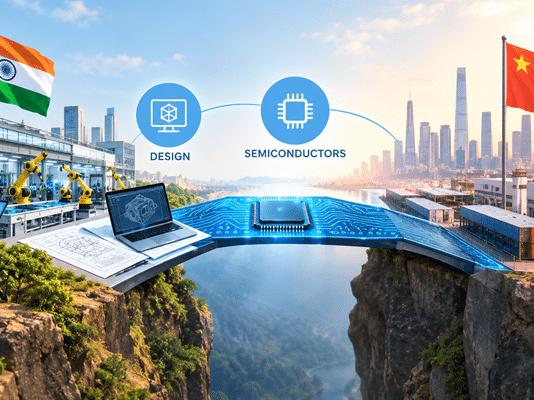

India is not trying to out manufacture China overnight. Instead, it is betting on engineering, semiconductor design, and smarter manufacturing to reshape its industrial future.
For the better part of three decades, the global manufacturing story has had a single, dominant protagonist: China. It has been the world’s undisputed workshop, producing everything from the smartphone in your pocket to the solar panels on your roof. However, as any seasoned engineer or industry observer knows, the landscape is shifting. Between geopolitical tensions, the fragility of over-concentrated supply chains, and a global search for ‘China Plus One’ alternatives, a historic window of opportunity has opened for India.
The key question is whether India can realistically challenge the ‘Factory of the World’. While the scale gap remains significant, India is moving away from simply trying to replicate the Chinese model. Instead, it is carving out a unique niche in high-value electronics, design for manufacturing (DFM), and semiconductors. This is not merely about making products more cost-effective; it is about making them smarter.
The reality check: Facing the scale gap
Before drawing conclusions, it is worth examining the numbers. China currently accounts for nearly 28.8% of global manufacturing output, while India accounts for approximately 2.8%. That represents a roughly tenfold difference.
To the casual observer, this may appear to be an insurmountable lead. However, for strategic investors and ambitious manufacturers, the gap represents a significant growth opportunity.
If India can even marginally increase its share of global manufacturing output, the potential gain would amount to hundreds of billions of dollars in additional output. The momentum is already visible. Over the last decade, India’s electronics sector has experienced remarkable growth, with production increasing from ₹1900 billion in 2014–15 to a projected ₹11,300 billion by 2024–25. That represents a six-fold increase over ten years.
The export story is equally impressive. Electronics exports have surged from ₹380 billion to ₹3260 billion over the same period—an eight-fold increase.
This is not merely a statistical anomaly; it is the result of a concerted effort to transform India into a major smartphone export hub, supported by global supply-chain shifts and the government’s Production-Linked Incentive (PLI) schemes.
The semiconductor strategy: A design-led leapfrog
One of the most significant developments for the electronics industry is India’s calculated entry into the semiconductor space. For years, the barrier to entry was considered to be the multi-billion-dollar mega-fab. China spent decades building massive wafer fabrication capacity, but India is taking a different, perhaps more engineering-focused, approach.
Instead of focusing solely on the substantial capital investment required for giant fabrication facilities, India is targeting the broader semiconductor ecosystem, where it already has a home-field advantage: chip design and embedded systems. The government’s $10 billion semiconductor incentive programme is broad-based, covering:
- Semiconductor fabrication
- Assembly, Testing, Marking, and Packaging (ATMP)
- Compound semiconductors
- A robust design ecosystem
With over ₹1600 billion in investments already approved, India is rapidly becoming a top destination for semiconductor ‘backend’ operations. By focusing on advanced packaging, speciality fabs, and mature-node technology, India aims to leapfrog into high-value segments without the decades of lag time usually required for traditional wafer-fab dominance.
DFM: India’s ‘hidden’ strength
If China’s strength lies in its sheer scale and world-class infrastructure, India’s engineering talent could prove to be one of its greatest advantages.
This brings the discussion to DFM. While the traditional Chinese manufacturing model followed a linear path of:
Mass Production → Scale → Export
The emerging Indian model follows a different trajectory:
Design → Prototyping → DFM → Assembly → Export
In this new paradigm, India is positioning itself as an optimisation hub.
The country has one of the world’s largest pools of electronics and software engineers, with thousands of chip designers already working in India for global technology companies. The plan to train more than 85,000 VLSI engineers over the coming years signals India’s ambition to own the intellectual property behind products rather than simply assembling them.
This design-led approach is particularly valuable in high-reliability and high-value sectors such as automotive electronics, Industrial IoT, medical devices, and aerospace. In these industries, the ability to optimise product designs for manufacturing—reducing costs while ensuring high reliability—is often more valuable than simply producing low-cost consumer goods at scale.
The policy engine: The PLI effect
India’s manufacturing transformation cannot be discussed without acknowledging the role of policy.
The PLI schemes have been a genuine game-changer. With a total outlay of roughly ₹1.9 trillion (~$26 billion), these schemes have attracted over $20 billion in investment and created an estimated 2.5 million jobs.
The electronics sector has become the leading example of the scheme’s success. It has attracted major global brands and contract manufacturers to establish or expand operations in India.
The policy not only encourages manufacturing but also supports scale, which has historically been one of India’s missing links.
Comparing the Titans: Structural advantages
Why is this happening now? Beyond policy, several structural shifts are favouring India over China in the long term.
- The demographic edge: India possesses a young, growing workforce. In contrast, China is grappling with an ageing population, rising wages, and a shrinking pool of available labour.
- Cost competitiveness: Lower labour costs continue to make India an attractive destination for electronics assembly and component manufacturing.
- Supply-chain diversification: The ‘China+1’ strategy is no longer just a corporate buzzword; it is a strategic necessity for global firms looking to mitigate risk.
The reality of the road ahead
It would be a mistake to suggest that China is losing its position. Its advantages remain formidable: deep component supply chains, a mature manufacturing ecosystem, and world-class logistics that India is still developing. Currently, India still relies heavily on China for a large share of its electronics components. Infrastructure gaps, regulatory complexities, and high logistics costs remain the ‘bugs’ in the system that India needs to debug.
A strategic roadmap
The sources suggest a clear timeline for India’s ascent:
- Short- to medium-term (5 – 10 years): Expect India to dominate in semiconductor design and packaging, smartphone exports, EV components, and solar manufacturing.
- Long-term (10 – 20 years): The goal shifts to advanced semiconductor packaging, speciality fabs, AI hardware, and high-reliability electronics for the defence and aerospace sectors.
From factory to design lab
India is unlikely to replace China as the world’s factory in the immediate future, but its strategic objective has clearly shifted. Rather than competing solely on manufacturing scale, India is building a design-driven, high-value manufacturing ecosystem that combines engineering talent with targeted policy support.
If China represents the factory of the world, India is positioning itself as its design lab and next-generation electronics hub. The coming decade will be the ultimate test: can India translate its demographic advantage and engineering expertise into genuine manufacturing leadership?
If current trends continue, India may not simply become another participant in the global electronics market—it could emerge as its second major pillar.
(This article is solely based on personal views; the data and other industrial information are extracted from various open source digital data)

