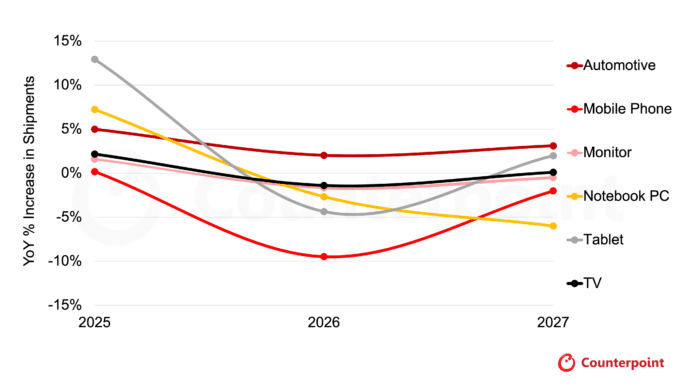

Smartphone FPD shipments are forecast to fall 9.5 per cent in 2026. Global flat panel display (FPD) shipments are forecast to decline 4.7 per cent YoY in 2026, as rising memory prices push up device costs and weaken demand for smartphones, tablets and other electronics.
The global flat panel display (FPD) market is facing renewed pressure as higher memory prices, driven by strong demand from artificial intelligence (AI) data centres, are increasingly being passed on to consumers. This is expected to weigh on demand across key FPD applications, particularly smartphones and tablets.
Global FPD shipment volume is forecast to decline 4.7 per cent year-on-year (YoY) in 2026, according to Counterpoint Research’s Flat Panel Display Tracker & Forecast.
“High prices for memory chips are leading to price increases across a range of electronics products, leading to reduced demand,” said Bob O’Brien, Research Director at Counterpoint Research. The impact is expected to be particularly strong in low- and mid-range smartphone and PC segments, where higher component costs are making it difficult for OEMs to maintain previous price points.
Smartphone displays face sharper decline
Mobile phones are expected to remain one of the weakest FPD applications in 2026. FPD shipment volume for mobile phones is projected to decline 9.5 per cent YoY as higher memory costs push up device prices and consumers delay upgrades.
The pressure is expected to be more pronounced in entry-level and mid-range devices, where manufacturers have less room to absorb rising component costs.
IT display demand weakens into 2027
The IT display segment is expected to see a smaller decline in 2026, supported by stronger shipments during the first half of the year. However, the downturn is expected to extend into 2027 as higher finished-device prices affect panel procurement.
Monitor panel shipments are projected to decline 1.7 per cent YoY in 2026, an improvement from Counterpoint’s earlier forecast of a 3 per cent decline.
Notebook panel shipments are expected to fall 2.7 per cent YoY, significantly better than the previous forecast of an 8.8 per cent decline.
However, rising device prices could prompt original equipment manufacturers (OEMs) to adjust panel procurement in 2027, with both monitor and notebook panel shipments expected to decline next year.
OLED displays gain momentum
While overall FPD shipments remain under pressure, manufacturers are increasingly turning to premium display technologies to offset weakness in low- and mid-range segments.
OLED monitor panel shipments are forecast to grow 60 per cent YoY in 2026, while OLED notebook panel shipments are expected to increase 50 per cent YoY.
The shift towards OLED highlights the growing focus on premium displays as manufacturers look to protect margins and differentiate products amid rising component costs.
TV and automotive displays remain resilient
TV panels have been less affected by the memory shortage as televisions are less dependent on memory components than smartphones and PCs. Mini LED FPD shipments are projected to grow by more than 10 per cent YoY in both 2026 and 2027.
Automotive displays are expected to remain the strongest segment of the FPD market. Among the six major FPD applications tracked by Counterpoint, automotive displays are the only segment expected to record YoY growth in 2026.
The momentum is expected to continue into 2027, supported by the increasing number of displays being integrated into vehicles. Larger average screen sizes are also expected to drive stronger revenue growth for automotive display manufacturers.
FPD market outlook
The global FPD market is expected to remain under pressure as higher memory costs translate into higher prices for finished electronics products. Smartphones and IT devices are likely to bear the brunt of weaker consumer demand, while premium OLED, Mini LED and automotive displays offer pockets of growth.
The market could face additional pressure in 2027 as OEMs adjust panel procurement in response to slower demand and elevated device prices.