Semiconductor firm Infineon teams up with energy storage specialist Skeleton Technologies to develop high-efficiency power architectures for data centres running heavy AI workloads.
Semiconductor manufacturer Infineon Technologies AG and high-power energy storage developer Skeleton Technologies have signed a Memorandum of Understanding to co-develop resilient power solutions for artificial intelligence (AI) data centres.
The agreement addresses the soaring electrical demands and spatial limitations of modern AI infrastructure, where escalating power requirements and high-density GPU computing are placing unprecedented demands on energy grids.
Under the partnership, the companies will explore end-to-end architectures across the data centre power chain. Key projects include developing next-generation solid-state transformers (SSTs) for medium-voltage AC to high-voltage DC conversion by combining Infineon’s silicon carbide (CoolSiC) semiconductors with Skeleton’s supercapacitor and power conversion technology. The firms are also developing peak-shaving systems that pair Skeleton’s energy storage with Infineon’s gallium nitride (CoolGaN) power devices.
The collaboration aims to improve energy conversion efficiency, increase power density, improve overall reliability, and reduce total cost of ownership for operators.
“AI is fundamentally transforming power infrastructure requirements,” said Andreas Weisl, executive vice president and chief sales officer for industrial and infrastructure at Infineon. He noted that increasing power density demands fresh approaches to energy conversion, distribution, and storage.
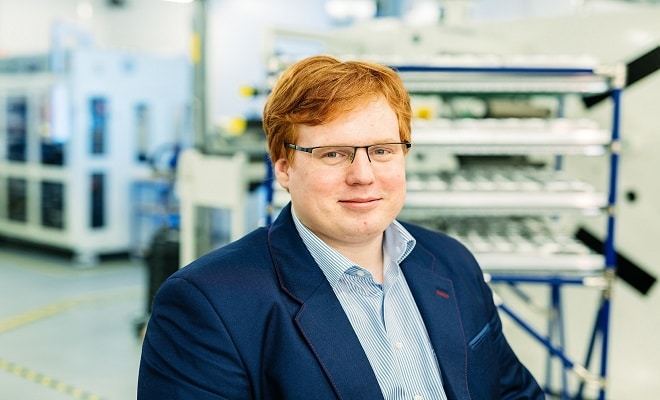
Taavi Madiberk, chief executive at Skeleton Technologies, highlighted that power density has become a critical bottleneck for global AI infrastructure. He explained that data centres must deliver significantly higher power to dense processor clusters without expanding the physical footprint of power systems, adding that combining Skeleton’s rapid energy delivery with Infineon’s power control will enable operators to house greater compute capacity within existing facilities.