Cloud providers account for over half of H1 2026 revenue growth as spending shifts towards optical transport and high-end routing.
The positive momentum that characterised the global telecommunications equipment market throughout 2025 has carried through into the first half of 2026. Preliminary data from market research firm Dell’Oro Group indicates that aggregate worldwide revenues across six key segments—Broadband Access, Microwave & Optical Transport, Mobile Core Network (MCN), Radio Access Network (RAN), and High-End Routing & Aggregation—grew by 5 per cent year-on-year in 1H26, marking a sixth consecutive quarter of growth.
This sustained expansion follows a 4 per cent revenue increase in 2025, which saw the market recover from a steep 14 per cent decline recorded between 2022 and 2024. While the initial 2025 recovery was driven by inventory normalisation and improving carrier demand, growth in 1H26 shifted markedly towards technologies with direct exposure to artificial intelligence and data centre infrastructure.

Although traditional communication service providers (CSPs) still generate over 90 per cent of total telecom equipment revenues, hyper-scale cloud providers are driving incremental expansion. Cloud operators contributed an estimated 55 per cent of total market growth in 1H26, reflecting aggressive capital deployment into AI data centres and associated high-capacity connectivity.
The surge in cloud investment resulted in distinct sectoral performance variations across product categories. Optical Transport and High-End Routing served as the primary growth engines, with Optical Transport recording double-digit revenue expansion on strong demand for data centre interconnects, while High-End Routing & Aggregation benefited from robust purchasing by both cloud firms and traditional telcos. In contrast, aggregate revenues across Radio Access Networks, Mobile Core Networks, Broadband Access, and Microwave Transmission remained largely flat over the same period.
Geographically, growth was broad-based across North America, EMEA, Latin America, and Asia-Pacific excluding China. North America benefited significantly from AI-driven demand for optical transport, routing, and fibre access gear. Conversely, the market in China contracted as domestic operators reallocated capital from traditional telecom networks to compute infrastructure; China’s top three CSPs are targeting a 40 per cent increase in computing capital expenditure in 2026, alongside a 24 per cent cut in traditional connectivity spending.
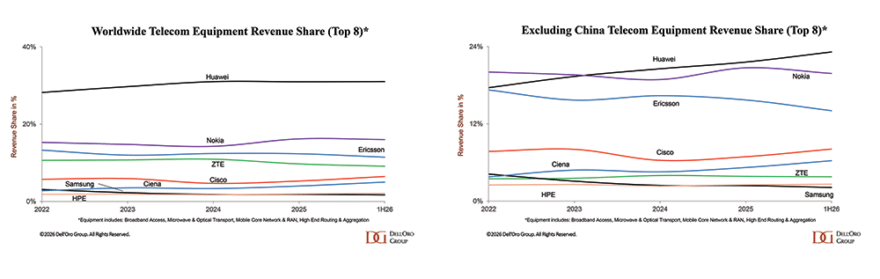
Vendor market shares outside China experienced notable shifts. Huawei maintained its position as the world’s largest overall equipment supplier, followed by Nokia and Ericsson. However, in non-Chinese markets, Huawei and Cisco gained market share relative to 2025, whereas Ericsson and Nokia saw their combined revenue share drop by approximately three percentage points. This divergence reflects varying vendor exposure to the fast-growing optical and routing segments versus flatter mobile infrastructure markets.
Dell’Oro Group has upgraded its full-year 2026 revenue forecast, projecting global market growth of 3 to 5 per cent (up from earlier estimates of 2 to 4 per cent). While ongoing cloud infrastructure investments provide strong tailwinds, the sector faces potential headwinds in the second half of the year from weakening Chinese spending and rising costs for memory and underlying components.