


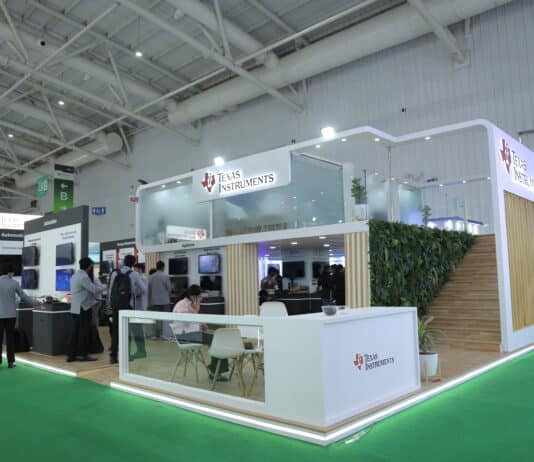

From semiconductor design to edge AI and electric mobility, TI is increasingly developing technologies in India for applications that extend beyond the domestic market.
Forty years after establishing operations in India, Texas Instruments (TI) is positioning the country as more than an engineering support base. Its India teams are involved in conceptualising, designing, developing, and supporting products that address applications ranging from electric mobility and medical electronics to smart energy and connected appliances.
Speaking to EFY at electronica India 2026, Santhosh Kumar, managing director and president, TI India, highlighted how the company’s India operations have evolved towards end-to-end product development.
“As engineers inventing for engineers, TI focuses on designing and manufacturing semiconductor technologies that help our customers solve increasingly complex challenges,” said Santhosh Kumar, managing director and president, TI India. “We have been part of India’s semiconductor landscape for 40 years, and our commitment here has never been stronger. electronica India 2026 gives us the opportunity to connect directly with the engineers shaping India’s next wave of innovation, building products that are smarter, safer and more energy efficient.”
That design-led approach is visible in applications being demonstrated at TI’s Bengaluru booth. More than 20 live demonstrations cover software-defined vehicles, battery management, advanced driver assistance systems (ADAS), power conversion, solar energy, grid systems, and connected infrastructure.
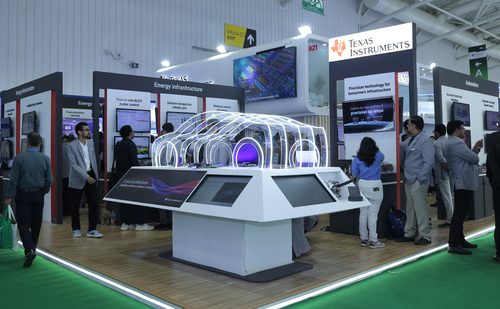
In electric mobility, TI is showcasing a commercial-vehicle ADAS architecture combining one camera with three radar sensors, alongside technologies for battery management, real-time wheel-speed tracking, zone control, and central computing for software-defined vehicles. A 48V gallium nitride (GaN)-based audio amplifier also demonstrates the role of wide-bandgap devices in automotive systems.
On the energy side, TI is demonstrating a 3.6kW GaN-based single-phase string inverter using a single MCU, H-bridge bipolar modulation, and a single photovoltaic (PV) input with maximum power point tracking (MPPT). The company specifies more than 96.5 per cent full-load efficiency. Other demonstrations include Rogowski-based electricity metering, edge-AI AC arc-fault detection, and grid-tie inverter technology.
Kumar also pointed to AI at the edge as an area where India-developed technologies are gaining relevance, with processing performed locally for applications requiring low latency.
For India’s semiconductor ecosystem, TI sees the next opportunity beyond chip creation: integrating devices into complete systems that solve real-world problems across mobility, energy, appliances, and internet of things (IoT).

