
IDTechEx report predicts rapid adoption of heavy electric machinery driven by total cost of ownership advantages and mega-battery technology.
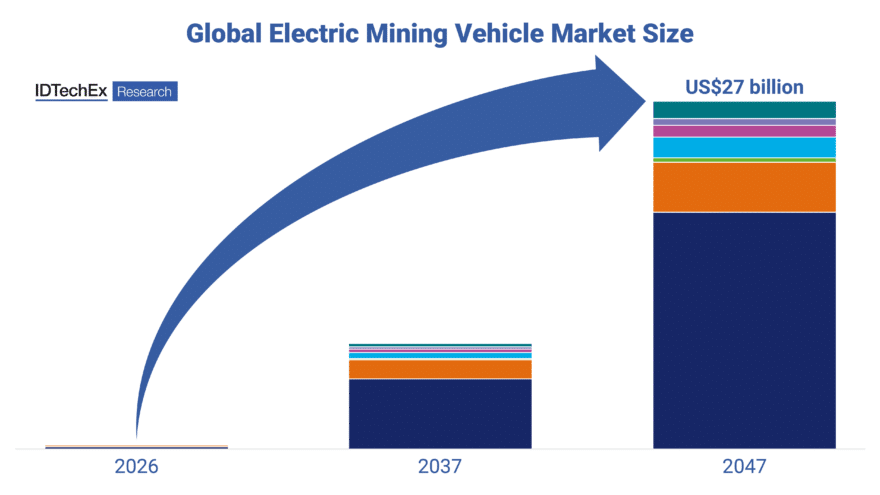
The global market for electric mining vehicles is projected to surpass $27 billion by 2047, driven by operational efficiencies, total cost of ownership (TCO) benefits, and corporate decarbonisation targets, according to research from IDTechEx.
With the mining sector contributing 2 to 3 per cent of global emissions—nearly half originating from diesel vehicle exhaust—electrification represents a vital pathway toward meeting net-zero objectives. Beyond environmental compliance, electric machinery offers significant operational advantages by eliminating direct exhaust fumes, heat, noise, and vibration, significantly improving underground working conditions.
While electric mining machinery carries higher upfront capital expenditure than traditional diesel equipment, lower electricity and maintenance expenses deliver substantial TCO savings. These operational efficiencies compound rapidly under near-continuous mine utilisation, prompting major mining groups—including BHP, Fortescue, and Anglo American—to accelerate fleet integration without relying on regulatory mandates or government subsidies.
Powertrain and battery technologies are evolving rapidly to meet demanding mine site requirements. Modern electric haul trucks regularly feature battery packs exceeding 1,500 kWh, with upper-tier models reaching up to 2,400 kWh. These expanded capacities enable 6 to 10 hours of continuous operation on a single charge. Simultaneously, equipment manufacturers are shifting from retrofitting existing diesel chassis to dedicated in-house electric production lines, led by OEMs such as Liebherr and XCMG, with Caterpillar planning similar moves.
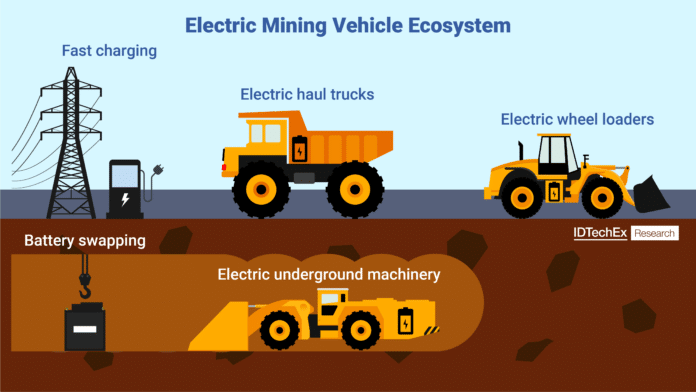
To support heavy-duty duty cycles, charging and battery technologies are undergoing rapid specialization. While lithium nickel manganese cobalt (NMC) and lithium iron phosphate (LFP) chemistries remain dominant, alternative technologies like lithium titanate oxide (LTO) are gaining traction due to their high C-rate tolerance and cycle life reaching up to 20,000 cycles. Infrastructure solutions are advancing in parallel, featuring megawatt-level fast-charging systems capable of replenishing a haul truck in 10 minutes, alongside autonomous battery-swapping setups operating in under five minutes.