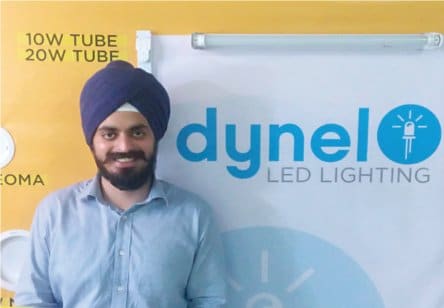

Thursday, May 22, 2014: Continental Device India Ltd (CDIL), a leading manufacturer of silicon semiconductor chips and devices, and an electronics manufacturing services provider, has recently ventured into the LED lighting domain by launching a range of LED lighting products under the brand name Dynel. “LED is an upcoming segment, and we hope to be a leader in it in the next five years or so,” says Prithvideep Singh, strategic marketing lead, Dynel, a CDIL brand, in conversation with Srabani Sen of Electronics Bazaar.

EB: Do you manufacture LED products or does your firm trade in them?
We manufacture lighting products, no trading. Having been in the market for 50 years—this is our golden jubilee year—the customer’s trust means a lot to us; hence, we only offer quality products. We are developing our own brand, Dynel, in India for the benefit of our Indian consumers. This is yet another landmark for CDIL and a quest to provide energy-efficient lighting alternatives to the world. It is our endeavour to be among the preferred choice of companies that provide lighting products.
EB: What are the LED products you manufacture under Dynel?
We currently manufacture LED bulbs, tubelights, panel lights, downlights, and a number of outdoor, emergency and portable handheld devices. We are constantly looking to add more products to our portfolio.
EB: Are you satisfied with the initiatives taken by the government to boost the LED sector?
A lot needs to be done to boost the LED sector in India. A big section is still unorganised, where players offer substandard products. This hurts the industry at large as many consumers’ first interactions with LEDs turn out to be poor, thus leading to a slower rate of acceptance. That being said, once the government comes out with the right kind of regulations and guidelines for LED products, the entire industry will get motivated to expand in India. Government bodies like the Bureau of Energy Efficiency (BEE) and the Bureau of Indian Standards (BIS) are actively working towards standardisation in LED lighting products, which will help to consolidate the market by filtering out the sub-standard and poor performing goods.
Although the percentage of buyers for LED lighting is still low today, given their higher initial cost, but this scenario is changing fast. With an increase in popularity, combined with the efforts of the Central government, new investments are being made in the industry to exploit the untapped potential of this market. We, therefore, believe that the demand for LED lighting products will double in the next two years.
EB: What kind of business and marketing strategies do you follow?
At the moment, the aware and educated customer, who understands the significant cost and energy savings is the one investing in LED lighting products. As such the demand for LED lighting is high in sectors like hotels, hospitals, factories, office buildings, etc, where lighting is needed for 10 to 16 hours in a day. These customers have realised that they can recover their money within a year or even eight months, depending on the number of hours of consumption. For households, LED lights will become popular once the regulations are in place and the costs come down just a little further.
Our business targets these segments, as well as the leading Indian organisations and the government sector. We will also focus on emerging sectors and regions, and aim to strengthen the role of our channel partners.
EB: Do you see more benefits in manufacturing LED products in India or trading in them?
Manufacturing locally is beneficial because we can serve the end customer much better. Understanding things unique to the Indian environment such as voltage fluctuations, sensitive pricing, rural lighting conditions, etc, allow us create India-centric products for the market and more importantly cut down on the lead time in bringing that product to the market. If you are actually developing and manufacturing products with the right R&D team, using in-house design and technology, then the benefits are huge.
Additionally, any servicing that might need to be done under the warranty can be executed with much more ease if you are manufacturing rather than trading.
EB: How much R&D is being done at CDIL?
The LED lighting business is still a new line for us. Yet, with our in-house R&D team, we are constantly making an effort to innovate. We are looking to get some premium products on board as well as products that would target rural areas specifically. A lot of new technologies exist across the world. For example, one can control the lights of the entire house from a smartphone. We plan to bring those technologies and other new products to India at a price that works for the Indian consumer.
EB: What are the new products available in the LED segment?
Products with dual colours have been recently launched. People have realised that lighting makes a big impact on people’s health, mood and even productivity. For example, cooler light temperatures have associations with environments where you need to be vibrant and alert, while warmer ones are good for environments involving relaxed, personal interactions. We actually have customers coming to us and asking for different colour tones of light for the day and different for the evening. Today, with the same product and fitting, you can change the colour of the lights as you please.
Then there are LED products that move away completely from the analogue realm and dive in to digital lighting, with lights that dim or brighten wirelessly and vary based on commands given from a smartphone or even just based on the sun’s position or the weather outside. The possibilities are really limitless now as lights have entered the digital realm.
At the component level, the latest LED lighting products in the market have increased energy efficiencies due to experimentation on chip sizes and an increase in lumens per watt efficacies.
EB: What market share are you targeting this year and the year after?
At the moment, there are two markets that we aim to penetrate. One is the infrastructure and institutional market. Here, our marketing efforts are focused on the builders, contractors, architects, interior designers, etc. So that is the one big marketing target for us. The other is the consumer market, but we will take some more time to penetrate it as our distributorship and dealer networks are still at a nascent stage.
Electronics Bazaar, South Asia’s No.1 Electronics B2B magazine