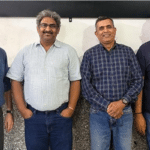
Monday, November 24, 2014: Eolane is a leading French EMS company. With over 3500 employees and 25 subsidiaries across the globe, the company ranks second in the European market and is counted among the top 20 in the world. Eolane is a niche player offering complete one stop solutions to its customers. The company specialises in eight major segments including industrial, telecommunications, aeronautics, defence, medical, automotive, energy and railways. In February 2013, Eolane acquired Finland based Elcoteq SE and made its entry to the Indian market with the objective of becoming a truly global company. In an interview with Richa Chakravarty of Electronics Bazaar, Sukhvinder Kumar, managing director and CEO, Eolane, speaks about the company’s objective for exploring the Indian market, its three year road map, as well as its business strategies and expansion plans in India

EB: How is the EMS industry shaping up in India?
The EMS industry is growing well in India. In comparison to other geographies like Europe, US, India is witnessing a good growth. The EMS industry has witnessed a CAGR of 26 per cent over the last five years. The high CAGR segment in India includes aeronautics, defence, medical and railways. These are the major thrust areas. The coming years in the industry also seem promising, though there are a few challenges like insufficient infrastructure, complex duty structures and long overdue labour reforms, etc.
EB: What is your business strategy for the Indian market?
LED lighting is already an established vertical that we have been focusing on since a long time now, we wish to grow this further and along with this, we are diversifying into the five new segments, including automotive, aeronautics, defence, medical and railways. In 2014, we successfully entered the automotive and aeronautics segment. We are soon going to get AS 9100 and TS 19649 certifications. By next year, we plan to diversify into other segments like defence, medical and railways. So, we have made our three year road map and are moving in accordance to that. It also looks like that these are the areas in which good growth will be registered in the coming years.
EB: How has the transition been for the company?
Eolane is a 40 year old French company that is technologically advanced and is willing to transfer its technology and expertise to India. Earlier, we depended on just a couple of segments, with telecommunications dominating our portfolio in the EMS segment. But the big change now is that we are adding many verticals to our portfolio with our diversification into automotive, aeronautics, defence, medical and railways. So, this is a big advantage that we have gained and it has come at the right time. This has been a learning experience for us.
EB: What is the difference between Elcoteq and Eolane? What made Eolane enter the Indian market?
Both Elcoteq and Eolane are European companies; hence, both are systems driven. The major difference between the two companies is in the segments or verticals they cater to and the customers they focus on. Eolane has eight big verticals with 700 customers to cater to. Eolane’s objective is to be a truly global company and India is the next geography it is very seriously looking at. So, there are good synergies between the two companies. Hence, it is a good strategic acquisition that Eolane has done.
EB: What was the company’s turnover in FY 2013-14?
The company registered a revenue of 400 million Euros in FY 2013-14. We do not share regional revenue figures but the Indian plant, which is based out of Bengaluru, witnessed a growth of 55 per cent in the last year. A few segments like LEDs, in particular, have been growing very well.
EB: What are the services that Eolane as an EMS player provides?
Eolane is a one stop shop company. So, from writing specifications, designing, prototype builds to integration and manufacturing the end product, we specialise in providing complete solutions. We have eight design centres, out of which seven are located in France and one in China. India will have our next design centre—this is part of our business plan for the next three years. Globally, we have more than 220 engineers working in our design centres.
EB: Is Eolane’s Indian division too a one stop shop company?
In India, our focus so far has been on NPI, industrialisation, manufacturing and aftermarket services. We have good capabilities to test systems development as well but the R&D part is still not ready in India. In the next two years we plan to bridge that gap, and in a three year time frame we will be a one stop solutions provider in India as well.
EB: What is the biggest challenge that the company faces while operating in India?
The supply chain ecosystem is quite different here in India. Whenever our customers walk in to our French, Germany or China subsidiaries, they know that from our side, we have the entire supply chain very well established there; but in India, this is still a challenge we are facing. We have to still depend on our neighbouring countries for electronic components. We have put in a lot of efforts in this direction to develop an ecosystem here for the mechanics, plastics, packaging but there still is a big gap for electronics components.
EB: What was the main objective of Eolane wanting to explore the India geography?
We are a niche company in terms of high value segments where the value addition part is end to end. If you take defence and railways, these are totally different segments which call for certain specific competencies. These are not the high volume business segments but rather, low volume and high mix businesses. This is the forte of Eolane. The company is known for very high quality and reliability, catering to the very high standards required for products in particular segments. We want to continue growing in that direction and not lose out on the early advantages, such as being the first company to enter the LED segment. As a company we would like to continue that legacy and build on that, and at the same time grow our competencies in the niche segment.
EB: What is the growth plan for the company, as laid out in your three year road map?
We have two major plans—the first obviously relates to our growth and the second to diversification into the eight segments where Eolane already has an advantage. With segments like LEDs, which is witnessing a growth of 108 per cent, we are sure that the company will grow tremendously. The most conservative growth figure that I can think of would be 30 per cent—nothing below that.
EB: What are your expansion plans in India?
We are already in the mode of expansion. We have a strength of around 500 people in India. We have added certain newer competencies and machines like flying probe testers, automated conformal coatings, etc. We are ready for further investments in our targeted segments. By 2017, we plan to start our design centre in India.
Electronics Bazaar, South Asia’s No.1 Electronics B2B magazine