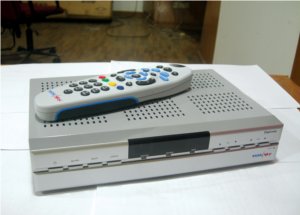

Set top box (STB) is a device which decodes digital pictures and converts them into an analogue format, streaming the signal to the analogue TV.
By Rahul Khosla
Saturday, January 16, 2010: Different types of STBs include direct-to-home (DTH) satellite boxes, digital cable boxes, digital terrestrial boxes and Internet protocol TV (IPTV). Different flavours of these STB categories include:
- Simple zapper boxes
- Personal video recorder (PVR) boxes with time-shift recording features, or live TV features like the PVRs from Tata Sky or Hathway cable
- Hybrid boxes with IPTV
- Boxes with return path feature
STB growth potential
In the past three years, there has been a phenomenal shift from analogue cable signals to digital transmission using STBs. Asian economies like India and China show enormous growth potential for STBs. China is expected to add around 17 million STBs in 2009, while India is expected to add 10 million. Currently there are about 700,000 STBs running on a subscription basis every month in India.
Technology advancement to match demand
Today, we see a shift from DVB-S to DVB-S2 or DVB-T to DVB-T2. Another move is from MPEG-2 to MPEG-4 encoding (a higher compression scheme). This helps operators to add more channels to the existing transponder bandwidth.
In order to make HD MPEG-4 services affordable, continued advances in design and smaller process geometry (nm) are the need of the hour. companies like NXP have chosen to move to 45nm process geometry as smaller process geometry has advantages like lower power, lower costs and higher integration possibilities.
High level of integration inside the chipset allows lesser time to market as the integration time and hassle have both being reduced. It is expected that in the coming years semiconductor technology would advance considerably to meet the growing demand in the digital TV domain.
STB growth in India
A couple of years ago, STBs were associated with Conditional Access System (CAS) under a tough regulatory regime imposed by the government. But today, STB is increasingly seen as a technology easily deployable in living rooms, fuelling consumer appetite for high-quality digital pictures.
Fast growth in STB sales in India is also being driven by increased sale of LCD TVs. a crossover in 2012 between the ramp-down in CRT demand and a ramp-up of LCD TV shipments have been predicted.
Other growth drivers for STBs include:
- Availability of more channels
- Availability of online movie channels
- TV services in remote areas via DTH
- Affordability—technically and commercially
- Digital picture quality
- Emerging acceptance of online shopping and gaming
In the next three to four years, CAGR is expected to be about 40 per cent, giving huge opportunities to the STB industry. gives the forecast up to 2012, based on various reports and some extrapolation.
Local vs imports
- Operators are shelling out at least Rs 1,000 per connection in the form of subsidies, hoping to recover costs through the economies of scale which would mean a high subscription base. The current strategy of most operators is to acquire the broadest customer base and later make money through value added services like video-on-demand, target advertisements, HD services, etc.
- No doubt manufacturing of STBs in India is lagging behind. For Doordarshan free-to-air STBs are manufactured in India by contract manufacturers, but they have very little experience in making CAS boxes. Jabil Circuits, Chennai, has been manufacturing STBs for Tata Sky.
- Unfortunately, more than 95 per cent of the STBs are imported. Of these, 80 per cent come from South Korea and China.
- While operators enjoy many advantages from these imports in terms of quality assurance due to the experience of the OEMs pushing STBs in the country, there are multiple limitations in importing these boxes:
- A distant manufacturing base (from the customers) takes longer time to realise products
- Force fitment of models to suit India requirements
- Heavy transportation costs and long lead times
- In this year’s budget, the government imposed a 5 per cent customs duty on imported boxes. While this is a blow to the operators who have being importing these boxes, it is a big relief to the Indian manufacturing industry. it pushes the operators to accept locally-manufactured STBs, which otherwise offered no advantages to them in the past.
- If we calculate the loss to the exchequer in 2008 due to imports—import of 5 million sets at an average price of $50—it amounts to $250 million. With imposition of the new customs duty, the government not only benefits economically but also helps the local manufacturing eco-system to grow.
- While there is some relief from the government, there are still many hurdles to cross in realising a matured eco-system for STB manufacturing and deployment:
- Although we have many contract manufacturers who can manufacture the boxes, we do not have OEMs like PACE, Thomson, Humax, Huawei and Coship that can be a single face for the operators
- Majority of the Indian STB eco-system comprises only
IDH manufacturers
- High capital investment needed to support an OEM role
- Little or no track record of local manufacturers against the proven track record of Korean and Chinese OEMs, as a result of which operators prefer imports
- Non-availability of components at times and lack of competitive pricing
- Lack of support from CAS vendors for local manufacturing
- Lack of support from operators as local industry is still at a nascent stage
Government support
- The increase in customs duty is expected to boost domestic manufacturing of STBs. However, the move will also increase the subsidies ranging from Rs 125 to Rs 250 per STB by digital pay TV operators. This will marginally impact their margins based on their ability to pass on the increase in cost.
- In the budget of 2009, customs duty on the import of STBs was increased from zero to 5 per cent and also allowing the import of inputs at 5 per cent. The decision will affect every new consumer as all players in the DTH market import STBs.
- With this move, we need to watch how quickly the industry players pick up signals and join hands in developing the local eco-system. This calls for support from all players including operators, CAS vendors, component suppliers, logistics and support experts, trained and skilled staff, etc.
- A crucial element to develop this industry is the entry of OEMs into the segment, which is missing entirely.
Players’ support
Every player in the industry can contribute in supporting local manufacture of STBs.
Role of middleware and CAS vendors:
- Local presence and support
- Local customisation
Role of local EMS partners to gearup to be OEMs:
- Brand creation as a product company
- Increased knowhow of product creation cycle
- Connections with eco-system partners
Role of government agencies:
- Tax subsidies on local manufacturing
- Increase customs duties on finished products
Role of operators:
- Acceptability of Indian brands
- Support and build up
The author is head sales and marketing, TV and STB business in India, NXP Semiconductors
Electronics Bazaar, South Asia’s No.1 Electronics B2B magazine