
 The CIA first used unmanned aerial vehicles (UAVs) over Afghanistan in 2000, and post the 2001 terror attacks in the USA drones have become a part of the US military. However, since then the consumption of drones has evolved considerably. From military to commercial sectors, drone technology is fast being adopted by individuals, corporates and governments.
In fact, experts are hopeful that the commercial use of drones will soon turn it into a booming sector, thus making these available for mass consumption. According to a report by Pricewaterhouse Cooper LLP last year, the global commercial market for drones is expected to reach US$ 127 billion by the year 2020. Currently, the global commercial market for drones is at US$ 2 billion. While this is something that will happen in the future, there are a few business opportunities that have already caught the eye of drone enthusiasts.
UAV training
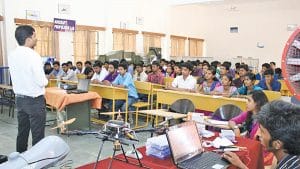
UAVs are expected to be available for mass consumption by the end of the next decade. With industries across the globe betting big on this technology, it has become imperative to create engineers who are professionals in operating UAVs. Thus, a lot of drone technology firms are venturing into the UAV training space, which will ultimately create demand for the technology. And with the Directorate General of Civil Aviation (DGCA) expected to come up with a clear set of regulations for operating drones commercially, India is expected to witness a sharp rise in the number of drone enthusiasts. According to a report by 6Wresearch last year, the Indian UAV industry is projected to hit US$ 421 million by 2021.
“Drone technology is the future, but we cannot expect everyone to have access to auto-operated drones as these are very expensive. Hence, we need professionals who understand how to operate drones, their technicalities and features, among others,” says Jagadesh Chander Munivel, director at Maavan Aeronautics, a drone training institute in Chennai.
Currently, the institute has more than 50 engineers training on the various aspects of operating a drone. The institute has courses in UAV design and manufacturing, flight dynamics, pilot training, autopilot training, aerial mapping and imagery. The initial cost (to set up an institute, which includes buying drones, rent among others) is estimated to be US$ 38,000, with an additional investment of US$ 30,000 to US$ 40,000.
Across the globe, the biggest challenge continues to be the high prices of drones, which make it difficult for training institutes to impart hands-on experience to their students. Most institutes initially train their students on simulators as handling of drones is an unwarranted cost.
> UAVs are expected to be available for mass consumption by the end of the next decade
> While globally, drones are used for aerial mapping extensively, India is still at a nascent stage
Aerial mapping
In the commercial space, a lot of sectors such as mining, real estate, infrastructure, agriculture and oil have been relying on drones for data that is otherwise difficult to access. As per a study by Allied Market Research, aerial photography via drones is estimated to reach the US$ 2.8 million mark worldwide by 2022. For instance, Mumbai based drone startup Airpix specialises in using drones for aerial mapping of areas that are otherwise difficult to reach. “We provide data acquisition and analysis solutions using UAVs for multiple industries. The solutions and reports provided by the company help its clients in project design, progress monitoring, volume calculations and inspection of critical assets,” says Shinil Shekhar, co-founder of Airpix.
Shekhar adds, “Drones are just a platform. What you make of them depends on how you select the sensors based on your project requirement and what kind of insights you derive after processing that data.” Currently, the company’s client portfolio includes the Indian government and the Indian Railways as well as a few private firms such as Larsen & Toubro, Shapoorji & Pallonji and JSW Steel.
While globally, industrial use of drones for mapping is done extensively, India is still at a nascent stage. Industry players hold the current regulations responsible for the slow growth in this business category. “For drones to become a great business, healthy regulations have to be in place—regulations that will promote the technology, safeguard national security and ensure public safety,” notes Shekhar.
 Aerial cinematography and photography
This is one category that took flight immediately after drones made their debut commercially. Drones are being extensively used in filming, news reporting, real-estate and wildlife photography. In India and the rest of the world, high-profile events such as weddings have been using drones to capture aerial views of the event for quite some time. And with Federal Aviation Administration (FAA) legalising the use of commercial drones last year, drone photography and cinematography are anticipated to grow.
Currently, drone photography is being pursued on an amateur level. But with the guidelines in place, this category is expected to gain a lot of attention from industries, as photography is pivotal to aerial mapping as well.
At present, the initial cost of proper drone photography is less than US$ 10,000.
Dronevertising
Marketers across the world are always looking at connecting with their consumers innovatively. And since drones are relatively a new technology in the commercial space, brands are looking at ways to explore it. In fact, the advent of social media has made it mandatory for brands to try something new.
Interestingly, a few marketing agencies have been mushrooming across the world that specialise in drone advertising, which is popularly called dronevertising. DroneCast, Hoovy and Intel are three major players in the segment. Big shots such as PepsiCo, Coco-Cola and GE have already used drones in their brand campaigns to connect better with their consumers. The initial investment is somewhere between US$ 20,000 and US$ 25,000.
The mindset of marketers in different regions is a huge challenge. While brands in the West are more experimental and are prepared to shell out more on a new technology, the same cannot be said for brands in India.
However, with the technology expected to become cheaper in the future, it may not be too far-fetched to say that drones would be the next logical step after digital media, and dronevertising may be the biggest trend in marketing in the future in India.
Drones for delivery
We cannot ignore the most basic functions of a drone—delivery. Amazon is developing a fleet of drones for its airborne service, Amazon Prime Air Delivery. The e-retailer’s drone delivery service has successfully delivered goods to two of its customers in the UK. And while it is still in its nascent stage—drones can only deliver goods that weigh less than 2kg and need a helipad to land—we can expect drone manufacturers to come up with new user-friendly designs that will soon make deliveries easier.
Since India along with the rest of the world is moving towards digitalisation, and it is one of the fastest growing online retail markets, cheap airborne delivery may just be the next idea waiting to be commercialised.
Cost of infrastructure for drone delivery is a major challenge as companies in this space have to invest in additional infrastructure support such as helipads. However, drone delivery is expected to be a core part of the logistics sector in the future.
By: Purba Das