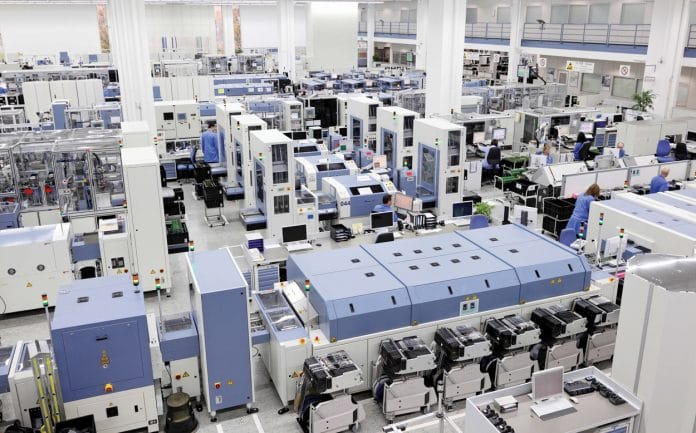

 The focus on ‘Make in India’ in the Indian electronics industry is increasing the opportunities for electronics manufacturing services (EMS) in the country. Here is a sneak peek into where this industry is headed.
By the ComConnect Consulting research team
The Indian market for electronic products is poised for significant growth in the next few years. According to a joint study by ASSOCHAM and NEC Technologies, domestic demand for electronic products is expected to grow at a CAGR (compound annual growth rate) of 41 per cent during 2017-2020 to reach a turnover of US$ 400 billion by 2020. The same study also mentions that domestic manufacturing of electronic hardware, which is currently growing at a CAGR of 27 per cent, may touch US$ 104 billion in 2020. This offers a huge opportunity for the Indian electronics manufacturing services (EMS) sector. Over the next five years, accelerated local manufacturing of electronic products to cater to growing domestic demand will drive the EMS sector in India forward. According to a Frost & Sullivan report, the Indian EMS market is expected to reach a size of US$ 7.92 billion by 2018.
Local firms backed by the ‘Make in India’ initiative, as well as global giants looking to relocate their manufacturing bases from China to alternate locations such as India, Vietnam and Indonesia due to mounting labour costs, will provide a strong impetus to the Indian electronics industry. Global as well as domestic electronics manufacturing services (EMS) players are looking at India as an investment destination with renewed interest. The Indian government is also making earnest efforts to increase domestic manufacturing.
| Methodology |
| Methodology The research methodology adopted to collate quantitative and qualitative information about the electronics manufacturing services (EMS) sector in India began with secondary research. Subsequently, the findings were analysed and have been verified through primary research by conducting extensive interviews with key industry experts. This sample group is a microcosmic representation of India’s EMS industry ecosystem. These senior professionals shared their thoughts on 1. The major growth drivers of the EMS industry in India 2. The key application sectors 3. The strategies to get a competitive advantage 4. The importance of turnkey manufacturing services to increase business in India 5. The need for ODM (original design manufacturing) in India 6. Possible demand for reverse logistics services (repair, rework, refurbishment, etc) 7. The challenges faced by EMS companies in India A trend analysis was done on the basis of their inputs. |
Market opportunities
The EMS industry in India has witnessed a lot of activity in recent years, both at the policy and organisation levels. While there is a high level of optimism within this industry at present, there are also many challenges that need to be addressed, to help India emerge as a major manufacturing hub in the years to come.
In spite of that, the EMS market is expected to be highly dynamic in the coming year, with India emerging as a hot spot for electronics manufacturing among South Asian nations owing to the low operating costs.
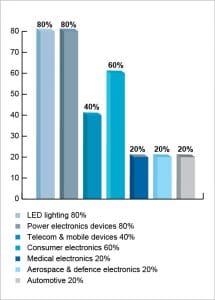
Survey participants indicate that the top three sectors driving the growth of the EMS providers (Figure 1) will be:
1. LED lighting
2. Power electronics devices
3. Consumer electronics
Manufacturing partnerships in these three segments have been growing steadily, as the market demand for the products is very high. At the same time, OEMs are striving to cut costs to maintain their competitive advantage in the face of rapidly changing market conditions, tech advances and global competition.
Other opportunities for EMS providers are in medical electronics and strategic electronics (including aerospace, defence and railways).
According to survey participants, the demand for EMS in medical electronics is totally driven by the increase in health consciousness and the higher average life expectancy. Moreover, the medical electronics segment has not been negatively impacted by recent government reforms like demonetisation and GST implementation.
Aerospace and defence (A&D) OEMs have been increasingly depending on EMS providers to address risk management, logistics and after-market service needs. EMS companies with global supply chains and advanced technological capabilities are well positioned to exploit this surge in demand. The Asia Pacific region is expected to be the hot spot for EMS providers as aerospace OEMs are fast shifting focus to this region. Towards the end of the decade, emerging markets like India are expected to become a very lucrative destination for EMS providers in the aerospace sector.
With the ‘mechanical to electronics’ transition in the automotive industry due to a rapidly rising demand for entertainment, safety and under-the-hood electronics, automotive electronics is emerging as one of the most exciting areas in the industry today. The increasing amount of electronic content and continuous tech advances in this industry are acting as major incentives for OEMs and Tier 1 suppliers to outsource to EMS providers.
Product mix
The Indian EMS providers have an affinity for a low-mix, high-volume model. Essentially, this is a contract manufacturing setup in which a few assemblies are produced in large quantities. Such a production arrangement may last for weeks or even months, using the same setup. The benefits of this model are that changeovers can be kept to the minimum while equipment utilisation rates are significantly higher. Contract manufacturers have proved to be more efficient with high volumes that require minimal engineering changes. But considering the low margins in this model, optimisation of supply chain costs is crucial to its success.
The pros and cons associated with the high-volume, low-mix solution are listed below.
Pros
1. Economies of scale
2. Higher productivity due to minimum changeover time
3. Optimum machine utilisation
Cons
1. Lower margins
2. Highly competitive prices
3. Price realisation drops to drastically low levels
While the low-mix, high-volume production model has been adopted for EMS companies catering to the mass manufacturing segment, there has also been a recent shift towards a high-mix, low-volume production process, which focuses more on quality and customisation. Due to the higher margins in this niche market, major changes in market dynamics often do not impact the profits of such a production model. This kind of production arrangement mostly caters to the strategic electronics sector, where the emphasis is on faster throughput and a high quality finished product. OEMs that prefer such solutions are willing to pay a higher price without compromising on quality. However, in this model too, success depends on controlling and improving the supply chain.
Growth strategies
EMS companies operate as strategic partners of OEMs by providing them with a full range of services, which include contract design services, prototyping, final system assembly, configuration, order fulfilment, and even after-market services, including repair. By using the services of EMS providers, OEMs can concentrate on their core competencies such as research and product development, brand building, sales and marketing. Outsourcing to EMS providers also enables OEMs to gain access to the latest equipment, process knowledge and manufacturing knowhow without having to make substantial capital investments, as the risks are converted into variable costs.
The ever increasing end user demands and fast-paced technological developments compel OEMs to continuously introduce new and innovative products into the electronics market. Consequently, they have to increasingly depend on EMS providers who offer significant benefits such as cost savings, reduced time-to-market, quality and flexibility.
| Process efficiency: The need of the hour |
| Constant innovation in process automation is a compulsion for EMS companies of any scale. The constant need to provide vertically integrated end-to-end solutions to customers has upped the ante for manufacturers in terms of quality and faster throughput. This has resulted in improved productivity, operational safety, enhanced consistency, better quality and waste reduction. Large EMS providers have options for custom automation of products and processes for which there are no dedicated machines in place. Automation through robotics ensures consistency in processes like polishing, painting and grinding. A mix of automation techniques can also be used. Flexible automation enables the deployment of assembly modules that can be easily configured using multiple robots and processes. This is essential to assemble, test, inspect, customise and package products in both high-mix, low-volume and high-volume, low-mix production, and entails complete automation across the production line. |
Since OEMs are very selective in choosing their EMS partners, the latter need to focus on nurturing long-term relationships with their customers through enhanced value-added services, strategic partnerships and alliances, as well as through diversification.
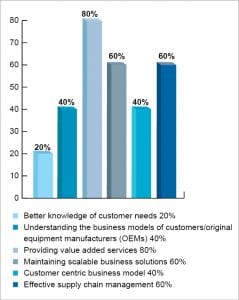
In response to the growing competition in the industry, EMS providers continuously adopt innovative and strategic business models. These include better knowledge of customer needs, understanding the business models of customers/OEMs, effective communication tools, creating a global footprint and focusing on core competencies. According to the survey participants, the top three strategies (Figure 2) to get a competitive advantage for acquiring EMS business in the electronics industry should be:
1. Providing value added services
2. Maintaining scalable business solutions
3. Effective supply chain management
EMS providers should also focus on customer-centric models, penetrate into niche markets and use effective information technology tools.
Moreover, considering the intense competition, the survey participants feel that EMS providers need to enhance their value proposition by offering integrated and end-to-end solutions, and also enter into strategic partnerships with OEMs.
Turnkey manufacturing gains importance
All the survey participants acknowledge that turnkey manufacturing services are the need of the hour to fulfil the increasing demand for ‘one-stop shops’ for EMS in the electronics segment.
Sometimes, OEMs follow the consignment contract manufacturing model to maintain greater control over the material planning and acquisition processes. This also minimises the risks associated with a vendor-managed pipeline. However, in the case of electronics, with its typical low-mix high-volume production model, OEMs prefer a partial or fully turnkey model, in which the EMS provider controls the acquisition of material too. This helps OEMs in reducing costs and remaining agile to address rapidly changing markets.
A common best practice among OEMs is to have systems that can analyse the total acquisition cost and use it to evaluate EMS suppliers as well as other types of contract manufacturers. These systems also assign a value to intangibles, such as the ease of working with a vendor.
Turnkey projects need a high degree of technical skill that can be customised according to the specific requirements of the OEMs. Only a few Indian EMS providers offer turnkey solutions for PCBAs, using Chip-on-Board (CoB), surface mount (SMT) and through-hole technologies. They also provide complete assemblies, including plastic mouldings, metal-die castings and sheet metal fabrication, apart from finishing, painting and printing – in short, they deliver the completed unit.
Some EMS companies also offer PCB manufacturing and EMS services together. This enables the company to provide better value added services to its customers. The combined expertise streamlines work and helps EMS companies to be better integrated within the production value chain. This arrangement reduces the turnaround time for the customers as they have to deal with a single vendor.
Original design manufacturing in demand
Electronic products need constant design revision, as end users expect creative and continuous innovation. Therefore, electronic product design and development is often outsourced to ODMs (original design manufacturers). The sooner an OEM engages a contract manufacturer for product design and development services, the better—particularly when the product being designed moves into the production and ramp-to-volume phases.
The ODM is expected to have experience in designing and manufacturing similar products. This enables the OEM to minimise costly design iterations, helps bring the product to market sooner and adds several other benefits to the contract manufacturing relationship.
Almost all the survey participants indicated that ODM services are in demand. Design is the best value added service that an EMS company can provide. Moreover, ODMs can develop unique products based on the Indian market’s needs, combining ‘Designed in India’ with ‘Make in India’.
However, 7 per cent of the survey participants do not see any value in working with ODMs, in the Indian context. According to them, most of the electronic products are already mature, having been well developed in China and other markets. Indian products need efficient manufacturing strategies rather than ODMs, as there is minimal ‘Making in India’ and more ‘Bolting in India’ in this space.
Scope in reverse logistics
India is still not a use-and-throw market for electronic products. After sales services, including repair and maintenance, are quite important for the Indian consumer.
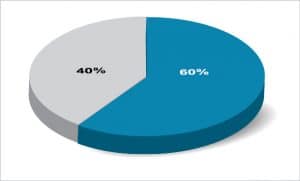
Echoing this view, 60 per cent (Figure 3) of survey participants say that the additional scope for business lies in the area of reverse logistics. They feel that services related to repair/reworking and refurbishment work will not only help EMS firms get additional business from the OEMs but also enable them to play a role in ewaste management. However, considering the complexity of the reverse logistics processes, only a few expert EMS providers in India can enter this space.
The challenges in moving forward
The success of Indian EMS players depends on several factors. We asked the survey participants to suggest the possible challenges that could derail the growth of this industry. Here is a collation of their opinions:
- Inefficient supply chain for the required electronic components
Unfair playing field, since companies from competing countries (China, Vietnam, Indonesia, etc) have access to finance at a much lower cost - Logistics inefficiencies and infrastructural bottlenecks, resulting in greater turnaround time and costs
- Higher cost of infrastructure
- Shortage of skilled manpower
- Limited support from the government
Survey participants feel that only a successful resolution of the above mentioned issues through appropriate industry initiatives and government interventions will help this industry to move ahead.
| Major contributors to this report Amit Bhargava, MD, Asha Electronics R.N. Kiran, AGM, East India Technologies Pvt Ltd Vijay Gujarathi, EOS Power R.K. Kapur, partner, Vital Electronics Manufacturing Co. Sreeram Srinivasan, CEO, Syrma Technologies |