
The demand for capacitors in the LED industry is quite high, as it is an important component that regulates the power used by LED lights. However, the Indian LED industry is highly dependent on imported capacitors at present, as only a handful of local companies make these products in the country.

By Shruti Mishra
As India shifted from conventional lighting to LED lighting, the demand for the components used in the latter also accelerated exponentially. The current market requirement for smaller sized, slimmer and longer lasting LED bulbs has put pressure on manufacturers to incorporate electronic components judiciously. It often happens that LED bulbs fail not because of the failure of LED chips, but because of the failure of associated components like capacitors. Of all the electronic components that go into the manufacturing of LED bulbs, capacitors are most vulnerable to mechanical, electrical and environmental fluctuations but are extremely reliable when used optimally.
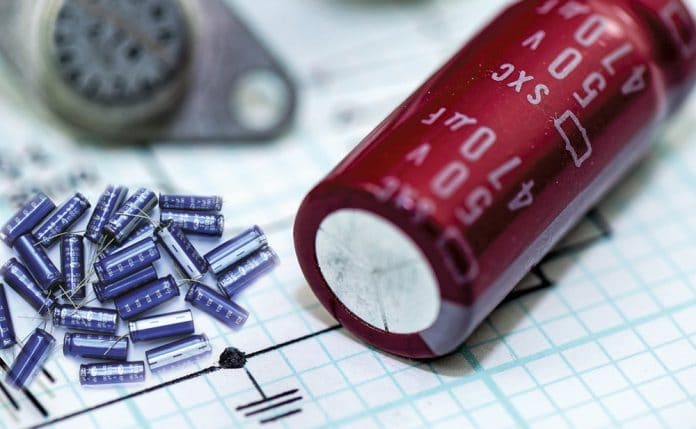
The capacitors attached to the LED drivers regulate the power used by bulbs or streetlights. The three main types of capacitors are: multi-layer ceramic chip capacitors (MLCC), electrolytic capacitors and film capacitors. MLCCs are chip capacitors with multiple layers of ceramics arranged and compressed in the form of a block, which reduces the overall size of the board. These capacitors are not leaded and show stable performance at high temperatures, with good humidity resistance. Flexibility remains an issue, which restricts their compatibility with the latest LED bulb designs.
Film capacitors contain an insulated plastic film as the dielectric. These are mostly used in the LED lighting industry because they offer design flexibility. Because of their unique healing property after any electric breakdown, they can be used for voltage dropping, interference suppression and many other applications. In addition, they are highly compatible with modern LED assembly methods that demand miniaturised and sleeker designs.
The cost factor remains the main reason for the popularity of electrolytic capacitors. Their main function is to smooth the voltage going into the driver as well as the current flowing through LEDs to avoid flickering at high temperature. These capacitors cannot be deployed in LEDs that are used for high temperature applications because of the faster evaporation of the electrolyte.
Impact of the rise in demand for LEDs
With LED lights capturing the residential, industrial and outdoor space, the requirement for capacitors has increased manifold. Anil Bali, vice president, Deki Electronics, says, “The expected sale of LED bulbs in FY 2017-18 was about 200 million pieces and of streetlights was about 7 million pieces. So, the number of film capacitors required in LED bulbs was about 400 million and in streetlights about 28 million.”
According to 6Wresearch, the Indian LED lighting market is projected to grow at 26.6 per cent between 2017-23. This makes it quite evident that the capacitor requirement in LED manufacturing is going to intensify.
Trends in the market
To tap the trend of miniaturisation, the Indian LED industry has adopted two new types of capacitors—fusible metallised polypropylene and metallised polyester capacitors, which address different needs. Both are comparatively smaller in size and sold in bulk.
In metallised polypropylene capacitors, a thin film of polypropylene is used as a dielectric instead of plastic. These capacitors possess high degrees of tolerance, and exhibit very little change in capacitance with time and applied voltages. That’s what makes them ideal for LED lighting applications, where a stable level of capacitance is needed.
The operating life of metallised polyester capacitors is comparatively higher and, therefore, these are used in applications that handle high peak current levels. This makes them suitable for high power LEDs. Also, at a moderate cost, these capacitors provide a higher level of efficiency than any other film capacitor.
Status of local manufacturing
Despite high demand in the LED sector, India lags far behind in capacitor manufacturing on the global front, due to a small manufacturing base. Only a handful of companies are engaged in manufacturing capacitors, which is not sufficient to meet the explosion in the demand for LEDs. Therefore, LED bulb makers are importing capacitors from countries like China and Taiwan. Capacitors fall under the Information Technology Agreement; so there is zero duty on the imports. The local industry feels that allowing zero per cent import duty is a drastic step, as it discourages new investments in manufacturing. Plus, taking advantage of the price sensitive nature of the Indian market, China is dumping large quantities of capacitors without paying attention to the quality, which affects the quality of the end product in the long run.
Underlining the benefits that Chinese capacitor manufacturers are getting, Bali says, “The Chinese capacitor makers are getting benefits like refund in VAT, whereas there is no provision for any kind of refunds for the local capacitor maker in India.” The GST rate of 18 per cent with zero per cent subsidies or tax benefits is further breaking the backs of the local capacitor manufacturers. Despite the government allowing 100 per cent FDI in the electronics hardware manufacturing sector, the existing components manufacturing ecosystem remains uncompetitive, because of the absence of both capability and scale. Industry players are pinning their hopes on the upcoming electronics policy and recommend the government should come up with a concrete policy that can give a boost to the dying electronic components manufacturing sector.