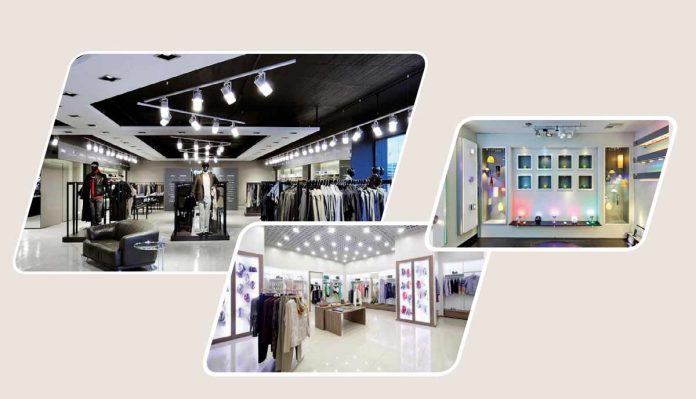

 The LED industry provides high quality lighting and innovative controls to the retail sector. Here’s a glimpse of how lighting and control technologies will influence this sector in the coming years.
By Baishakhi Dutta
The retail lighting market has always been dynamic, even prior to the adoption of LED technologies. Today, a number of factors are driving the LED market in the retail space. Chief among them are the mandatory energy efficiency regulations for new buildings and facilities. Other drivers include demand from the healthcare, hospitality, retail, IT and ITeS sectors, LED street lighting projects, the rising number of green buildings; the demand from institutions, government-aided projects, industrial and corporate houses, and upcoming residential colonies; and the bullish export market.
LED lights play a key role in the retail segment, and it is very important for retailers that their store is well illuminated to highlight the products on sale. Retail LED lights provide terrific advantages when illuminating mannequins and display cases. In retail, lighting accounts for as much as 40 to 50 per cent of the energy consumed. Thus, LED lighting is a relatively simple and inexpensive solution for those who wish to slash their energy bills while maximising their returns on capital expenditure.
Technological advancements
Retail stores are notorious for their high energy consumption. Lighting is an important component of the customer experience; after all, it helps retailers highlight displays and properly showcase products to customers so as to create a better shopping experience that can help drive sales. Therefore, it is very important to maintain a well-lit facility.
There are plenty of options that meet the need for higher-quality lighting, which leads to an enhanced shopping experience. Perhaps the easiest upgrade any retailer can make is to switch from outdated lighting technologies such as fluorescent, metal halide and halogen, to high-efficiency LED lighting. This will significantly boost energy efficiency as LEDs can reduce energy consumption by more than 65 per cent. This also means that less heat is created, offering the second benefit – rooms lit by LEDs have lower cooling requirements. The benefits of LEDs are substantial; however, tech advances in the form of control based solutions, particularly those achieved exclusively through LED technology, are rapidly enhancing the role of lighting in retail facilities.
Intelligent controls are the next big thing
Intelligent controls are the latest trend in retail lighting. With intelligent lighting systems and controls, it is possible to divide a store into zones and only use the light that is needed in any particular area, at a specific time. If there is no one in a particular zone, the lights can be dimmed in that zone to save energy. This system also allows retailers to track energy usage across a store and adjust the brightness depending on the amount of daylight available. The Internet of Things connects mobile devices with passive Bluetooth low energy, allowing the retailer to guide consumers around the store, and send targeted messages and promotions. Real-time information can be sent directly to the customer via the positioning of lights and the LED light network.
What’s the latest in the market?
Lighting has evolved from simple solutions to more complex options such as daylight harvesting, colour tuning, dimming, etc. The increased complexity of these controls enhances the lighting throughout a retail space.
Many retailers have introduced timers to sync their lighting with the store’s working hours in order to eliminate the use of energy when a facility is closed. This is in addition to the use of basic motion sensor devices in secondary or support spaces (including warehouse and storage environments) to reduce the overall running time of the lighting fixtures. Several studies claim that LED lighting delivers superior colour rendering (CRI) compared to other lighting solutions and more accurately depicts an object’s colour, enhancing the visual quality of a product, while helping reduce eye strain.
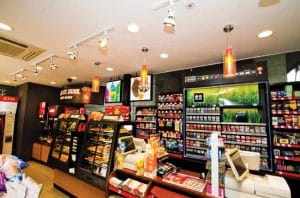 The introduction of Internet-based control systems is creating interconnected smart fixtures that provide greater control over a retail space. This includes real-time feedback on operations, which helps facility managers make better informed decisions or provide immediate responses to issues such as which fixtures are not working. The smart fixtures deliver information to the maintenance control stations about the wattage of each fixture, provide alerts on the maintenance functions needed and can control lighting output throughout the entire facility, streamlining maintenance efforts.
The connective capability of LED fixtures has changed their role from just being light sources, to gradually becoming tools for deploying IoT based initiatives within a facility. The latest fixtures come as integrated smart control solutions, which can act as networked nodes, using PoE, Bluetooth and Wi-Fi to support initiatives for greater customer engagement.
IoT connectivity with the lighting fixtures can be useful in enhancing the consumer experience, especially since many shoppers are constantly plugged into the IoT through their mobile devices. Some facilities are experimenting with new mobile marketing opportunities that use LED fixtures as communication nodes to interact directly with mobile devices like cell phones, tablets and smart watches.
As the IoT capabilities of LED lighting continue to advance, we will undoubtedly experience in-store hotspots in the near future, with coupons and other offers given to customers based on where they are within the store.
Making a purchase decision
Suggestions from industry veterans have helped us compile a list of the crucial factors that are to be kept in mind while investing in retail lighting. These are:
- Go for a renowned brand.
- Ask about the die/chip and package quality of LEDs in the system
- Set the minimum light levels for the application a s a benchmark.
- Enquire about the thermal design of the LED system.
- Ask about corrosion protection against humidity (condensation and moisture).
- Find out the operating temperature range and compare that to the application’s needs.
- Determine the electrical connection method (soldering or mechanical).
- Get a copy of the warranty and read the fine print (system or separate).
- Enquire about overall failure or return rates.