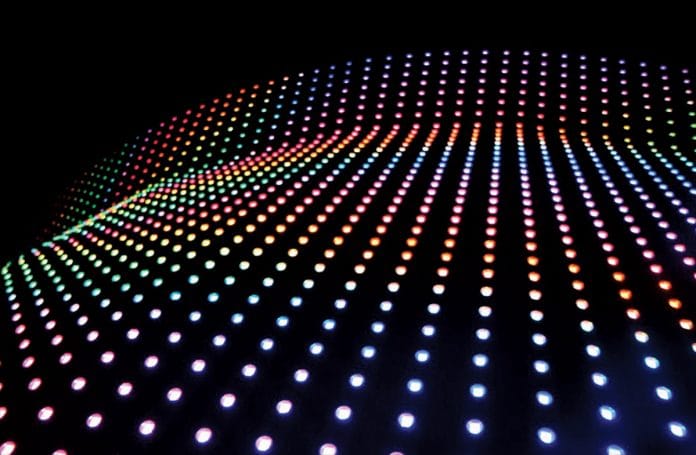

 Because of their high luminous flux and brightness, high-power LEDs are quickly becoming the preferred choice for LED luminaire makers. Apart from their improved luminous efficacy and design flexibility, what endears high-power LEDs to designers is their extended operating life and their availability in the full range of colours.
By Shruti Mishra
High-power LEDs (HPLs) are solid-state lights that give higher luminosity when compared to standard LEDs due to their higher current levels and power dissipation capability. Generally, LEDs with a minimum of 1W capacity are considered as high-power or high-brightness LEDs. These energy-efficient blocks offer enough lumen output for popular lighting applications. As the lighting industry is gravitating towards this comparatively new form of lighting, the competition between standard LEDs and HPLs is becoming intense. The choice is often based on performance and design preferences, and on both counts, HPLs score higher.
On the performance front, HPLs have a very wide operating range and can be switched on and off almost instantly, even at a temperature that’s as low as -40°C. They also withstand vibrations well, making them the preference of designers as this feature, combined with the extended operating temperature range, provides huge design flexibility. Besides, the colour illumination of HPLs is far more well-defined, giving them an edge over the conventional alternatives.
Application areas
A report published by Report Buyer states that the global high-brightness LED market size is expected to reach US$ 27.28 billion by 2024. This surge in demand will be driven by the rising consumer need for resource-efficient and low-energy lighting solutions. Because of their lower energy consumption and high brightness levels, HPLs are now being used in diverse segments which include medical, automotive, television sets, smartphones and general lighting. Experts believe that as customers get more and more aware about the benefits of HPLs, such as the high efficacy and unparalleled lighting performance, these sources of light are going to witness exponential demand in the near future.
The report also states that the consumer electronics segment is one of the leading users of HPL technology. The increasing consumption of HPLs in new-age 4k LED TVs has accelerated their demand recently. These LEDs are also used widely in mobile camera phones because of their excellent colour illuminating results and compact size.
In automotive applications, HPL clusters are commonly used in brake lamps and indicators due to their enhanced reliability, high operational life span, low power consumption and almost instantaneous response speed. HPLs are also being used as a safety measure for visibility, and have other advantages like low power consumption, improved system life and reliability. All this indicates that their usage in the automotive segment will only increase in the near future. And as more and more automobiles are made in the coming years, the sales figures of these lighting solutions will continue to rise.
On account of their unparalleled benefits, HPLs are revolutionising and extending their reach to many new lighting applications. In hospitals and clinics, for example, medical experts use HPLs in handheld dental curing devices, as well as state-of-art skin cancer therapy systems, due to the highly controllable LED emission wavelengths.
As HPLs are available in the full range of colours, they are ideal for stage lighting, where their colour dynamics, compact size and light weight are hugely advantageous. Another plus point is that these LEDs do not emit forward heat or UV light, so people on the stage do not feel the heat associated with conventional stage lighting.
Another area that has benefited directly due to the adoption of HPL technology is horticulture. In this segment, companies are offering packaged HPLs that enable smarter growing operations. The best part is that one can customise the spectrum as per the cultivation needs, which is paving the way for a new era of technology-driven farming.
Technological advancements
The evolution of high-power LEDs is one of the most significant developments in the LED lighting industry. Many companies are combining HPL technology with other compatible technologies to diversify their application areas, and provide more convenience as well as a unique experience to customers. Let’s take a look at two major technological advancements in the HPL space that occurred in the past one year.
Extreme density: Cree is perhaps the first company to introduce extreme density LEDs, which the company claims deliver five-and-a-half times more lumen density than Cree’s previous generation of HPLs. Called the XD16 LED, this new generation of HPLs is built on Cree’s NX technology platform. Performance wise, it delivers a lumen density of more than 284 lumens per square-millimetre, which is the highest level achieved by a commercially available lighting-class LED, company sources claim.
The XD16 range is considered ‘extreme density LEDs’ because it combines breakthrough lumen density and low optical cross-talk with good thermal contact and ease of system manufacturing, to enable innovative new designs for a wide spectrum of lighting applications such as colour-tuning, streetlights, and portable and industrial lighting.
Discrete LEDs: Luxeon V from Lumileds is the new high-power packaged LED that can be driven to the 15W level and targets a broad range of high-lumen-output applications, including sports field lighting, high- and low-bay luminaires, and outdoor area lighting. As per the company’s reports, this is a discretely-packaged, single-die LED that can deliver over 1700lm at 5700K CCT. The advantage of discrete LEDs is that they have a high optical control factor (OCF), which is a measure of how an LED’s size and performance benefit directional lighting applications. Because of the OCF, lighting manufacturers can improve the performance of any lighting design, create smaller and less expensive systems, and develop new lighting solutions, all of which are generally difficult to achieve with other types of lighting solutions, company sources claim.
The company claims that this new HPL delivers 60 per cent better thermal resistance than its counterparts, and 50 per cent higher lumen output than similar competitive products.