


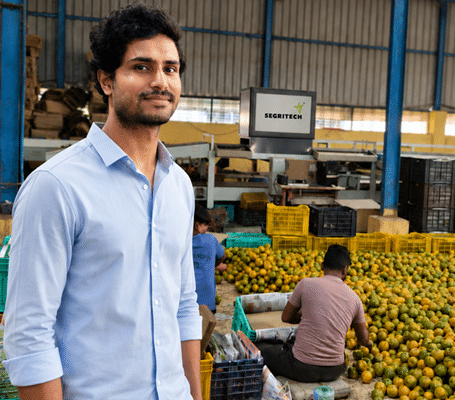

An agritech startup has developed an AI-powered machine that sorts and grades fruits directly on farms, helping reduce post-harvest losses by connecting produce with the right buyers. In an interview, Hetendra Singh Rathore and Sri Kusulu Devalla from Segritech spoke to Nidhi Agarwal from Electronics For You about bringing computer vision to post-harvest automation.
Q. Can you tell us about Segritech?
A. We are a post-harvest automation company focused on sorting and grading fresh produce, one of the most critical stages after harvesting. We developed a compact, portable sorting and grading machine that works directly on farms, unlike factory-based systems adapted from European or American designs. We built it specifically for Indian farmers, considering their smaller landholdings, lower production volumes, and budget constraints. It also helps local traders move the machine between farms, sort and grade produce on-site, and match it with the right buyers based on quality. The machine measures about 4.65sqm (10 feet by 5 feet) and processes up to 2 tonnes of fruits or vegetables per hour.
Users load the produce into the machine, where each fruit passes through a camera chamber and rotates to capture a 360-degree view. We analyse every fruit in real time for size, shape, colour, and external skin defects before automatically sorting it into quality grades. By analysing the fruit’s skin, we identify visible defects and diseases, ensuring damaged produce is separated from good-quality produce. We are also developing high-speed ripeness detection and non-destructive internal quality inspection for fresh produce. We don’t just sort fruit; we match every quality grade with the right buyer.
Q. Which part of the post-harvest value chain creates the highest losses, and how does your solution address it?
A. The highest post-harvest losses occur at the farm and wholesale market (mandi) level, where the biggest challenge is the mismatch between available produce and buyer demand. Farmers get their produce graded and sorted, but buyers often do not know what quality is available at the farm. Since fresh produce is perishable, it must be sold quickly. When the right buyer is not found in time, large quantities are discarded. Around 50 million tonnes of fruits are wasted in the supply chain, with most losses occurring at these stages rather than at retail or in consumers’ homes.
Our machine solves this by sorting and grading produce while digitising quality data that can be shared with supply chain stakeholders. This helps match each quality grade with the right buyer, whether for export markets, metro cities, Tier 2 and Tier 3 markets, juice and food processors, pharmaceutical companies, or other industries. Even damaged produce has buyers for uses such as biofuel and products made from fruit peels. By connecting quality data with market demand at the farm level, we reduce waste and improve market access for every grade of produce.
Q. How does your technology differ from the traditional fruit and vegetable grading systems used in the industry?
A. Around 90 per cent of fruit and vegetable sorting and grading in India is still done manually. Of the remaining 10 per cent that uses machines, most are mechanical systems that sort only by size and cannot assess quality. Only a few Indian companies, including us, have developed optical sorting systems using computer vision and deep learning for quality-based grading.
What sets us apart is that our machines are compact and portable. Farmers do not need to build a packing house or factory around the machine, and traders can easily move it from one location to another during procurement. Most other systems are based on European or American designs and are mainly suited for large export packing houses rather than Indian farms.
Q. How does your sorting and grading machine identify and separate fruits?
A. The machine uses computer vision and deep learning to inspect each fruit and evaluate its quality. It analyses parameters such as colour, shape, size, and surface defects or diseases. Based on these factors, the software assigns a grade to every fruit. The grading result is then sent to actuators, which automatically direct each fruit to the appropriate output tray. Fruits that do not meet the required quality are sent to a separate rejection tray.
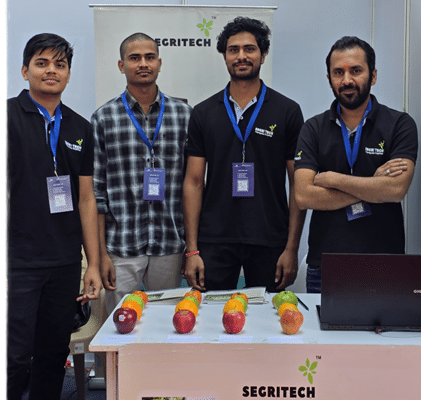
Q. What inspired you to start the company, and why is it called Segritech?
A. Before starting this company, we ran a fresh produce supply chain business, supplying fruits and vegetables to hotels, restaurants, and cafés. We relied on manual labor to sort and grade produce, so we experienced the problem firsthand. During COVID, demand from these customers dropped significantly, which led us to rethink our business. We identified sorting and grading as one of the biggest challenges in post-harvest processing and decided to automate it. We spent nearly three years on research and development before launching our machine. The name “Segritech” comes from our core purpose—segregating fruits and vegetables efficiently through automation.
Q. What are the main hardware components used in the machine?
A. The machine combines cameras, photoelectric sensors, processors, programmable logic controllers (PLCs), and actuators. Cameras capture images covering around 100 per cent of each fruit’s surface, while photoelectric sensors detect fruit movement. The computer vision models run on NVIDIA processors, and depending on the application, PLCs are also used for machine control. Once a fruit is graded, actuators guide it to the correct output tray based on the software’s decision.
Q. What is the role of the photoelectric sensor in the sorting machine?
A. The photoelectric sensor detects each fruit as it moves on the conveyor. Since every fruit is carried individually, the sensor helps determine its exact position and timing. This ensures the cameras capture the complete surface of every fruit at the right moment, enabling accurate grading and sorting.
Q. How does the computer vision system work in your sorting and grading machine?
A. The machine uses a camera setup to capture multiple images of every fruit from different angles. These images are processed by a computer vision model running on an NVIDIA processor. The model analyses parameters such as size, shape, colour, surface defects, and some diseases, then assigns a grade to each fruit. Based on that grade, the machine automatically directs the fruit to the appropriate outlet. The process is similar to how computer vision systems identify or count people, except our model is trained to recognise and classify fruits instead.
Q. What machine learning or computer vision techniques power your defect detection and fruit classification system?
A. Our system captures a high-resolution image of every individual fruit as it moves through the machine on a separate carrier. First, we segment the fruit from the background. Then, we analyse every pixel to extract colour information and study the fruit’s boundary to measure its size and shape. In addition to visual inspection, the machine also measures the fruit’s weight using a load cell sensor. By combining colour, size, shape, surface condition, and weight, the system classifies and grades each fruit with high accuracy.
Q. How do you train the AI models to handle variations in produce, and how does the system outperform human inspectors?
A. Instead of relying only on large datasets to handle changing environmental conditions, we control the imaging environment itself. The fruit passes through an enclosed conveyor with a controlled lighting system, which eliminates the effects of sunlight and other external lighting variations. This ensures that every image is captured under consistent conditions, making the artificial intelligence (AI) model more reliable. The system also uses high-resolution cameras that can detect surface details as small as one mm, that the human eye can typically miss. As a result, it can identify tiny scratches, blemishes, and other defects that human inspectors may miss, leading to more accurate grading.
Q. Can your machine detect internal defects that are not visible from the outside?
A. The current machine mainly analyses the fruit’s surface by capturing images of its entire outer texture. In many cases, internal defects leave visible signs on the surface, allowing the system to identify them. For example, in pomegranates, diseases such as plug disease can often be detected from changes around the crown. While the machine does not perform complete internal grading, it can identify several internal issues through surface analysis. The team is also conducting research and development (R&D) to enable full internal defect detection in future versions.
Q. Does the machine send sorting and grading data to a mobile or laptop application?
A. Currently, the machine displays the data locally. Since the number of deployed machines is still limited, the company is developing a cloud-based application. As more machines are connected, the data will be available through the application and platform, allowing farmers, traders, and buyers to access it remotely from anywhere.
Q. How did you test and validate the system before bringing it to market?
A. We carry out all testing in-house. We procure boxes of fruits, capture real images of the fruits, process those images and perform testing using actual produce before taking the system to the market. Our AI model is also retrained regularly. As we deploy the machine in the field, we collect new data, label it, and retrain the model repeatedly so its accuracy continues to improve over time.
Q. What were the biggest technical challenges you faced while developing the machine, and how did you overcome them?
A. One of the biggest challenges was achieving high-speed image processing in a compact and affordable machine. Initially, the processing hardware had very little buffer capacity, which created performance bottlenecks when handling image data. To solve this, we upgraded to NVIDIA-based processing devices, which provided much higher processing speeds and improved overall performance. On the hardware side, developing the first prototype was also challenging because it required sourcing many components and coordinating with multiple vendors. While prototyping took significant effort, scaling up production became much easier once the design was finalised.
Q. How is the machine manufactured, and what work is done in-house versus outsourced?
A. We use a combination of in-house manufacturing and contract manufacturing. Components such as 3D-printed parts and some actuator-related parts are manufactured in-house, while the remaining components are produced by vendors and contract manufacturers in Hyderabad. We have our own design engineering and R&D teams, and all product design is done in-house. We provide these designs to the contract manufacturers for production, and the complete machine is assembled at our assembly unit in Hyderabad.
Q. What has been your experience with market adoption of the sorting and grading machine?
A. One of the biggest challenges has been convincing people that the technology actually works. Many potential users initially believe automated grading is not possible, especially at this price point. Unlike products such as mobile phones or laptops, the machine cannot be sold through advertisements alone. It requires live demonstrations, and once people see it in action, they usually become convinced.
Among potential users, traders are generally more receptive because they are directly involved in the market and understand the value of grading and standardisation. Farmers, on the other hand, usually want to sell their produce as quickly as possible because fruits and vegetables are perishable, so they prefer to avoid additional processing unless they have the resources. While growing demand for graded produce is encouraging more farmers to adopt these practices, traders remain the primary users as they are responsible for sorting, standardising, packing, and meeting buyer requirements. Adoption is also becoming easier as more progressive farmers learn about new agricultural technologies through YouTube, news, and other sources.
Q. How many units have you sold so far, and what revenue have you generated?
A. We have sold five machines so far, generating revenue of approximately ₹10 million.
Q. Are you receiving any support or funding from the government?
A. Yes. We have received grants from Pusa Krishi under the ministry of agriculture, the ministry of electronics and information technology (MeitY), and the department of science and technology (DST). These government grants have supported our development efforts.
Q. Are you looking for more channel partners, distributors, or vendors?
A. Since we are associated with Pusa Krishi and the ministry of agriculture, we work with krishi vigyan kendras (KVKs) across villages in India. We also collaborate with non-governmental organisations (NGOs) that help farmers adopt technical and precision farming practices. In addition, we have built strong connections with farmer producer organisations (FPOs) and farmer networks, which help us reach our target users.
Q. Do you have collaborations with academic institutions?
A. Yes. On the technology side, we work closely with Indian institute of technology (IIT) Bombay, international institute of information technology (IIIT) Hyderabad, and Vellore institute of technology. For agricultural expertise, we collaborate with Indian council of agricultural research-Indian agricultural research institute (ICAR-IARI) Pusa Krishi in Delhi. We also connected with national institute of food technology entrepreneurship and management (NIFTEM) for various research.
Q. What are the current challenges your startup is facing as you scale?
A. Our biggest technical challenge was developing a compact sorting and grading machine specifically for Indian farmers, and we have successfully addressed that. Now, as demand from the farming community continues to grow, our focus is on scaling the business and meeting that demand efficiently.
Q. Have you filed any patents for your technology?
A. Yes. We have filed a patent for our machines, the most compact AI grading machine for fresh produce. The patent was recently published a few months ago.
Q. What improvements are you working on for the future?
A. We are continuously working to increase the machine’s processing speed. We are also developing packaging machines.
In addition, we are already at technology readiness level (TRL) 6 for the R&D on non-destructive quality inspection technologies that can detect internal defects and assess fruit quality at high speed using near-infrared (NIR) spectroscopy.
Q. Are you working on innovations beyond grading and sorting?
A. Our current focus is on extending the grading and sorting system to more fruits and vegetables. The machine already supports fruits and vegetables, including apples, pomegranates, oranges, sweet lime, guavas, avocados, tomatoes, potatoes, lemons and onions. From here on, we will cover new crops that are not oval and round in shape.
Q. What are your plans for future growth?
A. So far, we have developed two solutions to solve a major challenge in post-harvest automation. Our immediate priority is to scale these existing solutions. At the same time, we are continuing parallel R&D to develop important complementary solutions for Segritech.

