


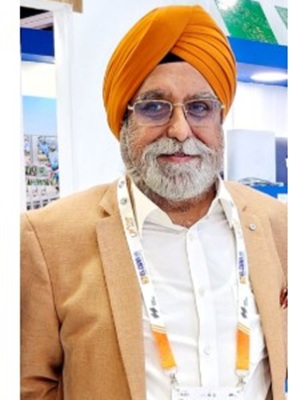

JS Gujral of Syrma SGS Technologies explains to Electronics For You’s Akanksha Sondhi Gaur, Pratyush Kumar, and Nikita Kumari how export momentum, niche-market focus, design-led manufacturing, and resilient supply chains are shaping the company’s global competitiveness and future growth.
Q. How do you compete with global players, especially from China?
A. We have been in the electronics industry for 40 years and exporting for the last 35 years. We have proved our resilience and global competitiveness. We are present in niche industrial, automotive, and medtech segments—not in high-volume consumer products where China dominates. Our strategy is not to compete head-on in high-volume segments but to focus on niche, high-value applications where differentiation matters.
Q. What’s your current growth momentum?
A. We are confident of maintaining our growth momentum. Our exports have grown at about 20 per cent for the last three-four years, and I expect them to keep growing at the same rate for the next two-three years. We have to innovate, be frugal in our costs, and drive relentless efficiency on the shop floor.
Q. What does your export growth indicate about your global positioning?
A. If our exports are growing at about 20 per cent while global markets like Europe and the US are not growing at that pace, it clearly indicates that we are gaining market share from competitors. It reflects the value and competitiveness we bring to customers globally.
Q. Which customer segments and brands do you work with?
A. Our customers are business-to-business (B2B): industrial, automotive, medtech, railways, information technology (IT), and some consumer telecom products like radio frequency identification (RFID). So we are present in four to six verticals. Defence and aerospace are other areas we would like to enter in the coming years.
Q. How are you incorporating Industry 4.0 and upcoming Industry 5.0 trends in your business?
A. The only difference from the largest players is scale. I may have 8-10 lines in a factory where Foxconn has 40-50. But in terms of machine vintage, we buy the latest machines and work on the best global software. We have implemented automated inspections and real-time AI-driven monitoring on our manufacturing lines. We use robotic automation where the process demands it, but we also have a social obligation to generate employment. It’s a cost-benefit analysis.We also balance automation with India’s need for employment. So, beyond process requirements, automation decisions are also a cost-benefit and social consideration.
Q. How advanced are your factories? Do you have dark factories?
A. We have the best systems. They are not fully dark factories, but about 80 per cent of the processes are automated. Machines talk to each other, and we have a manufacturing execution system (MES) that controls product quality with feedback loops. To that extent, we are comparable to the best in the world. We do not have totally robotic dark factories in India. Our MES enables closed-loop manufacturing, where machines communicate with each other and continuously provide feedback to maintain quality.
Q. How much are you investing in automation?
A. We invest a lot in automation to make manufacturing more resilient and defect-free. Every new machine we buy is fully automated. We choose machines with AI capabilities over non-automatic options.
Q. How do you handle India’s cost-sensitive market?
A. We handle it through scale and operational efficiency. These investments pay for themselves over time.
Q. What share of your revenue comes from design-led manufacturing?
A. As of March 2026, our own design products account for about 14-15 per cent of revenue, and revenue has grown 5x in the last 4-5 years. Design will continue to be a mainstay for our growth. The share will increase slowly because plain-vanilla manufacturing has also grown strongly, but we will continue to grow design revenue incrementally.
We are confident of maintaining the level of our own design and manufacturing.
Q. How does design-led manufacturing scale with revenue growth?
A. Even a small increase in design share creates significant value at scale. For instance, at ₹50 billion revenue, 14 per cent design contributes about ₹7 billion. If revenue grows to ₹100 billion and design reaches 15 per cent, that becomes ₹15 billion. So even a 1 per cent increase effectively doubles design revenue.
Q. How much are you investing in in-house design?
A. About 14-15 per cent of our revenue comes from our own designs, so we have a dedicated design team of 100-150 people across our company and sister companies.
Q. How do you differentiate from competitors? What’s your USP?
A. In electronic manufacturing services, 85 per cent of the products we make are owned by our customers. We build confidence through transparency, open-book costing, robust quality systems, resilient supply chain, integrity in sourcing to avoid counterfeits, and a very strong counterfeit detection policy.
Q. How are you de-risking component sourcing amid global supply chain disruptions?
A. 80-90 per cent of semiconductor and electronic component manufacturing is based in APAC—China, Taiwan, etc. We cannot change that. We mitigate it by building very strong relationships with vendors, customers, manufacturers, and distributors, and by keeping alternate parts ready if one make is not available.
India will remain import-dependent on components for some time. Maybe in five to ten years we can source some components from India. Manufacturing is in full swing now; supplies of parts will follow, so will the components. Given that 80–90 per cent of components are manufactured in APAC, this dependency is not something we can fundamentally change in the short term.
Q. Will the West Asia war impact your strong growth?
A. No, it won’t affect us. Usual disruptions will happen—we have to live with them. Such things are common to everyone, not unique to my company. Sea freight disruptions have to be navigated or mitigated as much as possible.
Q. How do you approach external disruptions strategically?
A. We focus more on risks that are unique and controllable within our operations. External disruptions like geopolitical issues or freight challenges are common to all players, so the focus is on navigating and mitigating them efficiently.
Q. What are key growth drivers for Syrma SGS over the next 3-5 years?
A. Exports would be one of our biggest growth drivers as domestic demand is already going up. as domestic demand is already going up.

