


South Asia and ASEAN, element14
With IoT making its presence felt across all industries, practically everything will be connected soon. Choosing the right connector, with care and consideration, can make all the difference in the operation of critical systems.
By Ravi Pagar, regional director – South Asia and ASEAN, element14
Connectivity is the lifeblood of today’s technology-driven world. The term has taken on many dimensions and can be in reference to the Internet, to the data network, to home appliances and devices of all sizes, automobile components, heavy machinery, military equipment, industrial equipment, and so on. Regardless of the context, connectors enable all these diverse systems to stay running and connected. Practically everything today uses circuitry or circuit boards, which in turn use connectors to link the various modules. Therefore, connectors play a vital part in the reliability and ruggedness of a system.
Many of us work indoors in moderate and controlled conditions, so of course the devices and appliances around us lead ‘comfortable lives’. However, most of the electrical and electronic systems and machinery that make our lives run smoothly themselves operate in harsh conditions, exposed to the elements of nature. These systems have to function under conditions that include extremes of temperature, high levels of dust, water and changing pressure.
Connectors provide the entry point for cables into these systems, which can be a point for wear and tear, and breakdown. This makes it critical to ensure that connectors form a secure barrier that safeguards the system even in unpredictable and unforgiving conditions. Choosing connectors that are designed to withstand the rigours of vibrations, extreme temperatures, dust and potentially explosive environments can make all the difference in how well the system holds up over time.
Connectors come in a wide range of options to suit diverse requirements. Designers and manufacturers of systems that are meant for tough and challenging environments should consider several different criteria before choosing the ideal connector for their requirements.
First, the IP (ingress protection) rating of a connector indicates the degree of protection provided against harsh elements like dust and water. Since connectors are essentially openings into the system, they must provide a high degree of impregnability. Let’s look at a connector with a rating of IP66. The first digit of the IP rating ranges from 0 to 6, and is an indication of protection against solids and moving parts, including dust particles. The second digit ranges from 0 to 8, and indicates the level of protection against liquids and moisture.
The locking and coupling mechanism used in connectors is also an important factor to consider. There are several different mechanisms including push-pull, quick-disconnect, twist locking, bayonet and more. For tough environments, connectors that hold up well during movement and vibrations are more reliable than those that are designed for ease of use.
Finally, the material used for the housing and insulation must be evaluated to ensure that it is also resistant to temperature fluctuations, dust and moisture.
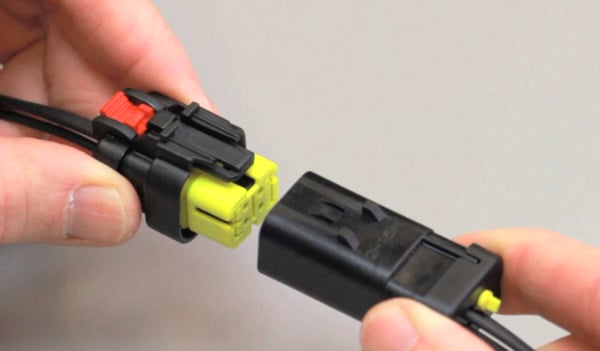 Systems that are used in industrial, infrastructure, construction, drilling and marine environments are massive and complicated, combining mechanical systems with sophisticated electronic components that provide automation and fine control. They are expensive to manufacture and to purchase, often requiring highly skilled staff to operate and maintain them. They undergo heavy use under inhospitable conditions and are expected to be rugged and safe. The connectors used in such systems should be chosen with care and well matched to the specific requirements. Rugged, sealed connectors in plastic or metal with ratings that align with the required specifications and the conditions should be chosen.
The Bulgin 4000 series from UK headquartered Bulgin was developed to provide excellent sealing characteristics of IP66, IP68 and IP69K standards – ensuring true environmental protection in harsh conditions – as well as to withstand vibrations, shocks and corrosion to EN/IEC 60068 requirements. These connectors are ideally suited for a wide range of marine, industrial, transport and infrastructure applications, especially where space is at a premium.
As manufacturing becomes hyper-efficient and automation is paving the way for the ‘lights out’ model (by which automated manufacturing can happen in total darkness) with minimal downtime and human interference, the demands on system components, particularly connectors, continues to increase. Automation relies heavily on sensors and the signals and data they produce, which leads to a noisy and high-EMI environment. This can negatively impact the performance of crucial high-speed data connections, so care must be taken to choose electrically shielded connectors for these systems. An ideal choice would be connectors with IP 65/67, but most importantly, here the connectors should have 360° EMI shielding (to make sure that the connector offers shielding effectiveness equal to that of the cable), such as the new M12 connector range from US based Phoenix Contact with push-in contact termination technology.
Marine applications require connectors that hold up well when immersed in saline water. Both moisture and salts are highly corrosive, and therefore the connectors must be tightly sealed and highly waterproof. They should have a minimum protection of IP68 and high salt spray resistance, preferably over 500 hours.
The oil and gas industry is a heavy user of machinery, which has to withstand harsh conditions that combine the characteristics of industrial and marine environments. Besides, the equipment is also exposed to potentially explosive environments with a mixture of volatile gases and liquids. The industry also uses underwater remote operated vehicles (ROVs) extensively. These feature sophisticated and sensitive electronics and need highly reliable connectivity for their data lines. Here again, the connectors used must be chosen with the appropriate level of ruggedness. Like in the above case, they should also have a minimum protection rating of IP68, along with having high salt spray resistance, preferably over 500 hours. They should also be rated to EX Zone 1 and 2.
These are just some of the examples of industries that operate in harsh conditions. However, as the Internet of Things (IoT) makes its presence felt across all industries, practically everything will be connected and online. Most of these connected devices and sensors will be outdoors – being used in agricultural applications, weather and energy monitors and sensors, in automobiles, CCTV cameras, traffic monitors, etc.
As the building blocks of these millions of connected devices, connectors play a critically important role in providing reliable and safe functioning. They have evolved in their capabilities in order to support a connected world. As a result, the market offers a huge range of options. Understanding the requirements as well as the features offered is important in order to choose the right connector with care and consideration. This can make all the difference in the efficient operation of the system that it goes into.