


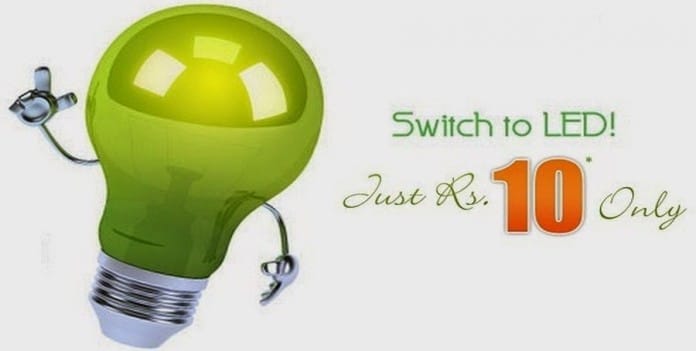

The Government purchases LED bulbs under the Domestic Efficiency Lighting Program (DELP) scheme. The bulbs are procured via competitive bidding and are offered to customers at lower prices than those available through retailers. The Energy Efficiency Services Limited (EESL) has been set up to facilitate the setting up of energy efficient projects.
India is planning to lower the cost of LED bulbs to Rs 44 from Rs 74, which was achieved through competitive bidding. This is far lower than the initial goal of Rs 99. The DELP scheme gives consumes the choice to make payment for LEDs in equated monthly instalments with an initial down payment of Rs 10. Owing to several EESL programs, the price of LED bulbs have fallen over 75 per cent within the last eight months. This program is bound to induce the market to bring down the retail price of LEDs to Rs 150.
Advantages of DELP Scheme
As estimated by the government, usage of LEDs in domestic and public lighting may result in nearly 90 per cent dip in energy consumption. With the replacement of 770 million incandescent bulbs and compact-fluorescent light bulbs to LEDs, there will be a saving of 105 billion kilowatt-hours (KWh) of energy. This will also lead to a dip in consumer electricity bills by Rs 400 billion.
As cited on GlobalLEDs/OLEDs, under the DELP scheme, there has been a distribution of 54.2 million LED bulbs which have been domestically manufactured throughout India. The DELP has set itself a target of 100 million within the next two months. It has asked for replacement of all incandescent bulbs with LED bulbs by 2018. Over half a million street lights have been replaced with LEDs in all Indian states as part of the Street light National Program (SLNP). The states that have adopted the program are Rajasthan, Uttar Pradesh, Maharashtra, Andhra Pradesh, Pondicherry, Tripura, Delhi and Kerala. Others are yet to follow.
Advantages of SLNP Scheme
The SLNP scheme is targeted at replacing 35 million street lights. This means a saving of 9 billion KWh of energy and 1.5 gigawatt (GW) in load reduction. Also, through this initiative, the urban local bodies will also be able to save Rs 55 billion. The program has already assisted in reducing carbon dioxide emissions by 64 million tons and the DELP has attained a reduction of half a million tons.
Conclusion
The lighting sector occupies nearly 20 per cent of total energy consumption in India. Depending on the way the industry players, policy makers, the electricity ministry, EESL, the Bureau of Energy Efficiency (BEE) and non-profit organisations (e.g., Electric Lamp and Component Manufacturers Association of India or ELCOMA) have combined together and the strong progress displayed by DELP and SLNP, there is a high probability that India will soon be able to lower down the price of LED bulbs to Rs 44.

